
Top News

Dhaka : A black day for the nation as at 1:07 pm on July 21, the roar of a Bangladesh Air Force jet shattered the midday calm in Dhaka. Moments later, an explosion rocked Milestone School and College, killing at least 35 people, many of them children. Smoke billowed above Uttara. A neighborhood was scarred. A country stood still in shock. This was not a warzone. It was a classroom.
Hidden cost of urban airports
Dhaka's Hazrat Shahjalal International Airport-and its neighboring military airstrip-operate dangerously close to one of the most densely populated cities in the world, said industry stakeholders while talking to The Bangladesh Monitor.
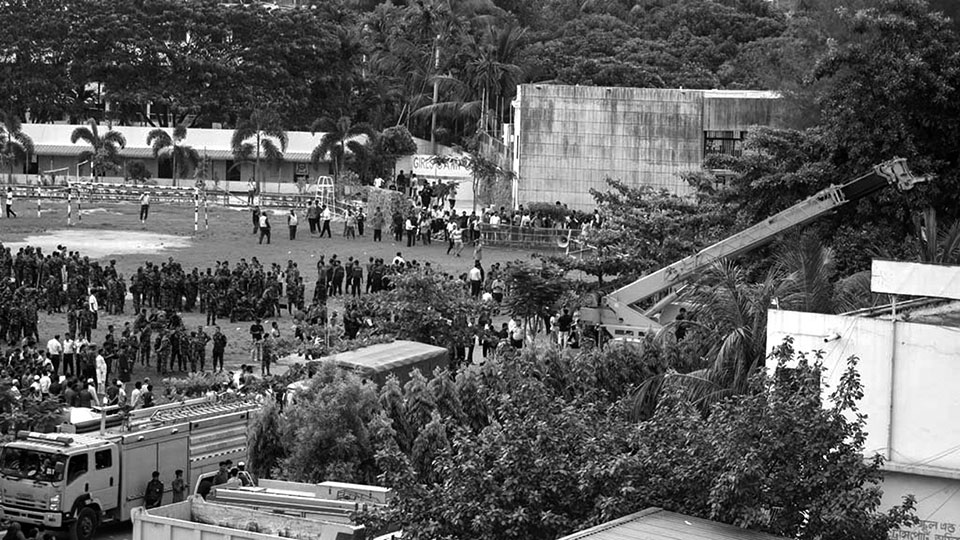
Scene of the site after the air force plane crashed at the educational institution premises
Schools, hospitals, markets, and apartment buildings all sit beneath flight paths, they stressed, adding, when aircraft take off or land, they fly directly over civilian lives.
There is little room for error. And when failure does come, it comes catastrophically-just as it did on July 21.
Pilot's last moments-still unclear
Initial reports praised the fallen pilot, Flight Lt Toukir Islam, for allegedly steering the aircraft away from more populated structures in his final seconds.
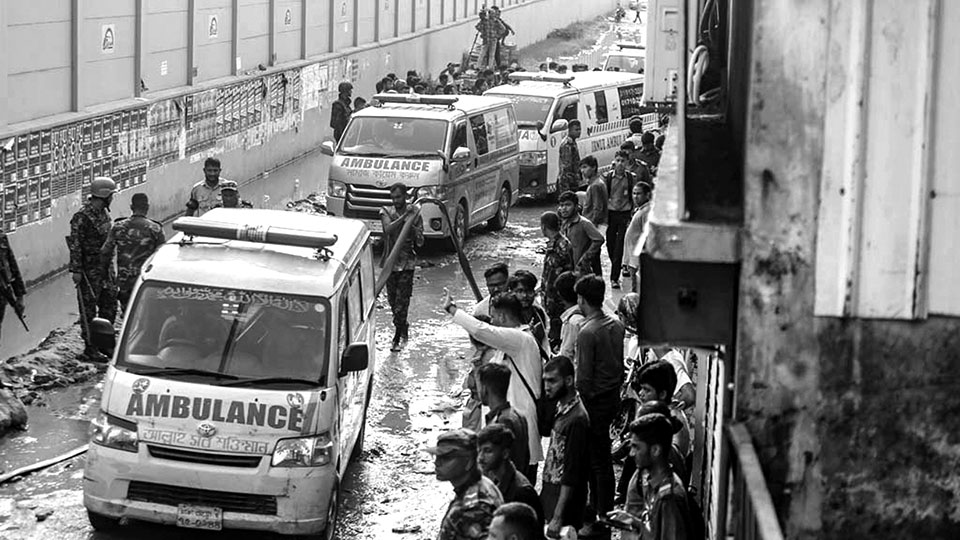
Ambulance carrying injured victims leaving the site urgently--Photo : Monitor
However, eyewitness accounts and military insiders later suggested that he may have ejected at the last moment-too late to survive, and too late to prevent disaster.
This uncertainty highlights a harsh truth: no matter the bravery, urban airfields offer no safe crash zones.
Ideal location criteria for int'l airport
The criteria for an ideal airport location as per international civil aviation standards are mentioned below:
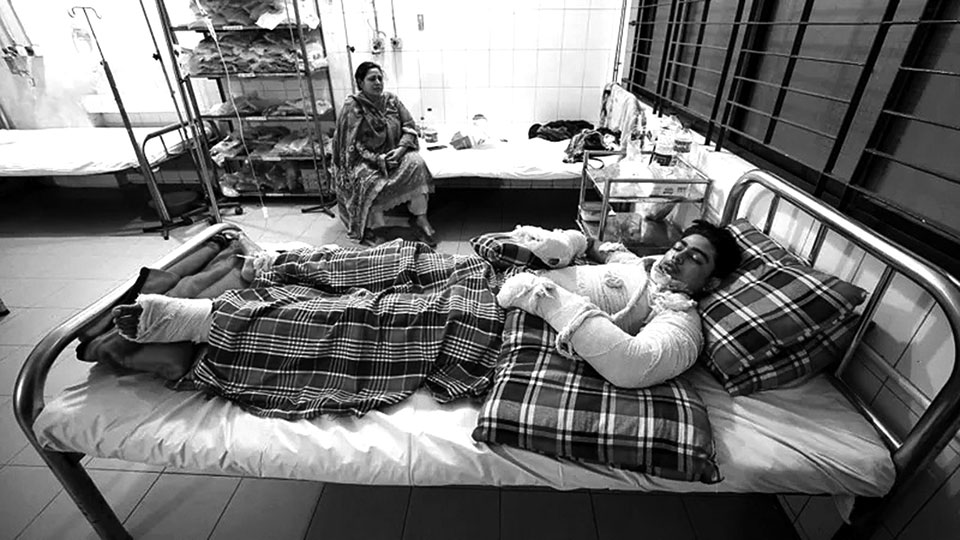
One of the wreched victims struggling to survive at a hospital bed in the capital
Geographic and strategic location
- Close enough to major population centers (but not too close to cause noise disruption)
- Centrally located for domestic and international connectivity
- Ideally near economic zones, industrial hubs, or tourist destinations
- Should not obstruct international flight paths (avoids restricted airspace or military zones)
Land availability and terrain
- Large area (typically 3,000-10,000 acres) for runways, terminals, expansion, and buffer zones
- Flat or gently sloping terrain--reduces construction cost and improves safety
- Minimal obstacles (hills, towers, water bodies) that would affect approach and takeoff
Accessibility, connectivity
- Close proximity to major highways, rail links, and urban transit systems
- Should allow easy development of cargo logistics corridors and passenger access
- Possibility to become a transport hub (multi-modal connections)
Environmental, social impact
- Away from densely populated areas to reduce noise, air pollution, and land acquisition conflict
- Avoids ecologically sensitive zones (wetlands, forests, wildlife reserves)
- Limited risk of flooding, earthquakes, or other natural hazards
- Requires Environmental Impact Assessment (EIA) and community consultation
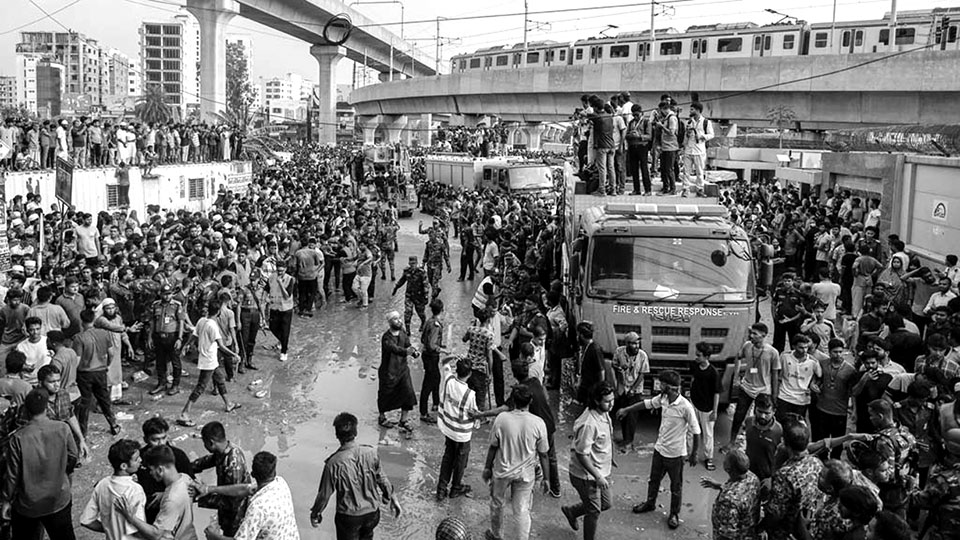
A huge curious crowd greatly hampered rescue efforts by fire service at the site--Photo : Monitor
Weather and climate conditions
- Favorable meteorological conditions year-round (low fog, moderate wind, minimal storm activity)
- Good visibility and minimal air turbulence or crosswinds
- Should allow for 24/7 operations
- Safety and airspace management
- Not located near restricted or military airspace
- Enough space for parallel runways and future expansion
- No bird migratory routes or large wildlife presence nearby (to avoid bird strikes)
Economic viability
- Proximity to economic centers enhances business case
- Opportunity to become a regional hub for passengers and cargo
- Suitable for Public-Private Partnership (PPP) or foreign investment
Learning from cities that chose safety
Dhaka is not the first city to face this challenge-but it risks being among the last to act. Across the world, many major cities have relocated their airports to safer, more sustainable sites outside urban cores. Here is what Dhaka can learn, according to experts:
Hong Kong
Then: Kai Tak Airport landed planes between skyscrapers.
Now: Chek Lap Kok Airport, 34 km away, opened in 1998 on reclaimed land-safer, quieter, and future-ready.
Munich, Germany
Moved its airport 29 km out of the city in 1992 to escape noise and space limitations.
Riem Airport was closed and repurposed; the new site offers room for expansion and zero overflights of homes.
Osaka, Japan
Kansai International was built on a man-made island, 50 km from the city, after concerns over noise and safety.
Result: one of the quietest and most efficient airports in Asia.
Istanbul, Turkey
Atatürk Airport, once surrounded by dense neighborhoods, was replaced in 2019 by Istanbul Airport-40 km outside the city.
Seoul, South Korea
Shifted primary operations to Incheon Airport, 48 km from Seoul. Built on reclaimed land on an island, away from dense population.
Gimpo Airport now handles smaller, domestic flights only.
Hyderabad, India
Replaced the congested Begumpet Airport with Rajiv Gandhi International, 24 km away.
Allowed modern infrastructure and safer aviation corridors.
Beijing, China
Opened Daxing International Airport, 46 km from the city center, to reduce pressure and risk from Beijing Capital.
Changi, Singapore
Close to city, yet on the edge of the island-minimizes disruption.
Doha, Qatar
Hamad International (Doha): Coastal, flat terrain, room for expansion.
Dhaka's moment of reckoning
Compared to these cities, Dhaka continues to operate as if the capital's skies are empty. However, they are not. They are full of life below-and full of risk above, claimed country's civil aviation representatives.
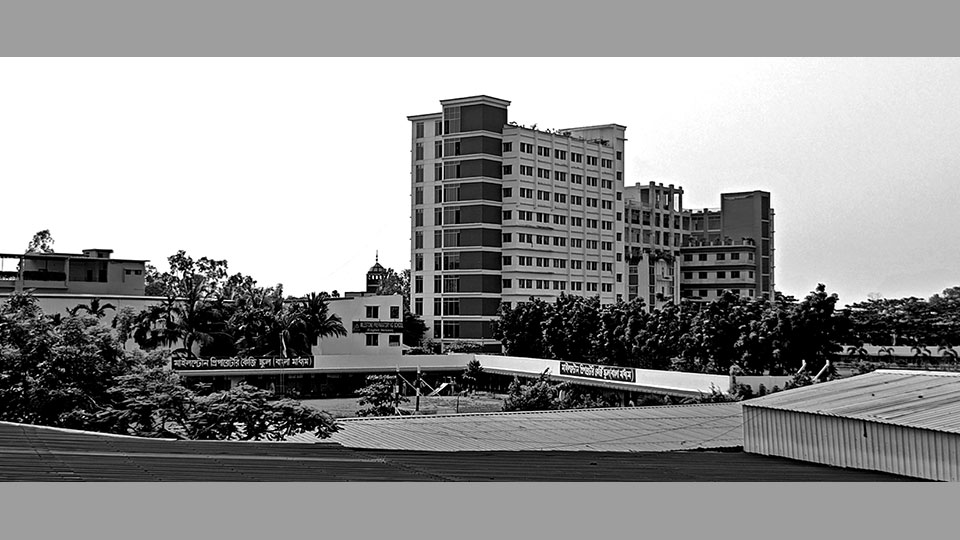
High-rise buildings like the one at Uttara’s Milestone School and College are at risk as the premise is located nearby Hazrat Shahjalal International Airport in the capital--Photo : Monitor
By keeping both military and civilian aviation embedded in the city, Bangladesh not only endangers lives but also stifles its own growth. Noise, pollution, crash risk, and logistical strain all limit Dhaka's future.
Experts suggest relocating air operations could allow:
- Safer skies for civilians
- 24-hour aviation logistics hubs
- Modern urban planning unburdened by flight paths
- Stronger national defense with isolated military facilities
We've moved before: from Tejgaon to Kurmitola
This is not uncharted territory for Bangladesh. In fact, Dhaka has already faced a version of this decision-and made the right one.
Until the late 1970s, Tejgaon Airport, located in the heart of Dhaka, served as the country's primary air hub. It began as a WWII military strip, then evolved into East Pakistan's first international airport. But as the city expanded and aviation evolved, the old airport's location became a liability. It was landlocked, surrounded by buildings, too small for modern jets, and increasingly unsafe for high-volume civilian traffic.
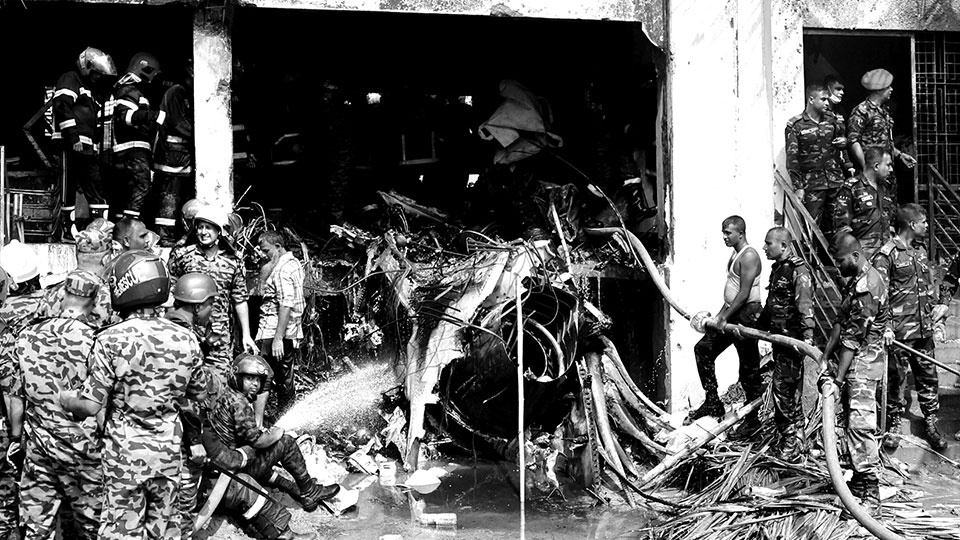
Rescue efforts underway to save victims of the deadliest plane crash of the country in recent times
Recognizing this, then airport development authorities in the late 1960s and '70s began developing a new airport at Kurmitola, then a relatively undeveloped area on Dhaka's outskirts. By 1980, all commercial flight operations had moved to the newly built airport-now Hazrat Shahjalal International Airport.
Tejgaon reverted to military control, while Kurmitola gave Bangladesh a safer, more scalable aviation gateway.
This historic shift offers a clear precedent: when aviation risks become urban risks, relocation is not only possible-it's necessary.
What comes next
The Milestone College tragedy must be a turning point, not just a headline. Children died in a school because a jet engine failed where it never should have flown.
We must ask: How many more warnings do we need? Bangladesh has the talent, the resilience, and the experience to build better. The question is no longer if we can move airport operations away from cities. It is whether we will-before it happens again.
Also on Bangladesh Monitor