

Top News
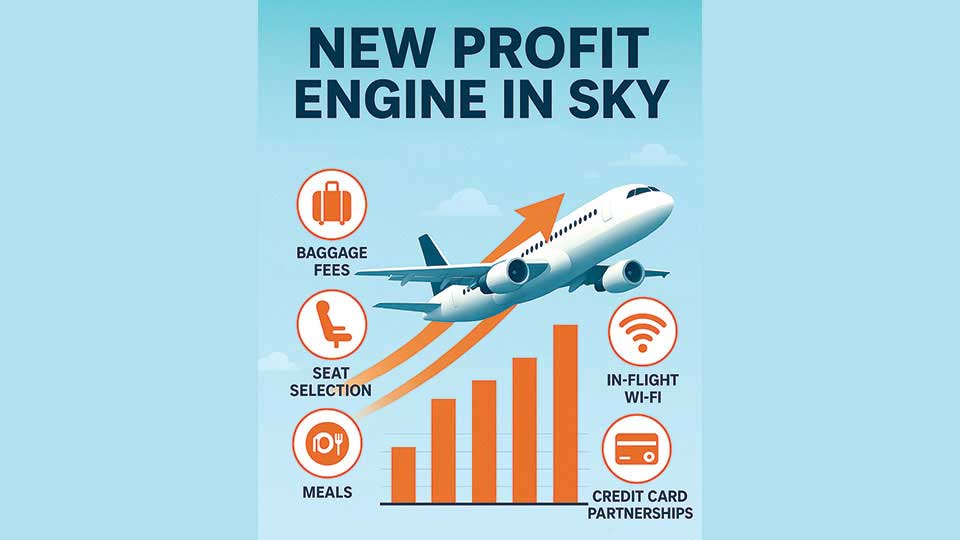
Dhaka : In a world where ticket prices alone no longer guarantee profitability, airlines are discovering a new lifeline - ancillary revenue. From baggage fees and seat selection to in-flight WiFi, and credit-card partnerships, the business of selling "extras" has evolved into a multibillion-dollar global industry. For carriers under pressure from high fuel prices and cut-throat competition, ancillary revenue has become not just an add-on, but a strategic core.
Ancillary revenue is the money an airline earns beyond the ticket price. It includes charges for checked baggage, seat upgrades, priority boarding, meals, WiFi, duty-free sales, travel insurance, hotel and car-rental commissions, and loyalty-program income.
Essentially, it is the airline equivalent of retail upselling - the shift from a one-size-fits-all ticket to a personalized à-la-carte experience where passengers pay for what they value.
According to industry experts, ancillaries are about smart retailing - matching services to customer needs, and monetizing convenience.
Sky-high growth story
Globally, ancillary revenue is soaring. According to reports, airlines earned about USD 148 billion in ancillary revenue in 2024, a 25 percent jump from the previous year. Another market study projects the sector to reach USD 459 billion by 2035.
For many low-cost carriers (LCCs), ancillaries now make up 30-60 percent of total revenue. Ultra-budget airlines like Frontier and Wizz Air rely on them for survival. Even full-service carriers, traditionally dependent on fares and premium cabins, are aggressively monetizing extras like lounge access, WiFi, and mileage sales.
A decade ago, ancillaries contributed just 5 percent to airline revenue on average. Today, they account for up to 20 percent - sometimes more. Clearly, the model has matured from side-business to profit engine.
Why it matters
A range of benefits make ancillary earnings essential for airlines:
Boosting margins: Ancillary products often have higher profit margins than base fares. While ticket prices are volatile and heavily taxed, extras like baggage or seat fees cost little to deliver but add significant income.
Competitive pricing: By unbundling fares, airlines can advertise lower base prices and attract price-sensitive travelers - then offer optional add-ons. This makes them appear cheaper on comparison sites while preserving profitability.
Data-driven personalization: Digital booking systems now allow airlines to target passengers with specific offers - say, a window seat for a solo traveler, or meal upgrades for families. It is sophisticated retail science, powered by data.
Revenue diversification: The pandemic exposed the fragility of relying solely on ticket sales. Ancillary revenue provides a diversified, more resilient income stream.
Enhancing experience: When executed well, ancillaries can actually improve customer satisfaction - offering flexibility, convenience, and choice rather than hidden costs.
Global best practices
Frontier Airlines in the US now earns over 60 percent of its total income from ancillaries. Spirit Airlines and Wizz Air follow similar models.
Emirates sells premium seat upgrades and WiFi packages; British Airways charges for advanced seat selection even in economy.
Airlines like Lufthansa and Singapore Airlines use real-time pricing and personalization engines that suggest add-ons before, during and after booking.
JetBlue and Delta leverage loyalty programs and co-branded credit cards for lucrative ancillary streams.
This shows that ancillary strategy is not about cost-cutting; it is about smarter merchandising and digital transformation.
Bangladesh's opportunity, challenge
Bangladesh's aviation sector has grown rapidly over the past decade, powered by outbound labor markets and rising middle-class travel. Yet, profitability remains elusive for most carriers.
High jet-fuel prices, airport surcharges, and intense competition from foreign airlines have squeezed margins. Several private carriers have struggled to stay afloat or scale meaningfully.

Biman's in-flight catering subsidiary BFCC reported revenue of BDT 24,879.67 lakh in 2024-25, hinting at untapped potential of ancillary units _Photo : Monitor
This is precisely why ancillary revenue could be the game-changer for Bangladesh's aviation industry, claimed industry experts.
Current steps
The national carrier, Biman Bangladesh Airlines, has started taking measured steps. In 2024, Biman adopted a modern Sabre digital platform that enables ancillary product sales, payment integration, and merchandising. Its in-flight catering subsidiary, BFCC, reported revenue of BDT 24,879.67 lakh in 2024-25, with profits hovering near BDT 7,995 lakh, hinting at the untapped potential of ancillary units.
Biman also posted record overall revenue of BDT 10,575 crore in FY 2023-24 - but insiders acknowledged that the next big growth phase would depend on smarter commercialization rather than just more flights.
Private airlines, meanwhile, have yet to fully embrace ancillaries. Their websites often lack integrated retail systems or dynamic pricing capabilities.
How Bangladeshi airlines can catch up:
- Digital commerce platforms: Invest in user-friendly booking engines and mobile apps that allow travelers to buy ancillaries - from seats to meals - in a few clicks.
- Segment-based offers: Families might want baggage bundles; business travelers value lounge passes or WiFi. Tailoring offers by traveler type increases uptake.
- Loyalty and partnerships: Build co-branded credit cards and retail tie-ups that reward frequent flyers. Even small airlines can partner with banks, hotels and ride-sharing firms.
- Dynamic pricing: Adopt data tools that adjust ancillary prices based on demand, route and timing - much like ticket fares.
- Transparent communication: Disclose all fees clearly. Hidden charges can alienate passengers and invite regulatory backlash.
- Staff training and incentives: Cabin and ground staff can be powerful sales agents if properly trained and incentivized.
- Leverage subsidiaries: Ground handling, catering, and training wings can be turned into profit-centers serving other carriers too.
Timing is perfect
Global travel demand is rebounding. Bangladesh's middle-class travel market is expanding. Digital payment adoption is at an all-time high.
If airlines act now, they can position themselves for sustainable profit growth. Ignoring ancillary potential would mean falling further behind regional peers - especially as foreign airlines continue to dominate international routes out of Dhaka, capturing not only traffic but also the value per passenger.
Ancillary strategy is the missing link for Bangladeshi carriers. Without it, local airlines will keep chasing volume instead of value, expressed industry stakeholders.
Risks, realities
Ancillaries are not a silver bullet. Poor execution - like charging for basic services or hiding fees - can damage brand trust.
Regulators worldwide are scrutinizing "junk fees," and Bangladesh's Civil Aviation Authority will likely follow suit.
Moreover, success requires digital infrastructure, pricing analytics, and customer insight - areas where local carriers must still build capacity.
However, as operating costs rise and competition intensifies, doing nothing is riskier. Ancillaries may not fix every financial challenge, but they can meaningfully enhance revenue per passenger and cushion profit margins.
Around the world, airlines have realized that flying planes is only half the business. The other half is retailing - intelligently, digitally, and profitably.
For Bangladeshi carriers, embracing ancillary revenue is not just a matter of copying global trends; it is about survival in a changing aviation economy.
The airlines that learn to sell more than a seat will be the ones that stay in the sky.