

Top News
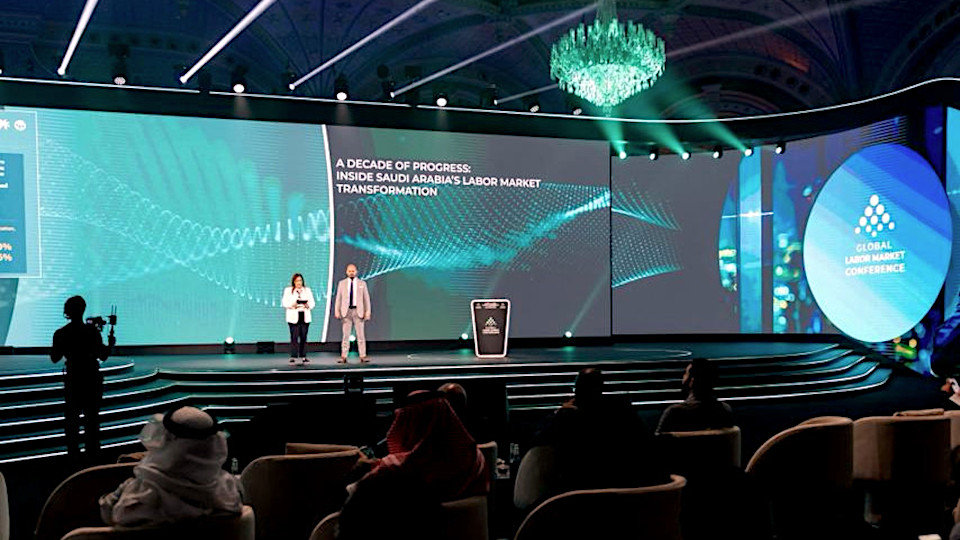
Dhaka: The Global Labor Market Conference (GLMC), in collaboration with the World Bank Group and Saudi Arabia’s Ministry of Human Resources and Social Development, has released a new report titled “A Decade of Progress,” documenting the Kingdom’s labor market transformation since the launch of Saudi Vision 2030.
The report serves as an analytical reference assessing labor market reforms and outcomes between 2015 and 2025, with 2015 used as a baseline year prior to the introduction of Vision 2030. It provides a data-driven evaluation of the impact of policies implemented under the Labor Market Strategy, highlighting significant institutional, social, and economic shifts, reads a press release.
According to the report, Saudi Arabia’s labor market has undergone three major transformations over the past decade.
The first relates to labor market activation and inclusiveness. Labor force participation reached 67.1 percent by 2025, alongside a rise in the number of employed Saudi citizens. Overall unemployment declined sharply to 2.8 percent by mid-2025, driven in part by economically inactive individuals transitioning directly into employment. Employment-to-population ratios improved, while labor supply constraints linked to inactivity declined.
The report also points to substantial gains among key demographic groups. Female employment rose from 11 percent in 2015 to 32 percent in 2025, while employment among mothers increased from 8 percent to 45 percent. Youth employment among those aged 18 to 24 increased from 10 percent to 33 percent, and the share of youth not in education, employment, or training fell from 40 percent to 25 percent over the same period.
The second transformation highlighted is the growing dynamism of the private sector. By the second quarter of 2025, 52.8 percent of employed Saudi citizens were working in the private sector, reflecting a structural shift in employment patterns. The report notes that most net job creation over the decade came from private sector firms, including a marked increase in employment within micro-enterprises, whose share of total employment rose from 6 percent to 26 percent.
Improvements in education-to-job matching also supported private sector growth, increasing from 41 percent in 2015 to 62 percent in 2025. These developments contributed to reduced labor market mismatches, greater job mobility, and higher rates of job-to-job transitions.
The third transformation identified in the report concerns changes in social values and attitudes toward work. The proportion of individuals unwilling to work declined from 49 percent to 12 percent, while preferences for public sector employment narrowed significantly. Among men, the share of jobseekers exclusively targeting public sector roles fell from 60 percent to 10 percent, while among women it declined from 48 percent to 22 percent.
Social acceptance of women working in mixed-gender environments also increased, supporting higher female participation in private sector employment and broader integration into the labor market.
Commenting on the findings, Cristobal Ridao-Cano, Practice Manager for Social Protection and Labor at the World Bank covering the Middle East and North Africa, Pakistan, and Afghanistan, said the private sector has emerged as a key driver of job growth in Saudi Arabia. He noted that rising employment ratios and declining unemployment reflect the successful transition of inactive individuals into the workforce, adding that lessons from Saudi Arabia’s transformation could be applied in other countries.
The report concludes that the progress achieved over the past decade provides a strong foundation for the next phase of labor market development. It emphasizes the importance of continued investment in skills development, data-driven policymaking, and public-private collaboration to support inclusive growth and economic diversification.
Released as part of GLMC’s ongoing efforts to promote evidence-based dialogue, “A Decade of Progress: Inside Saudi Arabia’s Labor Market Transformation: Indicators and Shifts between 2015 and 2025” coincides with the third edition of the Global Labor Market Conference in Riyadh. The conference brings together more than 200 ministers, policymakers, business leaders, and international experts to discuss labor market challenges and opportunities at regional and global levels.
K