

Top News
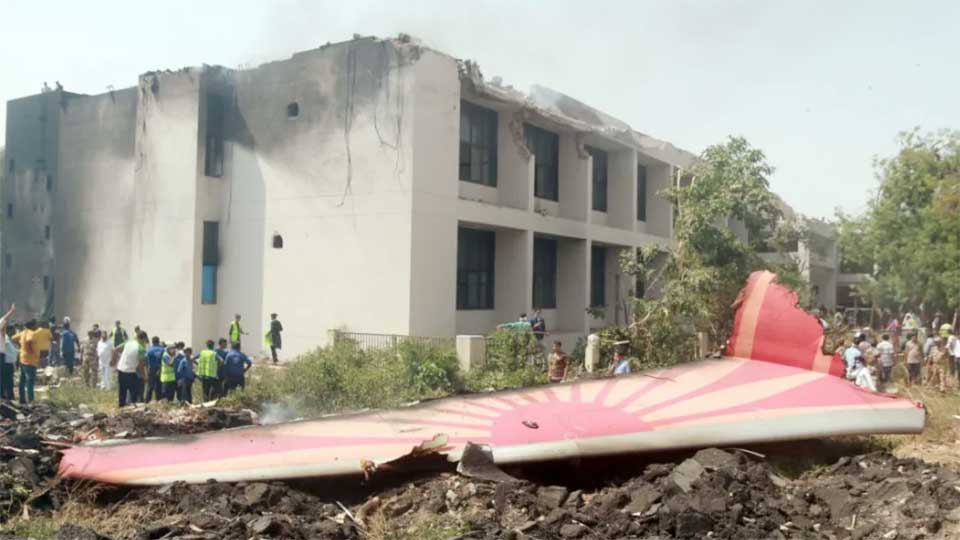
Dhaka: An Air India Boeing 787-8 carrying 242 people crashed shortly after takeoff from Ahmedabad on Tuesday (June 10) killing nearly everyone on board.
At least one passenger, a British national, survived and the passenger said he heard a loud noise soon after the plane left the ground.
Aviation analysts reviewing early footage of the flight said the aircraft’s configuration “didn’t look right,” raising questions about a possible technical fault.
Former British Airways pilot Alastair Rosenschein is among several experts who have told agency about their first look at video of Flight 171 which showed some potential anomalies.
"It's clearly got its [landing] gear down and that is not correct... it should have been up. And from the video... it's not immensely clear... but it does look like the aircraft didn't have its take-off flap setting."
Mr. Rosenschein explained that the wing flaps must be set correctly, as they extend the wing shape and provide essential lift at low speeds for effective takeoff and climb.
He added that, while speculative, this could explain why the aircraft crashed, as it may not have been able to maintain flight.
"The video is unclear, but the flap settings don’t appear correct," he said. "The aircraft’s altitude is also abnormal, appearing to descend rather than climb."
"It seems to be an aerodynamic issue caused by incorrect flap settings during takeoff."
Laura Savino, a former United Airlines captain, noted the aircraft used the entire runway for takeoff.
“It’s a long runway,” she told agency “You could see dust blowing at the end. The climb was shallow—they should be at about 15 degrees nose-up, but it looked like they were struggling. Then the plane settled and started to descend.”
Ian Petchenik, Flightradar24’s communications director, told he also found it puzzling that the aircraft lost altitude shortly after takeoff.
Paul Edwards, an aviation security analyst and fellow at the Royal Aeronautical Society, also says it remains a mystery why the landing gear was still down.
"On take-off, a pilot would bring up the wheels as quickly as possible... the aircraft is more efficient in accelerating and in the climb," he told the agency.
"It could have been he [the pilot] just didn't have time, or it could be that perhaps he thought he could control it, go round again and land or even land straight ahead."
"Really, we can't second-guess it," he added. "So that remains, if you like, a mystery."
He described the Boeing 787 Dreamliner as having an "impeccable" safety record.
Dr Jason Knight, senior lecturer in fluid mechanics at the University of Portsmouth, has raised the possibility that a bird strike could be linked to the crash.
"It is very unlikely that the plane was overweight or carrying too much fuel. The aircraft is designed to be able to fly on one engine, so the most likely cause of the crash is a double engine failure," he said.
Professor Graham Braithwaite, director of Aerospace and Aviation at Cranfield University, explained that passenger planes have an excellent safety record.
"Although take-off is a critical stage of flight, aircraft accidents are incredibly rare, especially involving modern aircraft types such as the Boeing 787.
"Take-off is a critical stage because the aircraft is still accelerating and any problem-solving requires a rapid response."
Professor John McDermid, Lloyd's Register Chair of Safety at the University of York, stated that "take-off and landing are the most dangerous phases of flight."
He called the accident "very surprising" given the redundancy of aircraft systems and their ability to climb on a single engine if necessary.
"It is unexpected that the accident happened before the aircraft reached 200 meters altitude. Pilots can abort take-off until late in the roll, so the issue likely occurred suddenly in the final stage of take-off or shortly after becoming airborne, and was severe enough to be uncontrollable."
Weather conditions will also be investigated, though Professor Paul Williams of the University of Reading noted that conditions at Ahmedabad airport "appeared very good" — dry, sunny, around 40°C (104°F), with good visibility and light westerly winds.
"There is currently no indication that turbulence or weather contributed to the crash."
-B
Share this post
Also on Bangladesh Monitor