
Top News
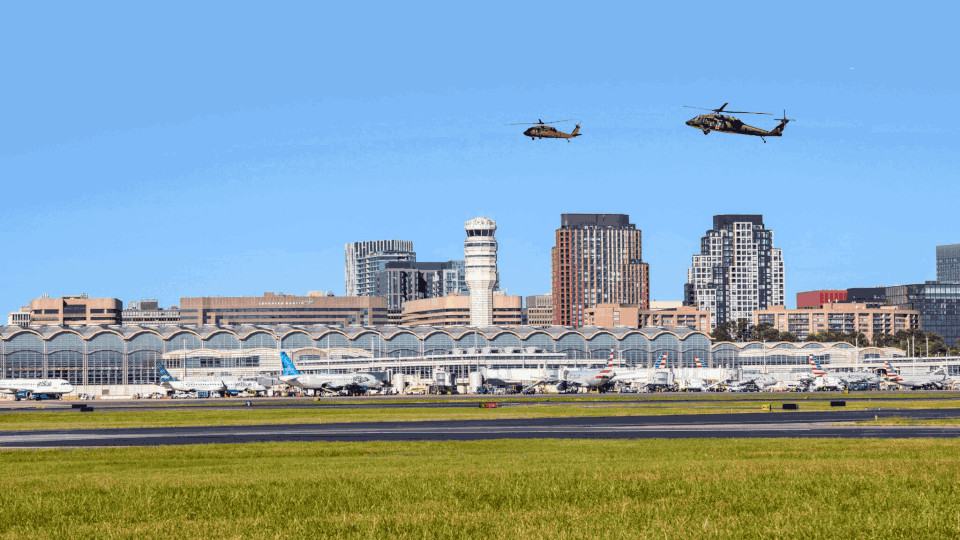
Dhaka: The US Federal Aviation Administration (FAA) has issued a general notice suspending the use of visual separation between fixed-wing aircraft and helicopters in busy airspaces, requiring air traffic control (ATC) to use radar to maintain lateral and vertical separation between such aircraft.
US Transportation Secretary Sean Duffy and FAA Administrator Bryan Bedford announced the "upgraded safety protocol" on Wednesday, March 18. The measure follows a year-long FAA safety review triggered by a mid-air collision in January 2025 between a US Army helicopter and a PSA Airlines regional jet near Ronald Reagan National Airport.
The crash, involving a Sikorsky UH-60L Black Hawk and an MHI CRJ700, killed 67 people. Both aircraft plunged into the Potomac River. Investigators found the helicopter was operating above its mandatory flight ceiling while its pilots wore night vision goggles that restricted their field of view.
"The tragedy over the Potomac one year ago revealed a startling truth: years of warning signs were missed, and the FAA needed dire reform," Duffy said.
Bedford added that the FAA is working to proactively manage aviation safety risks, including helicopter incursions in the flight path of commercial aircraft. "We identified an over-reliance on pilot 'see and avoid' operations that contribute to safety events involving helicopters and airplanes," he said.
The FAA cited recent near-miss incidents supporting the need for this change. On February 27, an American Airlines Airbus A320 cleared to land in San Antonio was placed on a converging course with a police helicopter. Separately, on March 2, a helicopter and a twin-engined Beechcraft 99 came into conflict near Hollywood Burbank Airport in Los Angeles.
The new protocol applies to Class B and Class C airspaces and Terminal Radar Service Areas, covering the country's busiest airports down to mid-sized ones. Controllers will use radar to maintain specific lateral or vertical distances between aircraft where helicopter and fixed-wing flight paths intersect.
Regulators are also exploring the use of artificial intelligence tools to identify potential conflict zones. Meanwhile, Congress is debating competing bills related to the January 2025 collision, including a controversial provision that would mandate aircraft carry ADS-B In systems.
V
Share this post
Also on Bangladesh Monitor