
Top News

Alexander Feldmen, President, Boeing Southeast Asia; Dr Patty Chang-Chien, VP and GM, Boeing Research and Technology; Dr Kirk Vining, Chief Pilot for Product Development, Director of Research Flight Operations, Boeing Commercial Aircraft; Han Kok Juan, Director-General, Ng Tee Chiou, Deputy DG, Tan Yean Guan, Director, Air Traffic Management Plans and Development, CAAS seen at the flight launch event on June 11
Dhaka: The Civil Aviation Authority of Singapore and the Air Navigation Service Providers of Japan, Thailand and the United States of America successfully conducted the world’s first-ever multi-regional trajectory-based operations (TBO) demonstration flight, using a Boeing 787-10 ecoDemonstrator Explorer.
The demonstration flight started its journey from Seattle to Tokyo on June 11, 2023, and landed at Singapore Changi Airport on June 13, 2023 at 8:08 pm. It will depart Singapore for Bangkok on June 14, 2023.
Speaking on the occasion, Han Kok Juan, Director-General, CAAS, said, “Singapore is pleased to partner with Japan, Thailand and the USA to develop and test new capabilities to improve flight efficiencies and reduce carbon emissions. This is a recognition of our position as a leading air hub and air navigation service provider, and pathfinder for sustainable aviation. With the signing of the Joint Declaration, we look forward to working closely with other air navigation service providers and industry partners to transform air traffic management and make the future of air travel a more sustainable one.”
The demonstration flight is part of a three-year collaboration programme aimed at improving flight efficiencies and reducing carbon emissions, with the potential of cutting an aircraft’s fuel burn by up to 10 per cent.
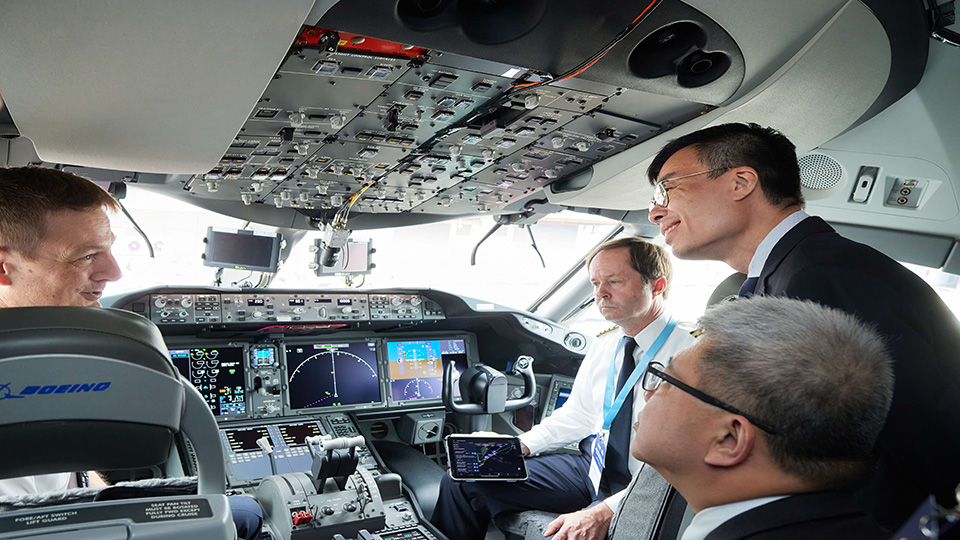
CAAS officials being briefed on the Boeing 787-10 ecoDemonstrator Explorer
The ANSPs and Boeing also signed a joint declaration to reaffirm their commitment to make TBO a reality worldwide.
Today, international flights are managed through multiple Flight Information Regions (FIRs) by their respective ANSPs, with each ANSP acting separately and independently.
The capabilities developed for the functions, including air and ground exchange of live flight information and the negotiation of flight trajectory between multiple ANSPs and the aircraft, are being tested in the demonstration flight.
Multi-regional TBO is expected to fundamentally change the way air traffic is managed and yield significant benefits. These include improving safety and efficiency, minimising delays and disruptions, cutting travel cost and time, and reducing fuel burn and carbon emissions.
- T
Share this post
Also on Bangladesh Monitor