
Top News
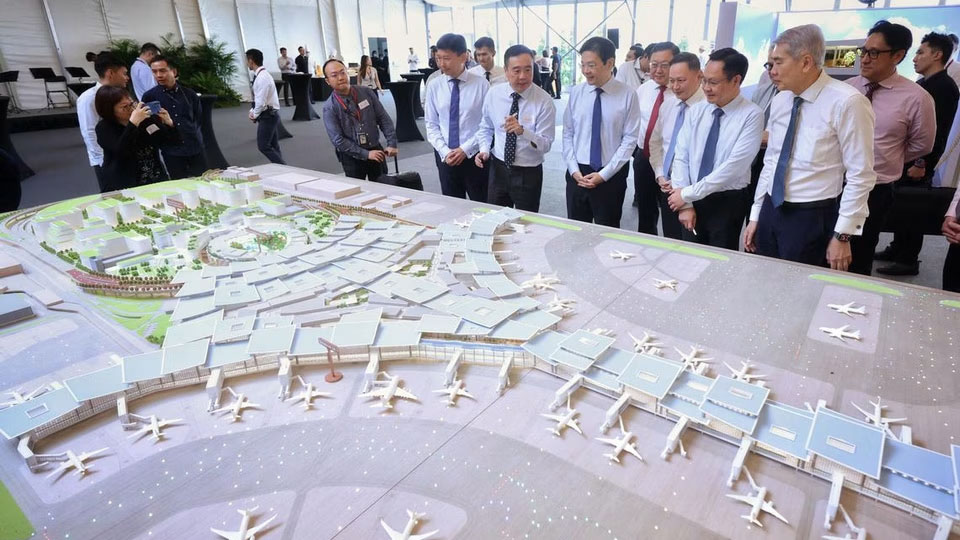
Singapore’s PM Lawrence Wong looking at a model of Changi Airport Terminal 5 on May 14. Transport Minister Chee Hong Tat; CAG MD for Changi East Ong Chee Chiau; China Communications Construction Company Chairman Wang Tongzhou; SIA CEO Goh Choon Phong; CAG CEO Yam Kum Weng; and CAG Chairman Lim Ming Yan, among others, also seen on the occasion
Dhaka: Singapore’s Prime Minister Lawrence Wong has broken ground on Changi Airport Terminal 5 (T5) on May 14.
The expansion project, more than a decade in the making, aims to position the airport to handle an anticipated surge in air travel within the Asia-Pacific and beyond.
With the ground-breaking, work on the mega terminal has commenced, following delays owing to the Covid-19 pandemic.
Singapore’s flag carrier Singapore Airlines and its budget wing Scoot will consolidate their operations under one roof at T5 when the terminal opens in the mid-2030s, as per reports citing the airport’s operator Changi Airport Group (CAG).
The airlines now operate across Terminals 1, 2 and 3, and SIA Group, as per reports, said the consolidation at T5 will provide space for its future growth and improve “operational synergies”.
There will be room at T5 and other terminals for other carriers to expand their operations, claimed reports citing CAG.
Designed to handle about 50 million passengers a year, T5 will effectively double the size of Changi Airport and allow it to handle 140 million passengers yearly—boosting its current capacity of 90 million by more than 55 percent.
At present, Changi Airport is linked to more than 170 cities. With T5, the airport will be able to reach its target of more than 200 city links by the mid-2030s, said PM Wong.
Works completed so far include a new runway, the airport’s third; an underpass for vehicular traffic; and tunnels for baggage and automated people-mover systems similar to the Skytrain.
With three runways operational by the time T5 opens, a second control tower will be built to manage air traffic.
In a first for the airport, T5 will house a ground transport center, bringing together the Thomson-East Coast and Cross Island MRT lines, buses, taxis and other transport services.
Plans include baggage robots that can operate in poor weather conditions, as well as video analytics and artificial intelligence tools that can track aircraft turnarounds to predict potential delays.
To make it easier for passengers to move around, three automated people-mover systems as well as travelators will reduce walking distances. There will be two people-mover systems within T5 that can connect departing passengers to their gates and arriving passengers to two arrival immigration halls. A third people-mover system will link T5 to T2, facilitating passenger transfers to other terminals.
- T
Share this post
Also on Bangladesh Monitor