

Top News
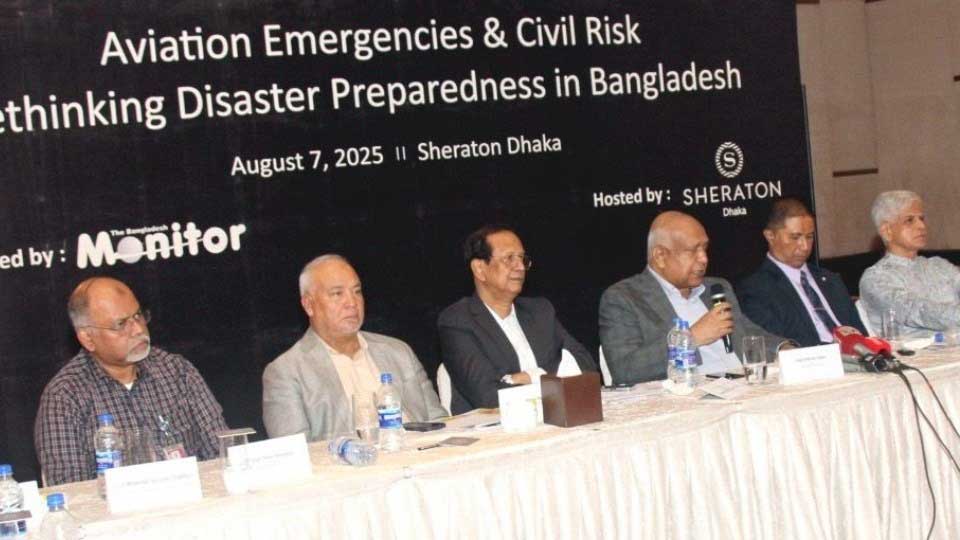
Country's military and civil aviation experts seen attending a round table conference held at Sheraton Dhaka in the capital on August 7—Photo: Monitor
Dhaka: The devastating crash of a Bangladesh Air Force F-7 fighter jet into Milestone School and College in Uttara on August 6, killing 35—mostly children, teachers, and staff—has triggered urgent calls for reforming Bangladesh’s aviation disaster preparedness and urban planning around airports.
In the wake of the tragedy, The Bangladesh Monitor convened a high-level round table conference on August 7 at Sheraton Dhaka in the capital, titled “Aviation Emergencies and Civil Risk: Rethinking Disaster Preparedness in Bangladesh’s Airspace.”
The event brought together senior officials from the Civil Aviation Authority of Bangladesh (CAAB), Bangladesh Air Force (BAF), airline executives, urban planners, and industry stakeholders for an open, solution-oriented dialogue.
A heavy reckoning
Presenting the concept paper, The Bangladesh Monitor’s Editor, Kazi Wahidul Alam, said the accident exposed “alarming gaps” in disaster management.
“This was not a combat zone. This was a classroom,” Alam said, describing how small children with severe burns were seen “wandering helplessly” without immediate medical aid.
He listed key failures—absence of a unified command, delayed ambulance response, lack of nearby burn units, and no contingency for rapid evacuation.
Calling for urgent action, he proposed:
- Formation of a National Aviation Emergency Taskforce comprising CAAB, BAF, emergency services, and local government.
- Civil-Military Emergency Protocols with clear roles and communications.
- Quarterly simulation drills in high-risk areas.
- Aviation Incident Response Zones around dense air corridors.
- Decentralized burn treatment units.
- Community awareness programs.
- Integration of aviation safety zones into urban planning.
“From tragedy must rise transformation,” Alam said, urging the nation to “ensure skies may roar, but the ground remains safe.”
Airport relocation, urban planning, and coordination gaps
Aviation analyst and former BAF Air Defense Director Air Commodore (Retd) Ishfaq Illahi Choudhury questioned the approval of high-rises near the airport and pressed for airport relocation—a plan once proposed for Arial Beel but later scrapped.
Group Captain Kamrul Islam of the BAF said the force has a 24/7 search-and-rescue unit with helicopters, but congestion at the crash site slowed efforts.
Air Commodore AKM Ziaul Huq stressed the need for stakeholder MoUs, more frequent joint drills, and additional emergency medical units near airports.
Biman Bangladesh Airlines’ Chief of Technical Captain Tanvir Khurshid, warned of hazards in joint military-commercial airport operations, including potential mid-air collisions and flight delays.
Architect and environmental activist Iqbal Habib criticized the Civil Aviation Act for ignoring public health impacts like noise and vibration, and questioned why schools and malls are allowed under flight paths.
Air Commodore (Retd) Shafiqul Islam opposed relocating the airport, arguing that without proper urban planning, any new site would eventually be engulfed by the city.
NOVOAIR MD Group Captain (Retd) Mofizur Rahman, however, supported relocation and suggested hospital helipads for faster evacuations.
ICAO compliance, enforcement failures
Former Accident Investigation Head Captain (Retd) Salahuddin M Rahmatullah called for a national disaster preparedness program and relocation of schools from airport vicinities.
Air Astra CEO Imran Asif and Wing Commander (Retd) ATM Nazrul Islam highlighted Bangladesh’s non-compliance with ICAO guidelines, lack of buffer zones, and the absence of field hospitals at crash sites.
Col (Retd) Md Sohel Rana urged modernization of the air force fleet.
Tanzim Anwar of the Aviation and Tourism Journalists Forum cited 525 illegal structures near the airport, lamenting RAJUK’s inaction.
US-Bangla Airlines’ Captain Shamsuzzahan noted high-rise encroachments near Jashore airport and tree obstructions in Cox’s Bazar, pointing to poor inter-agency coordination.
Cathay Pacific’s Ahmed Reza echoed the need for accountability and offered foreign airline expertise.
Unique Hotels and Resorts CEO Shakawath Hossain called for firefighter training upgrades and relocation of Dhaka’s airport with surrounding safety-compliant development.
Call for unified action
Across the board, participants agreed that Bangladesh’s fragmented approach—split between CAAB, BAF, RAJUK, and multiple ministries—leaves the country vulnerable to aviation disasters, especially in urban zones.
The consensus: without coordinated command, strict enforcement of air safety parameters, ICAO compliance, and public awareness, the Milestone School tragedy could be repeated.
As Alam concluded in his opening remarks, “We owe it to those young children… that their deaths should not be in vain.”
- T