

Top News
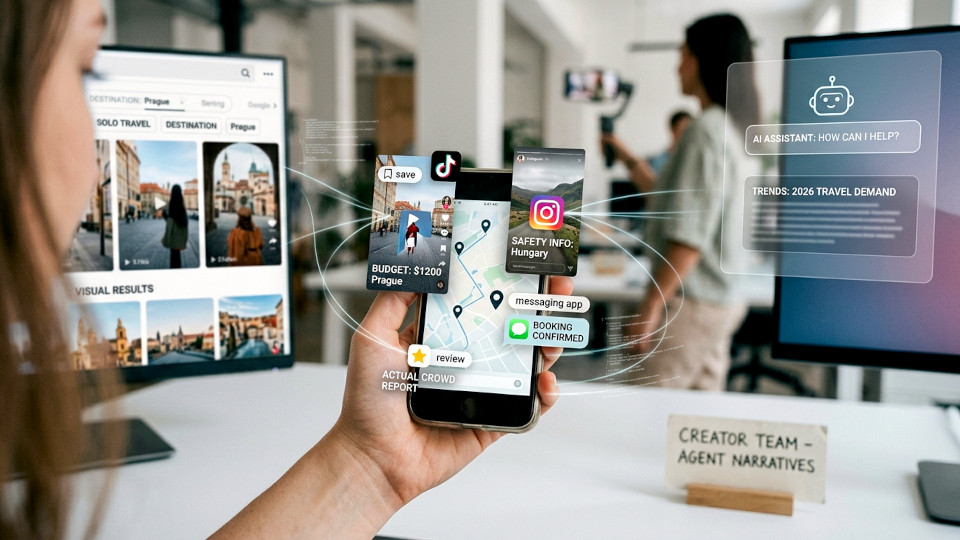
Dhaka: Social networks in 2026 have evolved far beyond entertainment. They now serve as research hubs, service directories, and navigation tools. This transformation demands a fundamental rethinking of how travel brands engage audiences online, as artificial intelligence quietly reshapes every layer of the experience.
Navigating disordered customer journeys
Travel planning is no longer a straight path from inspiration to booking. In 2026, a customer might discover a destination on TikTok, abandon the idea due to budget concerns, revisit it after a conversation, and finally book weeks later after seeing an Instagram ad.
This fragmented journey passes through countless touchpoints, including Google searches, online travel agencies, review platforms, messaging apps, and community groups. Conventional sales tracking methods are largely ineffective in this environment.
Social media now plays a persistent role throughout. Platforms resurface interest, address doubts, display prices, and provide safety information. Because this guidance feels more authentic than static websites, travel brands must deliver consistent value at every possible point of contact, rather than targeting one specific stage in the buying process.
Effective content strategies in 2026 work across three dimensions: concrete inspiration — offering real trip ideas tied to specific budgets and timeframes; pragmatic reassurance — providing clear facts on costs, crowds, and weather; and operational clarity — helping users find answers or complete bookings quickly.
Algorithms replacing traditional search
A significant behavioral shift has occurred among younger audiences. Many Gen Z users and millennials now turn to TikTok and Instagram as their primary search tools, entering queries like "what to do in Prague" or "hotel spa Hungary" and receiving visual results rather than lists of links.
By 2026, these platforms have effectively entered an automatic "travel mode." They monitor subtle user signals, such as watching destination videos, saving posts, or following travel accounts, and begin anticipating intent before a formal search even takes place.
For travel professionals, this means visibility no longer depends primarily on keywords. Content must speak to real situations and specific audiences. Successful approaches include leading with contextual details like budget, duration, and season and addressing concrete scenarios such as traveling without a car, with young children, or during school holidays.
Audience segmentation also matters. Content tailored for families, remote workers, active seniors, or friend groups performs better than generic travel promotion. Distributing content across formats, including short videos, stories, and live streams, also helps train platform algorithms to correctly categorize and distribute material.
AI reshaping production, customer interaction
Artificial intelligence has moved from a supporting role to a central operational function. Chatbots now manage much of the routine messaging for agencies, airlines, and accommodations, handling booking queries, cancellation explanations, and certification requests. This automation frees human staff for higher-value interactions.
However, the shift also redefines advisory roles. Machines handle standard responses well, but human judgment remains essential for situations requiring empathy, nuanced recommendations, or complaint resolution. The distinction between automated efficiency and genuine human warmth is increasingly visible to customers on social platforms.
AI also supports content creation by drafting posts, generating variations, summarizing reviews, and identifying comment trends. Teams that use these tools effectively redirect their energy toward editorial direction and personal expression rather than repetitive production tasks.
The recommended approach involves assigning routine tasks, such as frequently asked questions, follow-ups, and initial responses, to software, while reserving on-camera roles, sensitive communications, and key content decisions for people.
Creator authenticity over polished campaigns
Traditional advertising formats are losing effectiveness. In 2026, high-performing campaigns increasingly resemble user-generated content, using vertical video, casual tones, rapid editing, personal narratives, and unpolished settings. This approach converts promotional material into something closer to a personal recommendation.
Travel brands adopting this rougher aesthetic, featuring imperfect speakers, unremarkable backgrounds, and plain language, tend to gain stronger credibility. Travel agents who post personal videos build loyal communities because their content is long-form, on-camera, and candid about limitations, including products or destinations they would not personally recommend.
Internal figures such as hotel managers, tour guides, and destination specialists represent the brand more authentically than corporate accounts, making them increasingly valuable as content creators.
Honesty as competitive advantage
Social media once rewarded idealized imagery. But in 2026, artificially perfected content carries risk, particularly for travel brands selling real-world experiences. Overpromising widens what some describe as the disappointment gap, prompting backlash in the form of viral "expectation versus reality" comparisons.
Misinformation about safety conditions, weather, or regulations spreads rapidly. Brands that appear to conceal problems lose trust quickly. Brands that combine inspiring content with honest disclosures, including crowding, seasonal drawbacks, booking restrictions, and logistical challenges, build stronger, longer-lasting loyalty.
Practical steps include conducting regular content audits to verify that images and messaging reflect reality, creating educational posts about crowds, weather patterns, and local regulations, and using real, named individuals rather than anonymous corporate announcements to deliver sensitive information.
The broader shift is clear. Travel brands that can simultaneously adapt to fragmented customer journeys, algorithm-driven discovery, AI-assisted operations, creator-style content, and radical transparency are best positioned to convert social platforms into durable engines of growth and loyalty.
V