

Top News
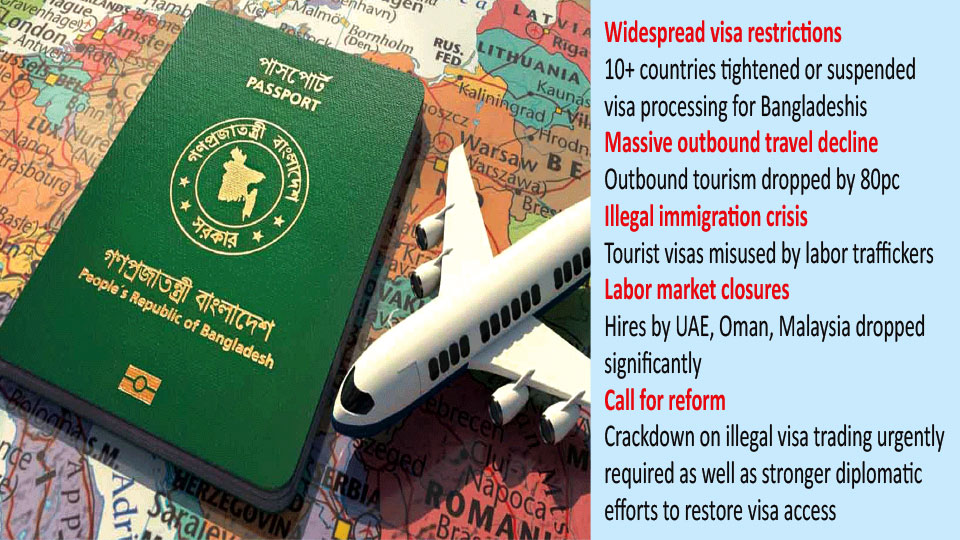
Dhaka : In recent months, Bangladesh's travel and tourism sector has faced unprecedented challenges, primarily due to stringent visa restrictions following the pervasive issue of illegal immigration. These twin crises have not only disrupted the flow of outbound travelers but have also significantly impacted the nation's economy by resulting in massive revenue loss for both the government and private stakeholders.
Aspiring migrant workers and outbound travelers from Bangladesh are victims to increasing hardships in obtaining visas for popular destinations, as several countries in Southeast Asia and the Middle East have imposed visa restrictions, while some are issuing limited visas over overstaying allegations, said the country's outbound tour operators.
Outbound travel decline
Following the political upheaval in August 2024, which saw the ousting of the former Prime Minister Sheikh Hasina, India imposed strict visa limitations on Bangladeshi nationals. This move drastically reduced the number of daily visas issued from over 7,000 to merely 500-700, severely affecting medical tourism and student exchanges.
The Benapole border, a primary gateway between the two nations, witnessed a dramatic drop in daily travelers from 7,000-8,000 to less than half, leading to a significant decline in revenue collection from passport-holding travelers.
Additionally, at least 10 other countries have introduced similar restrictions or made visa processes more challenging for Bangladeshi travelers over the past one month to a year, over allegations of overstays, claimed tour operators.
Furthermore, on May 27, the US suspended international student visa processing indefinitely, affecting several thousand of Bangladeshi students who fly to the US for studies each year.
According to the Bangladesh Outbound Tour Operators Forum, there was a 60 percent decline in sales since last December.
Passenger load factor on flights to several destinations abroad has dropped to 50 percent.
All of these plunges in travel are resulting in massive revenue loss for the government too, as it is currently earning half of the travel tax, embarkation charge, and excise duty, among other earnings, compared to what it used to bag before.
Of the popular destinations for Bangladeshis, visa processing currently remains smooth only for Sri Lanka, Nepal, Malaysia, and Bhutan, expressed the forum.
They informed, around 40,000-45,000 Bangladeshis travel abroad by flight each year for leisure purposes.
Southeast, Central Asian doors closed
The tourism industry, already grappling with the aftermath of the Covid-19 pandemic, now faces an 80 percent drop in outbound tourism due to these visa complications.
Tour operators report that many countries are now scrutinizing visa applications more rigorously, leading to a rise in rejections. India, being the primary destination for Bangla-deshi tourists, has seen a significant decline in travel, with India-bound tourists now representing less than 10 percent of the usual volume.
Industry insiders claimed Southeast Asian countries, including Vietnam, Cambodia, and Laos, as well as Central Asian nations like Uzbekistan and Kazakhstan, have entirely halted visa issuance for Bangladeshi travelers, citing allegations of overstays.
Illegal immigration, visa trading menace
Compounding the problem is the rampant issue of illegal immigration and visa trading.
Some businessmen misuse tourist visas to send labors who do not intend to return, or those who might flee to third countries. Due to this, legitimate tourists face difficulties to obtain visa afterwards.
Taslim Amin Shovon, an outbound tour operator and a Director of Tour Operators Association of Bangladesh, said, "In Vietnam alone, over 30,000 Bangladeshis have overstayed illegally in the past two years. At least 2,000-2,500 people traveled to Vietnam each month."
The reason behind misusing tourist visas by some dishonest businessmen is the ease of obtaining such visas and its low cost, while they sell them to labors at high prices.
"This way, they have sent a large number of workers, which has led these countries to impose such visa restrictions," claimed Shovon.
In 2016 alone, an estimated USD 2.1 billion was laundered out of Bangladesh through illegal transactions to pay for work visas, which are officially supposed to be free of cost, in countries like Saudi Arabia, Qatar, the UAE, Oman, Singapore, and Malaysia. This illicit practice not only burdens aspiring migrant workers with exorbitant costs but also tarnishes Bangladesh's reputation on the global stage.
Aspiring migrant labors are also going through plenty of hardship in obtaining visas for destinations like the UAE, which imposed restrictions in July following street protests by hundreds of Bangladeshis in the Gulf nation supporting the July-August mass uprising.
The circumstances have been further worsened by an oversupply of labors through illegal visa trading in Oman and corruption in the recruitment process in Malaysia, leading to the closure of labor markets for Bangladeshis over the past year.
The UAE hired an average of 5,000 workers until August last year. However, the number declined to only 23 in December, according to the Bureau of Manpower, Employment, and Training.
Additionally, Oman hired only 358 workers last year, compared to 127,000 in 2023.
Dubai, Europe visa cuts
Meanwhile, visit visas were previously issued smoothly by Dubai for Bangladeshi travelers. However, after the July-August uprising, visa issuance by Dubai was suspended. Even though, it resumed in February for a while, it was halted again due to illegal immigration issues.
Even European countries have also limited visa issuance, many passports are being rejected, as per reports. It affected traveler flow to Turkey as well, since many stopover in Turkey before traveling to an onward European destination, said tour operators.
Earlier, 30 people per month used to travel to Turkey from Bangladesh. Now, the number has dropped by over 50 percent to 12-13, as per industry insiders.
According to them, business tours have decreased, while leisure tours have nearly stopped to European destinations like Germany, France, Italy, and Spain, since July.
Indonesia lost
On the other hand, obtaining a visa for Indonesia at the moment takes about one to one and a half months, yet rare. Additionally, the visa fee is quite high, around BDT 14,000. On top of it, Indonesia is issuing very limited visas, and applicants must undergo an interview and provide a local guarantor's invitation.
Whereas, earlier, Bangladeshi tourists could obtain on-arrival visas for Indonesia, with no fee required. However, after the Covid-19 pandemic, the facility has been completely closed for Bangladeshis.
Thailand e-visa curse
Visa issuance issues by Thailand began with the introduction of its e-visa system in January 2.
Industry stakeholders informed, since the launch of the e-visa system, the number of approved visas has declined from 800 to 400 per day. The visa can be submitted; however, the visa fee cannot be paid, causing delays in approval. Furthermore, payments for group visas cannot be processed at all.
Call for comprehensive reforms
Addressing these challenges requires a multifaceted approach. The government must intensify its crackdown on illegal visa trading and ensure that immigration complies with local laws.
Simultaneously, diplomatic efforts should be made to restore and strengthen bilateral relations with the said countries to ease visa restrictions and facilitate smoother travel for Bangladeshi citizens.
Without immediate and comprehensive reforms, the sector risks further decline, affecting not only the economy but also the nation's global standing.