
Top News
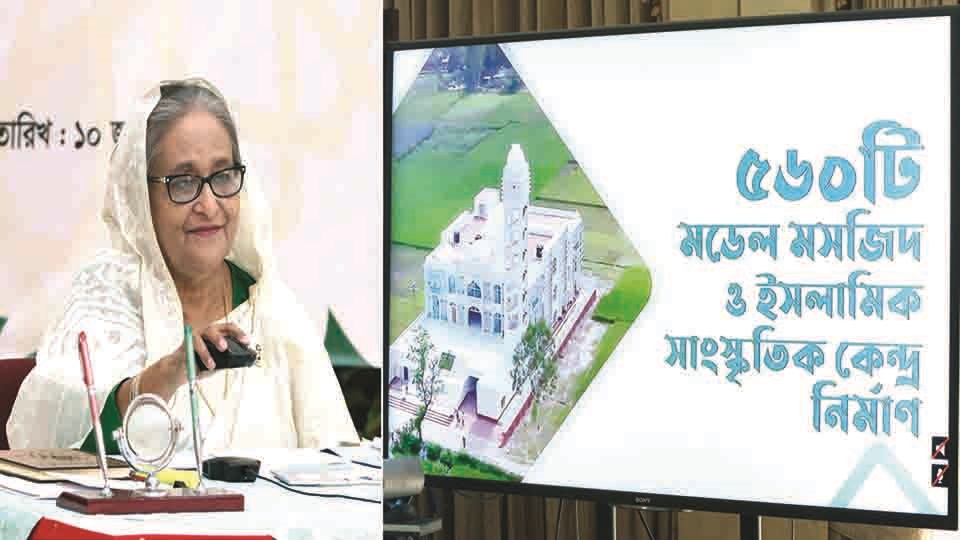
Dhaka : Prime Minister Sheikh Hasina on June 10 opened 50 radiant model mosques newly-constructed across the country, fulfilling one of her election pledges.
The landmark mosques have been established as part of the government's move to set up 560 such mosques-cum-centres of excellence at district and upazila levels, with the aim of spreading Islamic fraternity, real Islamic values and practices, conducting research, creating strong infrastructures for prayers for men and women alike, providing religious teaching and training and enhancing public awareness against social diseases.
In a model mosque cum-Islamic cultural centre, there are separate prayer halls and ablution places for men and women.
The centres have Islamic libraries, Islamic book sale corners, training centres and pre-registration for Hajj aspirants and imams; Hifzkhana and the offices of Islamic Foundation.
Another significant addition to the mosques is autism corners and guest rooms for tourists, both local and foreign.
They also have arrangements for Islamic research and religious activities and funeral activities. Besides, facilities are there for educating children and the mass people.
One of the most interesting additions is the toilet facilities for the physically-challenged devotees.
The Prime Minister inaugurated the 50 model mosques virtually from her official residence Ganabhaban in the capital on the occasion of the Mujib Year.
State Minister for Religious Affairs Md Faridul Haque Khan chaired the inaugural function, attending it from Osmani Memorial Auditorium in the capital.
The 50 mosques are at Savar upazila in Dhaka; Madhukhali and Saltha upazilas in Faridpur; Pakundia and Kuliarchar upazilas in Kishoreganj; Shivalaya upazila in Manikganj; Rajbari Sadar upazila, Shariatpur Sadar and Gosairhat upazilas; Shariakandi, Sherpur, and Kahaloo upazilas in Bogra; Sapahar and Porsha upazilas in Naogaon; Sirajganj Sadar upazila, Chatmohar upazila in Pabna; Godagari and Paba upazilas in Rajshahi; Khansama and Birol in Dinajpur; Patgram upazila in Lalmonirhat; Panchagarh Sadar and Debiganj upazilas; Rangpur Sadar upazila, Mithapukur, Pirganj and Badargonj upazilas; Haripur upazila in Thakurgaon; Subarnachar upazila in Noakhali; Gafargaon and Tarakanda upazilas in Mymensingh; Lohagara, Mirsarai and Sandwip upazilas in Chattogram; Jamalpur Sadar and Islampur upazilas; Nabinagar and Bijoynagar upazilas in Brahmanbaria; Bhola Sadar, Dakshinsurma upazila in Sylhet; Daudkandi upazila in Comilla; Panchari upazila in Khagrachhari; Kushtia Sadar; Khulna district; Kachua upazila in Chandpur; Rajapur upazila in Jhalakathi; and Chuadanga Sadar upazila.
On April 5, 2018, Sheikh Hasina laid the foundation stone for the construction of model mosques and Islamic cultural centres involving BDT 8,722 crore.
Besides, 100 more model mosques will be established in the second and third phases by 2021, marking the birth centenary of Father of the Nation Bangabandhu Sheikh Mujibur Rahman, according to project officials.
Each model mosque is being constructed on a 40-decimal plot under three categories.
Sixty-nine four-storied mosques are being constructed in district towns and city corporation areas under category A, while 475 three-storey ones in upazilas under Category B, and 16 four-storey ones in coastal areas.
Each A category mosque has 2360.09 square feet of floor, while B or C category mosques have 1680.16 square feet floors each.
A district model mosque has enough space for some 1,200 devotees to simultaneously offer prayers. The upazila-level mosques can accommodate 900 devotees at a time.
Each extraordinary mosque is costing BDT 15.62 crore in district town or city area, while BDT 13.52 crore in upazila areas and BDT 13.61 crore in coastal areas.
Also on Bangladesh Monitor