


Bangladesh aviation market shows resilience amid volatility : IATA-linked report

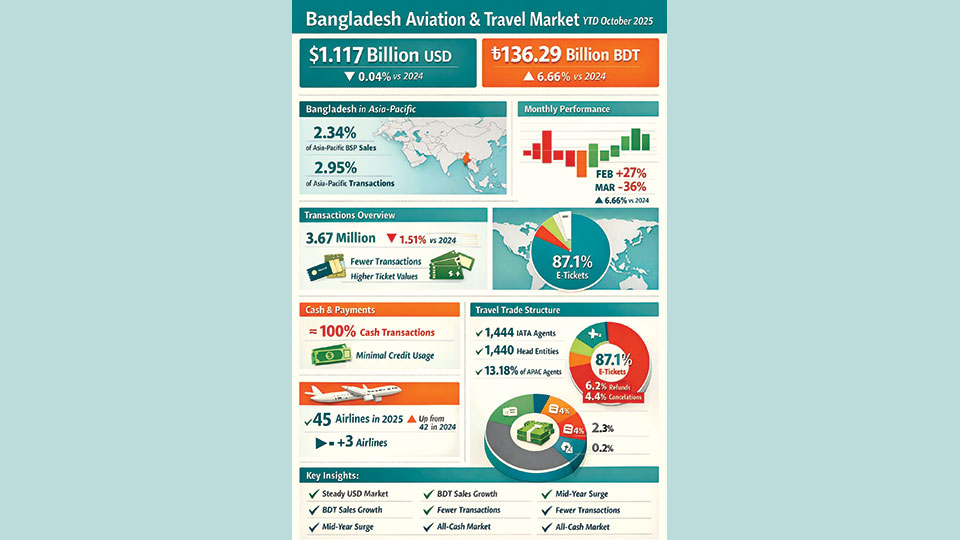
Dhaka: Bangladesh's aviation and travel market is demonstrating resilience despite a year marked by sharp monthly swings, currency pressures, and subdued transaction volumes, according to the latest IATA-linked Travel Agency Association (TAA) BSP report covering year-to-date performance through October 2025.
The report, based on data from IATA's Billing and Settlement Plan (BSP), shows that while total airline ticket sales in US dollar terms remained virtually flat compared to last year, the market recorded solid growth in local currency, underscoring the impact of exchange-rate movements and sustained domestic demand for air travel.
Flat dollar sales mask underlying growth
Total gross sales generated through BSP-accredited travel agents in Bangladesh stood at USD 1.117 billion during the January - October period, marginally lower than the USD 1.118 billion recorded during the same period in 2024. This represents a negligible 0.04 percent year-on-year decline, indicating that overall market value has largely held steady despite external pressures.
However, when measured in local currency, the picture appears significantly stronger. Gross sales in Bangladeshi taka reached BDT 136.29 billion, up 6.66 percent year-on-year, reflecting the impact of taka depreciation against the US dollar as well as consistent booking activity across the year.
Bangladesh accounted for 2.34 percent of Asia-Pacific BSP gross sales by value and 2.95 percent of total regional transactions, reinforcing its position as a mid-sized but stable aviation market within the region.
Sharp monthly fluctuations
The report highlights pronounced month-to-month volatility in sales performance. The first half of the year was particularly weak, with February through May recording steep declines in dollar terms compared to 2024. April posted the sharpest fall, with gross sales down nearly 26.8 percent year-on-year in USD and 18.81 percent in BDT.
Momentum returned from June onward, with a strong rebound in the peak summer travel months. July, August, and September recorded year-on-year growth of 35 percent, 57 percent and 39.5 percent respectively in US dollar terms, driven by outbound leisure travel, migrant traffic, and pent-up demand.
August emerged as the strongest month of the year, generating USD 149 million in gross sales, up more than USD 54 million compared to the same month in 2024. October also closed marginally higher year-on-year, suggesting a stabilization of demand heading into the final quarter.
Industry observers say the uneven monthly performance reflects a combination of factors, including visa constraints, airfare volatility, capacity adjustments by airlines, and changing travel patterns among Bangladeshi passengers.

Transactions decline despite higher values
While sales values held firm, the total number of BSP transactions declined. The report shows 3.67 million transactions processed year-to-date, down 1.51 percent from 2024. This suggests higher average ticket values and fewer overall bookings, a trend consistent with rising fares and cautious consumer spending.
Electronic ticketing (TKTT) continued to dominate the market, accounting for more than 87 percent of all transactions. Refunds and cancellations declined year-on-year, indicating improved travel confidence and fewer disruptions compared to previous years.
Notably, refund transactions fell by over 8 percent, while cancelled documents dropped by more than 6 percent, a signal that post-pandemic booking stability is gradually returning.
Cash-heavy market remains unchanged
Bangladesh remains one of the most cash-dependent BSP markets globally. The report shows that nearly 100 percent of transactions were settled in cash, with negligible use of credit facilities. Industry insiders say this reflects both regulatory constraints and the financial structure of the local travel trade, where access to international credit remains limited.
There was no change in the number of BSP head entities, which stood at 1,440, unchanged from the previous year. The total number of IATA-accredited agents in Bangladesh was 1,444, representing 13.18 percent of all BSP agents in the Asia-Pacific region.
The number of participating airlines increased to 45 in 2025, up from 42 last year, indicating growing airline interest in the Bangladesh market despite operational challenges.
Strategic implications
Analysts say the data points to a market that is holding its ground rather than expanding aggressively. The modest decline in transaction volumes, coupled with higher sales values in local currency, suggests that affordability remains a concern for travelers, while airlines and agents continue to navigate cost pressures.
"Bangladesh remains fundamentally demand-driven, with strong outbound flows for labor, education and visiting friends and relatives," said an industry executive familiar with the BSP data. "However, growth is increasingly shaped by pricing, currency volatility, and airline capacity decisions."
As airlines recalibrate networks and governments focus on infrastructure and policy reforms, stakeholders expect the final quarter of 2025 to be crucial in determining whether the market can convert its late-summer rebound into sustained year-end growth.
For now, the IATA-linked BSP figures underline a key message: Bangladesh's aviation market is not immune to global headwinds, but it continues to demonstrate resilience, adaptability, and long-term potential in one of Asia Pacific's most dynamic travel corridors.