
Top News
Dhaka : Bangladesh tourism which suffered neglect from policy makers, has entered the age of virtual tourism. Again, initiatives of private sector are playing the lead role. If initiated properly, the initiative is likely to boost promotion of tourism in Bangladesh.
With the Covid-19 pandemic limiting where people can go, hotels, destinations and travellers alike, have felt the effects. Tourism has all but stopped, local vacations are often out of the question, and with more people working from home, business travel has also decreased.
Traditionally used predominantly as a marketing tool, virtual tourism, also known as virtual reality tourism, has become increasingly popular amongst tourism industry stakeholders in recent times.
From the point of view of commerce, it is not so attractive, but from promotional point of view, it is enormous, specially under existing global situation. If correct virtual tourism is effectively made, the real benefits are expected to come when world is free from Covid-19 pandemic.
Up until mid-March,2020, virtual tourism experiences were something only a handful of innovative travel companies used in their marketing. Interest has now exploded among both tour operators and the destinations. And this is despite the fact that the technology has been available for a long time. Since Google Earth, the world has never been the same, and the same can be said about the entry of YouTube - also owned by Google. Google is a virtual tourism locomotive.
Fuelled by technological developments and Internet usage worldwide and closely linked with the concept of smart tourism, we now see virtual tourism activities in many parts of the travel and tourism industry.
What is virtual tourism?
Virtual tourism is essentially a hybrid concept- it combines both the notions of virtual reality and tourism. In essence, virtual tourism facilitates a tourism experience, without actually having to travel anywhere.
In its simplest form, virtual tourism may consist of a video of a tourism destination. The 'tourist' watches the video, utilising their hearing and sight senses.
More sophisticated forms of virtual tourism include being immersed in an environment through use of a headset or simulator. It may involve use of various props, users may be required to wear gloves and there may be additional sensations such as movement (like in a rollercoaster simulator), feeling (for example if the user is sprayed with water) and smell.
Virtual tourism covers a broad spectrum of digitally mediated reality, which includes virtual reality, as well as mixed reality and augmented reality.
In fact, the growth of virtual activities expands far beyond the reach of the tourism industry. People are now buying houses without actually seeing them in person, having felt that a virtual tour was sufficient. People are visiting museums via virtual tours and teachers are using virtual realities to enhance the educational experience of their students.
Virtual reality has very much become ingrained in everyday life. You can now join a safari tour live from the comfort of your own home using a computer or smart device!
Bangladesh scene
In Bangladesh, Bengal Tours, one of the leading tour operators of the country is pioneering Virtual Tourism.
Talking to The Bangladesh Monitor, Masud Hussain, Managing Director of Bengal Tours said when shortly after Covid-19 took the global tourism industry to its knees, things like meeting, promotion, training, etc were underway virtually.
"Understanding all those, sometime in July last year, I started thinking about what we can do during the lockdown situation, Bangladesh being an unpopular tourist destination, and as we were way behind of our regular promotional activities. I felt that after Covid, it will be difficult to fight back to our previous position. Immediately, I started general communication with foreign counterparts regarding introducing products, matching with new normal situation, discussing on Covid protocols, etc," Masud said.
During the time, he came to know that "VIRTUAL TOUR" is going to be organised by some of their foreign counterparts. Getting no response from other local tour operators, he started working on this issue himself.
Masud said that his past work for foreign media as a research coordinator-- to make News/Documentaries in the last two decades-made him familiar with virtual tour.
"During my time as a research coordinator, I make brief documentations to introduce the location, character, landscape, physical condition, etc through still/video photography with voice/texts. This, I would say, is another form of today's virtual tour. The only difference is, during virtual tours, we need to do it on live", he added.
According to Masud, Bangladesh is comparatively a less popular tourism destination, normally a group of tourists with special interest shows their interest to visit Bangladesh. Generally, their subjects of interest are limited very often but it is very intense and vast. The local inbound operators must have the knowledge and to be very careful to select the subjects/destinations to operate virtual/physical tour.
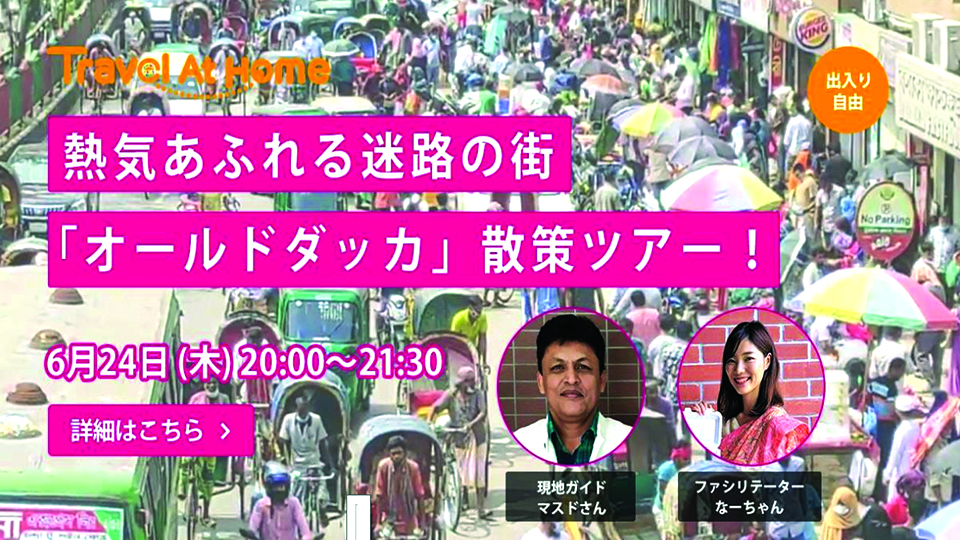
In January, 2021 Masud finished his research work, field visit and made several VIRTUAL TOUR programmes as well as sorted technological tidbit, pricing etc. He then approached their foreign counterparts. Immediately they have responded and uploaded the materials on their sites.
In the last few months, he has done number of VIRTUAL TOURs successfully of which most of the clients were from Japan.
Masud said, normally a tour is to be promoted through online platforms by a designated tour companies/persons mentioning the date, time, subject, tour duration, guide details, method of transmit, processes, mode of payment, etc which is conducted by a local host (overseas) who must have sound knowledge on destinations/tours.
Masud said, "We do not know how long we will have to live with Covid. Hope life will be normal in early/mid of 2022 Insha'Allah. At this moment, we have plenty of time to design the new programme, to study on our own products and tourist supplying destinations, to share possible online trainings/meetings/sites, to maintain the communication with our existing and new counterparts.”
This is the right time to promote our products through VIRTUAL TOUR. Income can be limited but investment is substantial, Maud concluded.
Benefits of virtual tourism
Because viewers can experience activities, locations, and destinations from the comfort of their own homes. There are many clear benefits to virtual tourism. The most obvious of these benefits is that viewers can see and experience a destination without traveling to it, which means they aren't limited by available flights, travel logistics, safety concerns, and whether destinations are open. They do not even have to think about time zones or weather conditions.
The other huge benefit for viewers is cost. Virtual tourism makes destinations accessible to millions of people who may otherwise not be able to afford to travel to them. Viewers are embracing the rise in virtual tourism destinations and the increasing quality and availability of virtual reality technology to see and experience things they never thought possible.
For hotels and destinations, the clear benefit is the ability to stay top-of-mind with potential customers and to highlight a location, amenities, and offerings. Viewers who have experienced a hotel or location through virtual tourism are more likely to book a future stay, and will eagerly anticipate experiencing the activity in the “real world”.