

Top News
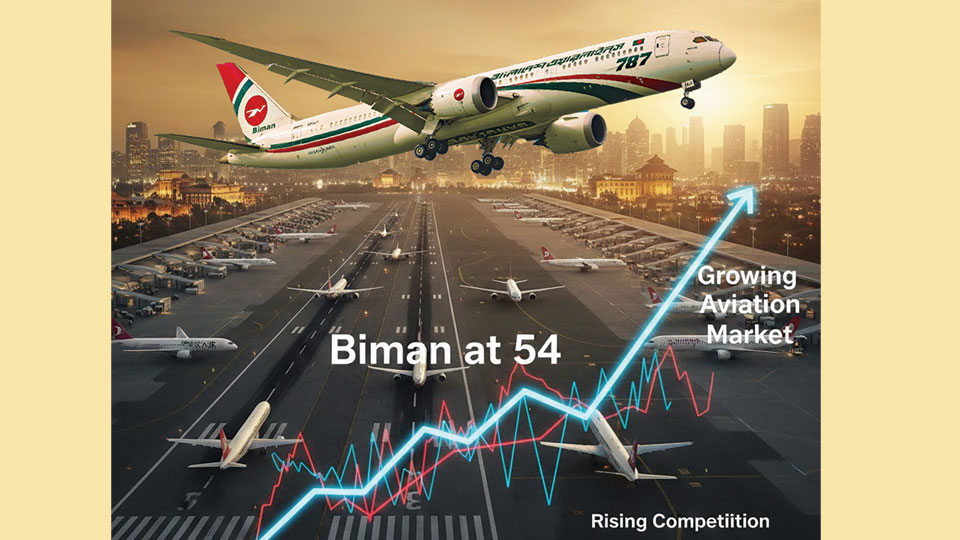
Dhaka : As Bangladesh enters a period of rapid growth in outbound and inbound air travel in the post-covid era, its national carrier, Biman Bangladesh Airlines, stands at a crossroads. Passenger numbers are rising, foreign airlines are expanding, and private local operators - particularly US-Bangla Airlines - are steadily gaining market share. Yet Biman, at 54 years of age, has struggled to fully seize the opportunity.
Data from Civil Aviation Authority of Bangladesh (CAAB) show that Biman's international capacity has stagnated at around 20-22 percent over the last few years, while US-Bangla has expanded its presence and continues to raise its capacity share. Today, US-Bangla is the largest Bangladeshi carrier in terms of fleet size and the second-largest Bangla-deshi carrier in international passenger carriage, representing roughly 13.4 percent of total weekly international passengers from Dhaka.
Together, Biman and US-Bangla now carry about 34.8 percent of all international passengers. The remaining 65 percent is transported by foreign airlines - a dominance that reflects both the strength of Gulf and Southeast Asian carriers as well as the limitations faced by Bangladesh's own airlines.
Aviation experts observed that despite Biman's wider geographical footprint and long legacy, the national carrier has fallen behind in market competitiveness due to strategic and operational weaknesses. One core problem remains the shortage of aircraft.
Bottleneck : Fleet constraints
Biman has not added a single aircraft to its fleet over the past five years. Instead, its fleet has shrunk to 19 aircraft after two leased planes were returned in 2025 at the end of their contracts. Efforts to lease replacements have failed repeatedly - five tender rounds reportedly brought no concrete response from international lessors.
Officials and sector insiders pointed to a structural cause: Biman's inability to make rapid decisions under government procurement rules in a global aviation market where leasing deals are negotiated and concluded within days. At the same time, aircraft availability worldwide remains tight due to supply-chain disruptions and delivery delays.
The impact of this shortage is already visible. Biman has announced suspension of its Manchester flights from April 1, ahead of the Hajj season, while its Narita service was shut down in mid-2025. The airline also said that, although it is reopening Dhaka-Karachi services from January 29, launching new routes will not be possible until additional aircraft enter the fleet.
Legacy airline at 54
Founded on January 4, 1972 - just weeks after independence - Biman began modestly, operating a Douglas DC-3 on routes connecting Dhaka with Chattogram, Jashore, and Sylhet. Over subsequent decades, the national carrier expanded to as many as 29 international destinations worldwide, from New York to Tokyo, enjoying a domestic monopoly until 1996.
Today, at 54, Biman operates 19 aircraft serving 22 international destinations across Asia, Europe, and North America. However, the market reality around it has changed dramatically: the emergence of private local carriers, aggressive expansion by Gulf airlines, and intensifying price competition have transformed the aviation landscape.
Reaction-driven decisions, missed opportunities
Aviation expert Wing Commander (Retd) ATM Nazrul Islam argued that Biman's biggest weakness has been its strategic mindset.
He observed that genuine competition began after the 2000s when private airlines entered both domestic and international markets. Since then, Biman has gradually lost market share.
According to him, Biman's decision-making has been largely reaction-driven rather than proactive. When competitors lower fares or increase frequencies, Biman responds later; it rarely leads market moves. As a result, he said, control of key markets slips to others.
He cited examples in both domestic and international sectors: private airlines introduced higher frequency and lower fares on local routes, forcing Biman to reactively match the model. On some international routes, including Japan and Italy, Biman eventually failed to sustain operations altogether.
What Biman said
Biman spokesperson Boshra Islam rejected the notion that the national airline is falling behind competitors, asserting that the carrier is strengthening capacity and planning future expansion.
As part of its long-term growth plan, she said, potential new destinations such as the Maldives and Australia are under consideration. However, final decisions will depend on the arrival of new aircraft.
She confirmed that Biman currently operates 19 aircraft and has taken the decision to purchase 14 new Boeing aircraft. Deliveries are expected to begin in the next 5-6 years, after which capacity expansion will support new routes and service improvement.
She emphasized that modern fleet, accurate planning, and efficient operations are essential for progress, and that Biman is working in that direction in order to become more competitive in the coming years.
Fleet expansion not enough, strategic reform required
ATM Nazrul Islam stressed that mere addition of aircraft will not solve Biman's fundamental challenges.
He argued that Biman has long been run like a government department rather than a fully commercial airline. Frequent politically influenced appointments to top management have undermined professional, business-driven decision-making. Without a shift in mindset - from bureaucratic control to corporate governance - fleet additions alone cannot transform the airline.
He also pointed to fleet composition. Although the introduction of Boeing 787s and 777s has improved fuel efficiency, deploying only wide-body aircraft across all routes is not always commercially viable. Many routes are "thin" - with seasonal or fluctuating demand - and large aircraft leave seats empty, resulting in revenue loss. Mixed-fleet strategies using medium-sized aircraft such as Airbus A321neo or Boeing 737 MAX are common globally, he noted, and Biman needs to adopt a similar approach.
He further identified failure to establish a functional hub airport as a key missed opportunity. Unlike Singapore, Dubai, or Istanbul, Bangladesh lacks a true transfer hub. Dhaka, Chattogram, Sylhet, or Cox's Bazar have not been turned into effective hubs, even though Cox's Bazar could potentially serve as a regional tourist hub. The weakness of Bangladesh's tourism infrastructure also constrains Biman's growth.
How local airlines compare with foreign carriers
Among foreign airlines serving Bangladesh, Saudi Arabian Airlines currently leads with nearly 13 percent of the market share, powered by strong demand for Jeddah and Riyadh - especially for Umrah and Hajj travel. Emirates follows with over 10.5 percent, operating the highest weekly seat capacity on the Dhaka-Dubai route. Qatar Airways, Turkish Airlines, Gulf Air, Kuwait Airways, and Flydubai also hold strong positions.
Why private airlines move faster
US-Bangla Airlines, the country's largest carrier by fleet size, now operates 25 aircraft, including multiple leased units. Its third Airbus A330-300 joined the fleet in October.
According to US-Bangla spokesperson Kamrul Islam, private airlines have structural advantages. Government procedures involve multiple layers of approval and banking protocols, slowing decision-making for Biman, while private carriers can conclude leasing deals faster. Nevertheless, he noted, the global aircraft shortage is also affecting private airlines.
Meanwhile, demand keeps rising
Despite some fall in domestic air travel due to better road and rail connectivity, passenger traffic through Hazrat Shahjalal International Airport grew by about 7 percent last year. Around 12.5 million passengers - domestic and international combined - used Dhaka airport in 2024, up from 11.7 million in 2023.
International travel demand is being strongly driven by overseas employment. According to the Bureau of Manpower, Employment and Training (BMET), some 4.769 million Bangladeshi workers went abroad for jobs from 2021 to October 2025 alone.
Big question ahead
As Biman crossed five and a half decades, the question is no longer about its symbolic national status - it is about competitiveness. Can the airline transform its governance, diversify its fleet, expand capacity, build a hub and move from reactive to proactive strategy?
The aviation market is growing. Whether Biman grows with it - or watches others take the lead - will be determined by decisions made now, not decades of legacy behind it.