

Chief adviser, US envoy discuss visa restrictions issue

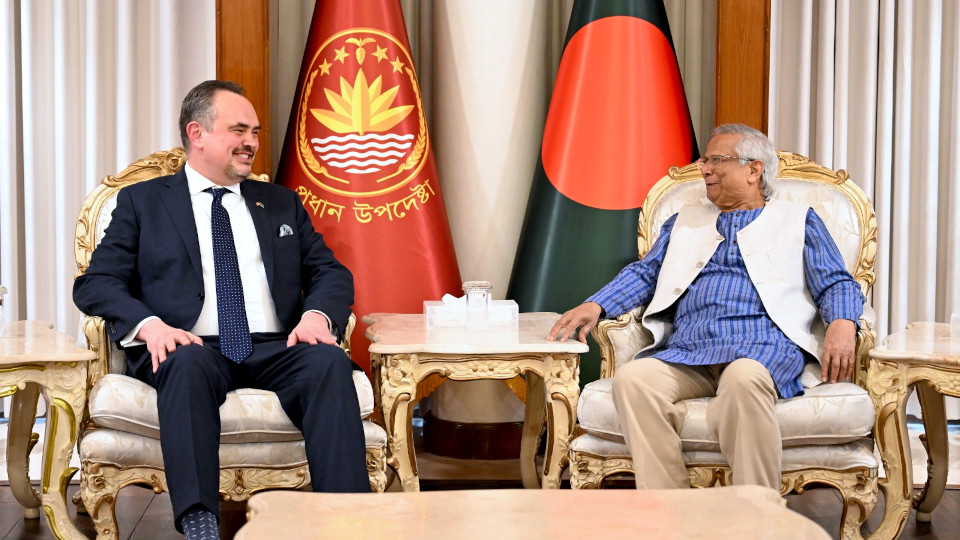
Dhaka: Chief Adviser Professor Muhammad Yunus on Thursday, January 22, discussed recent US visa restrictions, the upcoming February 12 general elections, and key aspects of Bangladesh–US relations during a courtesy call by newly appointed US Ambassador Brent Christensen in Dhaka, read a press release of the press wing of the CA. The meeting was held at the State Guest House Jamuna, where the two sides exchanged views on a broad range of bilateral, regional, and global issues, including the recently imposed US visa restrictions affecting several countries, Bangladesh among them.
During the meeting, the Chief Adviser underscored the importance of continued dialogue and cooperation between Dhaka and Washington on immigration and mobility-related issues, expressing hope that engagements at various levels would help address concerns arising from the visa measures.
Professor Yunus also briefed the US envoy on preparations for the February 12 general elections, stating that the polls would be free, fair, and transparent and would set a benchmark for future elections in Bangladesh. He said the Interim Government was fully prepared to ensure a credible electoral process, noting that the European Union would deploy a large number of election observers and expressing hope that other development partners would follow suit.
“It will be a festive election. It will set the standard for good elections in the future,” the Chief Adviser said.
The meeting also covered sweeping labor law reforms approved by the interim government, the planned Bangladesh–US tariff agreement, and ongoing cooperation on trade and investment. Professor Yunus thanked US President Donald Trump for reducing tariffs on Bangladeshi exports and voiced optimism that current trade negotiations would lead to further tariff relief.
Ambassador Christensen welcomed the progress in bilateral trade talks, highlighting expanded agricultural trade as a key pillar of Dhaka–Washington economic engagement. He also praised the interim government’s reform initiatives and commended Professor Yunus’s leadership over the past 18 months.
The US envoy said he was looking forward to working with whichever government emerges from the February elections and reaffirmed US support for Bangladesh’s democratic transition.
Both sides also discussed the Rohingya crisis, with Professor Yunus expressing appreciation for continued US humanitarian assistance to more than one million Rohingya refugees sheltered in Bangladesh. He stressed the need for sustained international support until a durable solution is found.
On foreign policy priorities, the Chief Adviser highlighted Bangladesh’s strategic position between South and Southeast Asia, noting Dhaka’s plans to seek ASEAN membership and its application for a Sectoral Dialogue Partnership with the bloc. He also reiterated his efforts to revive the South Asian Association for Regional Cooperation (SAARC) as a platform for regional economic and people-to-people cooperation.
National Security Adviser Dr. Khalilur Rahman and SDG Coordinator Lamiya Morshed were present at the meeting.
T