

Top News
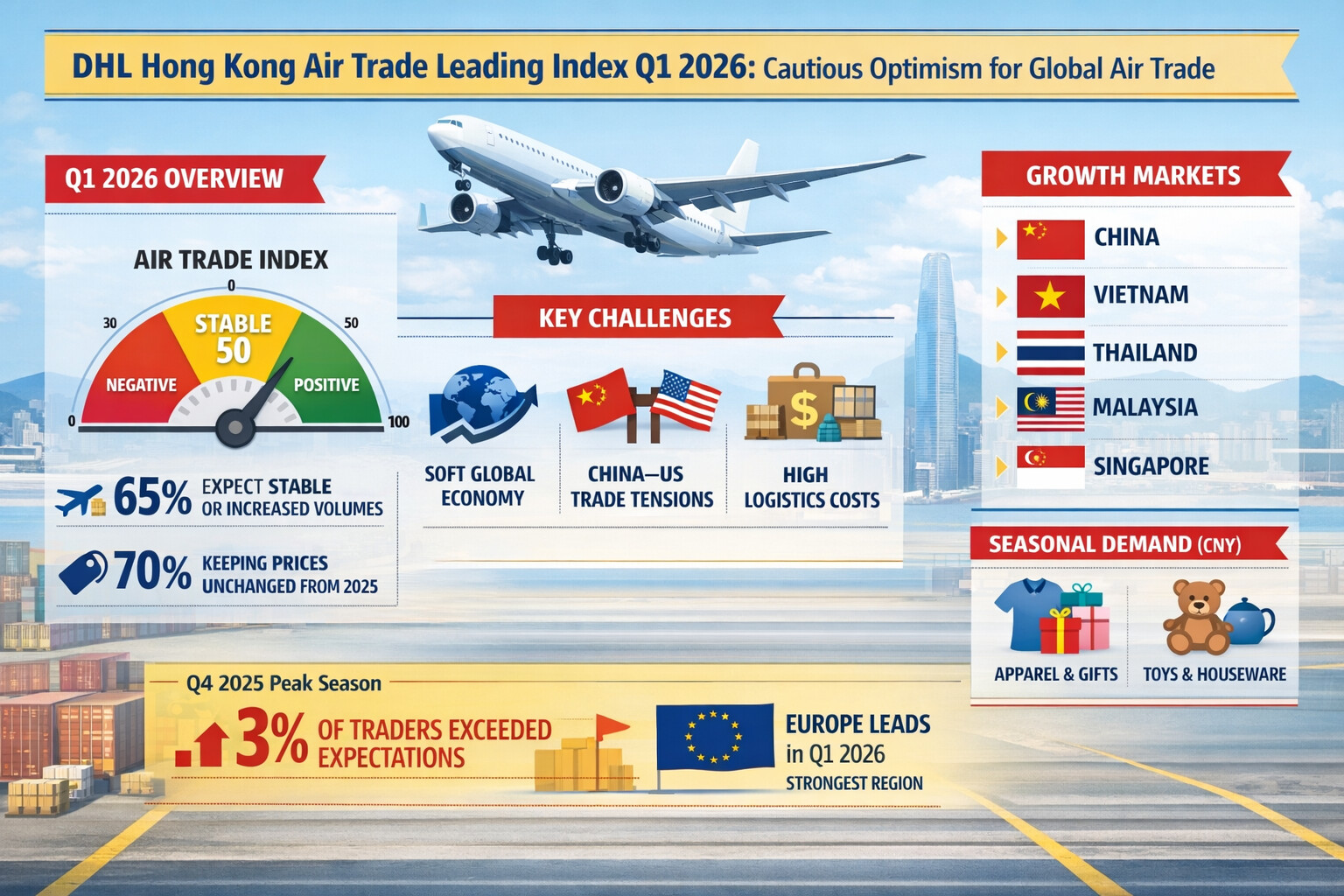
Dhaka: DHL’s Hong Kong Air Trade Leading Index (DTI) for the first quarter of 2026 paints a picture of stability in global air cargo activity, marked by cautious confidence among traders navigating a challenging economic landscape.
According to the latest findings, the overall air trade index held steady in Q1 2026, reflecting resilience in the sector and consistency with recent quarters. Despite ongoing geopolitical and economic uncertainties, air traders continue to demonstrate confidence in maintaining business momentum.
Survey results indicate that optimism remains guarded. Nearly two-thirds of respondents expect shipment volumes to either remain unchanged or grow in the coming months, signaling sustained demand across key air trade routes. However, performance during the traditional peak season in the final quarter of 2025 was largely in line with expectations rather than exceptional. While more than half of traders met their forecasts, only a small fraction reported exceeding them, underscoring the operational complexities faced by the industry.
Looking ahead to 2026, air traders identified a soft global economy and weak consumer demand as their primary concerns. These challenges are further intensified by ongoing China–US trade tensions and elevated logistics costs, which continue to pressure margins.
In terms of growth prospects, the Chinese Mainland remains the most favored market, while Southeast Asian economies—including Vietnam, Thailand, Malaysia, and Singapore—are emerging as attractive secondary destinations for expansion. Pricing strategies are expected to remain largely stable, with over 70 percent of traders planning to keep rates unchanged from 2025. Meanwhile, close to one-fifth anticipate moderate price increases, most commonly in the range of 3 to 6 percent.
Seasonal factors are also expected to influence air cargo demand in the near term. With the Chinese New Year approaching, traders anticipate increased shipments of apparel, gifts, toys, and household goods. Regionally, Europe recorded the strongest index performance in Q1 2026, continuing to outperform other markets, while the Asia-Pacific region faced comparatively tougher conditions.
T