

Top News

A major blaze turned the cargo village of the capital’s Hazrat Shahjalal Int’l Airport into ashes on October 18
Dhaka : When the government announced that an international expert team from Turkey - soon to be joined by specialists from the UK, Australia, and China - would help probe the massive fire that tore through Hazrat Shahjalal International Airport's (HSIA) cargo village on October 18, the move was billed as a step toward transparency.
However, aviation and logistics insiders warn that the truth may never emerge because the investigation's main sources of information are the very agencies accused of negligence and misrepresentation: the Civil Aviation Authority of Bangladesh (CAAB), Biman Bangladesh Airlines, and Customs officials.
"The international team will depend on data, access, and explanations from CAAB and Biman. However, these are the same agencies whose statements about the fire contradict what actually happened on the ground," said a senior logistics operator familiar with the incident, speaking on condition of anonymity. "If the foundation is false, no foreign investigation will uncover the truth."
Contradictions at the heart of the fire
At a press briefing two days after the inferno, CAAB Chairman Air Vice Marshal Md Mostafa Mahmood Siddiq declared that "no fire-fighting vehicle was obstructed from entering" the site. He insisted the airport's own fire unit reached within 30 seconds and that over 40 vehicles were deployed.
Yet multiple eyewitnesses and members of the airport's firefighting units tell a different story. Fire engines faced delays entering the compound as access routes were blocked by parked cargo trucks and unregulated courier offices. Hydrants were missing or inoperable; firefighting teams struggled to find usable water sources in the first critical minutes.
The Fire Service's preliminary assessment later confirmed the cargo area lacked "proper fire detection and protection systems." Investigators found no operational sprinklers, and only two functional hydrant points across the entire airport - none within the cargo village itself.
This directly contradicts CAAB's claims that firefighting capabilities met International Civil Aviation Organization (ICAO) standards.
At a press briefing after the incident, Lt Col Mohammad Tajul Islam Chowdhury, Director (Operations and Maintenance), Fire Service and Civil Defence, said, the incident would not have turned out so big, if proper systems were installed at the site.
Warnings ignored, rules violated
The blaze- believed to have started at the Import Courier Section exposed deep-rooted governance failures and safety negligence stretching back more than a decade.
Records show that in 2011, Biman Bangladesh Airlines formally warned CAAB that the cargo village lacked a permanent fire extinguishing system and posed a serious risk of disaster. A CAAB survey committee even recommended installing at least 15 hydrants for the import section and nine for the export area.
None of those recommendations were ever implemented.
Instead, the cargo village evolved into a maze of unapproved tin sheds, sub-leased offices, and overlapping authorities. A private organization - the International Air Express Association of Bangladesh (IAEAB) - leased space from CAAB and illegally sub-leased it to more than 60 courier companies, issuing security passes to their staff without CAAB's authorization.
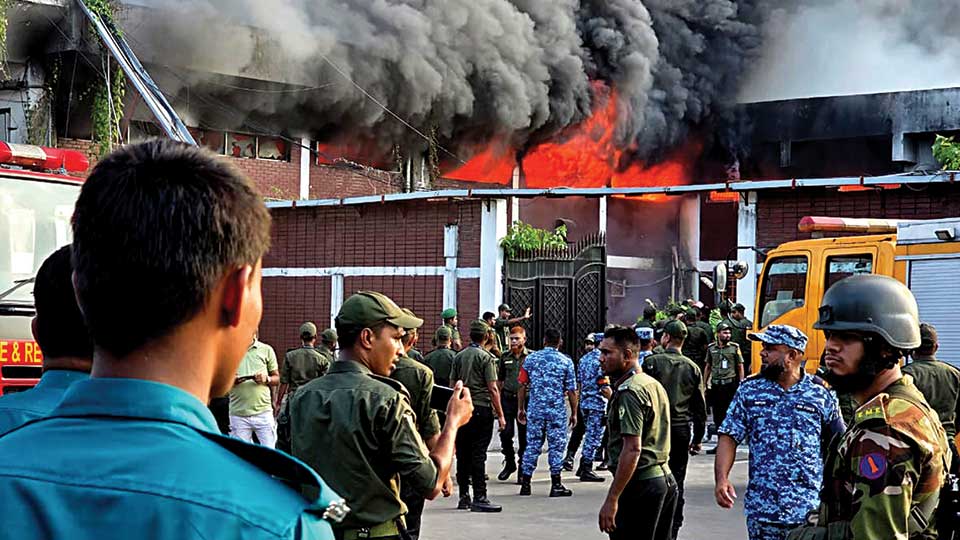
Fire tearing through the cargo village of Dhaka Airport on October 18
According to inquiry findings, IAEAB stopped paying lease fees between 2019 and 2023, accruing government dues of BDT 9.33 crore, while continuing to collect double rent from courier companies. Despite this, CAAB renewed IAEAB's lease in 2023 - even allowing operations from an unapproved, flammable tin shed that ultimately became the center of the blaze.
"The cargo village was a ticking time bomb - a mix of outdated infrastructure, poor oversight, and political indulgence," said an aviation safety expert who reviewed the committee's report.
Ignored memos, dead fire trucks
Internal CAAB documents show that the authority's engineering and procurement units sent 19 separate letters between April 2024 and July 2025 urging urgent repair and maintenance of firefighting vehicles at eight airports, including HSIA.
None were acted upon.
As of July, 19 rescue and firefighting vehicles across the country were out of service or malfunctioning. HSIA itself had four such vehicles - one Protector, one Rosenbauer, and two Morita models - several of which were long overdue for maintenance.
Experts warn that the neglect could lead to "catastrophic operational failure" and even downgrading of airport safety categories under ICAO inspection.
A pattern of denial
This was not the first fire at Dhaka airport's cargo village. In 2013, a blaze started in the very same import courier area. It was traced back to an IAEAB sub-lease, and yet no one was held accountable.
Even after that, CAAB and Biman continued their overlapping lease arrangements without clear operational control or safety audits.
"Every time something goes wrong, they form a committee, wait out the public anger, and move on without fixing the structure," said another logistics provider requesting anonymity. "It's a cycle of denial."
Economic, insurance fallout
The October 18 fire gutted thousands of tons of import and export goods, including pharmaceuticals, electronics, and readymade garment samples destined for Europe and the US.
Business associations estimate total losses at BDT 12,000 crore. Yet the cargo village itself was insured for only BDT 20 lakh. Many exporters had no insurance for stored goods, relying on airport assurances of "secure handling."
The Dhaka Chamber of Commerce and Industry and the American Chamber of Commerce in Bangladesh (AmCham) called the incident a blow to the country's trade credibility.
AmCham President Syed Ershad Ahmed said the tragedy was "a consequence of decades of neglect and lack of automation," urging the government to modernize the cargo management system and allow multiple private operators instead of a single monopoly.
"Sensitive goods like pharmaceuticals and electronics require special warehouses and segregation," the AmCham President said. "None of that exists. The management is manual, unsafe, and outdated."
The foreign probe's uphill task
The government's formation of a local five-member committee - along with the arrival of Turkish, British, and Australian experts - was meant to project seriousness. However, experts question how much freedom the foreign investigators will have to dig.
The cargo site has already been cleared and partly reconstructed, raising fears that physical evidence has been lost. All operational records, access logs, and CCTV footage are under CAAB's control.
"If investigators rely solely on official versions, they'll reproduce the same cover-ups," said a freight forwarding agent requesting anonymity. "True accountability demands forensic independence, not bureaucratic hospitality."
Unless investigators demand direct access to the data - and unless whistle-blowers within the airport system are protected - the probe may end up as another bureaucratic ritual with no consequence.
A crisis of accountability
The HSIA fire has once again laid bare how Bangladesh's critical infrastructure is managed - with blurred responsibility, outdated equipment, and disregard for safety norms.
CAAB owns the facilities. Biman operates handling. Customs supervises clearance. Yet when disaster struck, none took responsibility.
Even as flames engulfed high-value goods, passengers were stranded, 15 flights were rerouted, and cargo operations remained suspended for over a day. It was only through coordinated efforts of the Army, Navy, Air Force, and 37 Fire Service units that a major catastrophe was averted - though luck, not preparedness, may have been the saving grace.
The way forward
Aviation and logistics experts say Bangladesh must overhaul its airport safety framework - not through committees but through systemic reforms:
- Make fire-safety audits man- datory under ICAO supervision.
- Digitize all lease and cargo documentation.
- End unauthorized sub-leasing and centralize management under a single accountable operator.
- Require full insurance coverage for all key installations and stored goods.
- Replace or repair dysfunctional fire vehicles and modernize hydrant networks.
Otherwise, they warn, the next blaze may not spare lives.
"Every report since 2011 said the same thing: fix the fire systems, end the lease chaos, and modernize management," said a Biman official requesting anonymity. "If nothing changes, we'll just be counting down to the next fire."
For now, amid promises of international cooperation and high-level inquiries, one truth remains unextinguished: the system itself is still burning.