

Top News
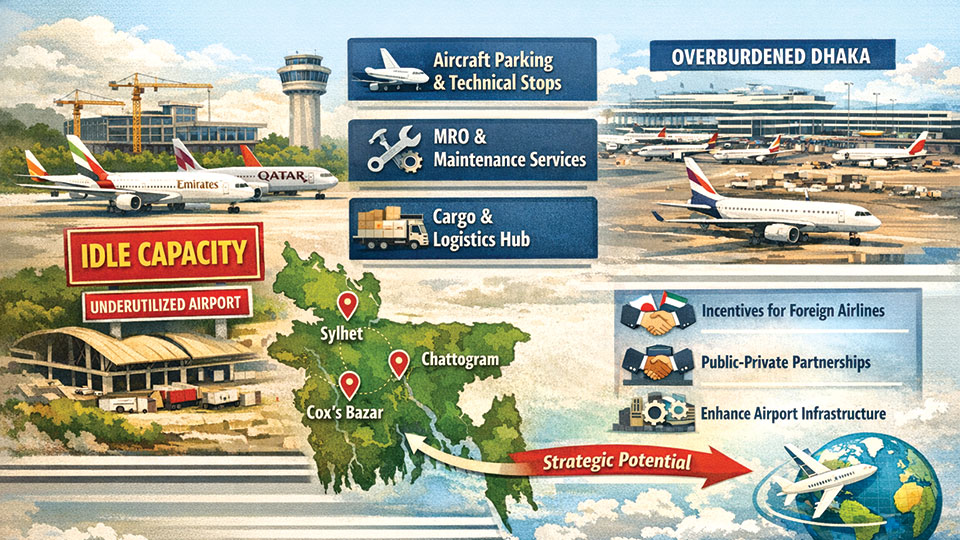
Dhaka: The ongoing disruptions in air operations across key Middle Eastern destinations have triggered an unusual but telling global response. Leading carriers such as Emirates and Qatar Airways have begun relocating their idle aircraft to safer and more stable zones - including airports in Sri Lanka, Spain, and elsewhere. This adaptive strategy highlights a growing niche in global aviation: long-term aircraft parking, technical landings, and auxiliary aviation services.
One airport that has unexpectedly benefited from this situation is Mattala Rajapaksa International Airport (MRIA) in Sri Lanka. Once ridiculed as "the world's emptiest international airport," MRIA is now finding renewed relevance as a parking and contingency hub. Its history is well known: inaugurated in 2013 under President Mahinda Rajapaksa, the airport struggled from inception due to poor demand forecasting and lack of airline interest. Within a few years, most airlines withdrew operations, leaving behind a massive but underutilized infrastructure - widely labeled a "white elephant."
Yet, in a twist of fate, MRIA's very emptiness has become its strength. With vast unused apron space, minimal congestion, and adequate runway capacity, it has emerged as a convenient refuge for grounded aircraft during times of crisis. What was once a liability is now being partially repurposed into an asset.
This evolving scenario offers a critical lesson for Bangladesh.
Despite having at least three international airports outside Dhaka - Cox's Bazar, Sylhet, and Chattogram - the country has yet to position itself strategically to capture such emerging opportunities. The newly developed Cox's Bazar International Airport, built at a cost of nearly BDT 7,000 crore, is a case in point.
Although its runway and core infrastructure are nearly complete, the airport remains largely non-operational due to the absence of a sustainable passenger and cargo base. Airlines, both domestic and international, have shown no interest at all in launching regular services at this moment. No initiative is now being found by its implementing agency Civil Aviation Authority of Bangladesh (CAAB) to make it fully functional, as much work, including the Terminal building, still needs to be done.
However, this does not mean the airport lacks potential.
With targeted policy support and operational readiness, Cox's Bazar could be repositioned as a multi-functional aviation hub. At a time when global airlines are actively seeking safe, cost-effective locations for aircraft parking and technical stops, Bangladesh could offer its underutilized airports as viable alternatives. Strategic geographic positioning, competitive pricing, and streamlined ground handling services could make Cox's Bazar attractive for transit operations, refueling stops, and even maintenance services.
Similarly, Sylhet and Chattogram airports remain significantly underutilized, primarily due to infrastructural gaps and limited international connectivity. These airports require focused investments in cargo handling, maintenance facilities, and passenger services to meet global standards. Without such upgrades, they will continue to operate below capacity, missing out on both commercial and strategic opportunities.
Meanwhile, Hazrat Shahjalal International Airport in Dhaka is operating under increasing pressure. Passenger and cargo volumes continue to surge, pushing the airport toward saturation. The much-anticipated third terminal, initially expected to ease congestion from early 2024, is still not fully operational and faces ongoing delays. This imbalance - overburdened Dhaka versus underutilized regional airports - reflects a broader lack of integrated aviation planning.
The current global aviation environment, shaped by geopolitical uncertainties and operational disruptions, presents Bangladesh with a rare window of opportunity. By adopting a forward-looking strategy, the country can diversify the use of its airport infrastructure beyond traditional passenger services.
Key policy actions could include:
- Introducing incentives for foreign airlines to use regional airports for parking and technical operations
- Developing MRO (Mainte-nance, Repair, and Overhaul) facilities to attract long-term aviation business
- Enhancing cargo infrastructure to position regional airports as logistics hubs
n Establishing public-private partnerships to improve operational efficiency and service quality
The experience of MRIA demonstrates that even underperforming infrastructure can be repositioned with the right strategy and timing. Bangladesh must act swiftly to avoid repeating the same mistakes - investing heavily in infrastructure without aligning it with market realities.
In aviation, as in all sectors, timing and adaptability are everything. The question is not whether Bangladesh has the infrastructure - but whether it has the vision to use it effectively.