

New Year begins: how air travel expected to reshape with industry trends in 2026

Dhaka: After a turbulent 2025, the global airline industry is expecting a smoother sail in 2026. However, whether this expectation would come true is still uncertain due to rapid shifts in geopolitics and an ever-rising cost of living. Despite these hurdles, 2026 would bring a series of significant changes for travelers, including widely available premium experiences in the air, improved airport experiences, and airline reforms that would drastically reshape the industry.
Here, we discuss the trends set to shape air travel in 2026.
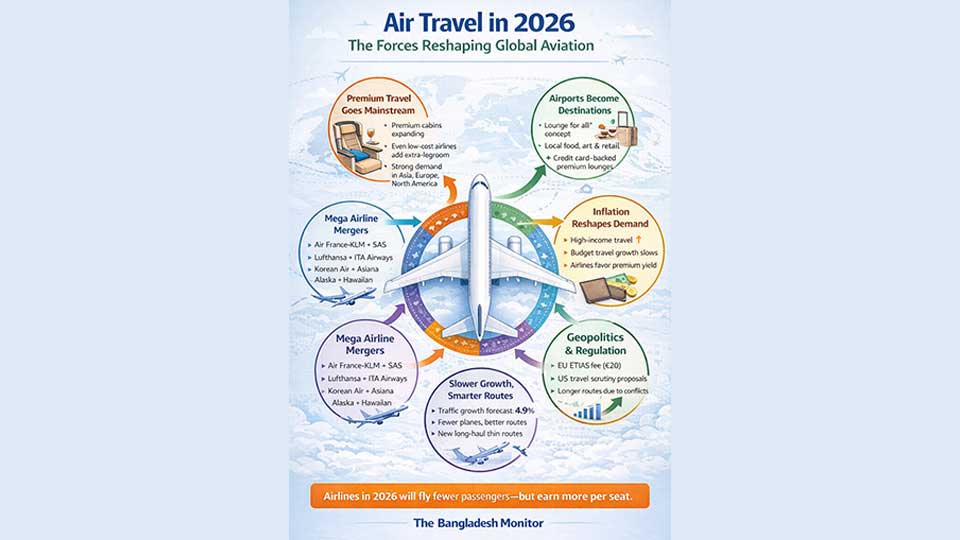
Airlines Widely Availing Premium Products
Major airlines have opted to widely offer their respective premium products in 2026. These investments are expected to attract customers willing to spend more or redeem points for luxury.
One notable example is aviation giant American Airlines, which introduced its long-awaited new Flagship business and premium economy seats on Boeing 787 aircraft and the Airbus A321XLR last year. But, by the end of this year, the premium Flagship products will be available on at least a dozen aircraft, including its largest aircraft, the Boeing 777-300ER.
In addition to major airlines, even renowned budget carriers are opting for premium class products from this year. Southwest Airlines, the largest low-cost carrier by revenue in the world, will start selling extra-legroom seats in January.
Data from the International Air Transport Association’s December outlook also aligns with this move by airlines. The global airline trade group predicts “robust demand” for premium travel in Asia, Europe, and North America. Premium travel demand has been on a consistent rise since the pandemic.
Airport Upgrades Bringing Satisfaction
The airport experience has always been a major element of the overall air travel experience. Airlines are betting heavily on this and competing with each other to establish the best airport lounge facilities for their respective brands. Credit card companies are also investing in this area to attract new customers.
Modern airports are focusing more on local food and retail, artistic terminals, and diverse seating options instead of legacy concourses with out-of-trend chain shops and rows of typical seats. Global architecture firm Gensler titled this trend the “lounge for all.”
Airline Mergers and Acquisitions Redefining Travel Experience
Multiple major airlines and airline groups, including Lufthansa Group, Air France-KLM, Korean Air, and Alaska Airlines, are planning to complete major mergers and acquisitions in 2026. These will result in the opening of new routes, combined loyalty programs, and travel options that passengers would enjoy in the coming years.
Air France-KLM’s acquisition of majority control of SAS Scandinavian Airlines would allow a combination of the Air France-KLM Flying Blue and SAS EuroBonus loyalty programs, along with SAS entering a transatlantic partnership with Air France-KLM partner Delta Air Lines.
Another European airline group, Lufthansa Group, is proceeding with its plans to merge with Italian carrier ITA Airways. Similar to the Air France-KLM and SAS integration, this would initiate a new combined loyalty program and transatlantic partnerships for ITA Airways.
Apart from these, Korean flag carrier Korean Air would complete its merger with former domestic competitor Asiana Airlines by the end of this year, while Washington-based Alaska Airlines plans to complete its merger with Hawaiian Airlines by April.
Geopolitics Threatening Overall Scenario
Geopolitical developments can largely affect the global aviation industry in 2026. The European Union’s newly introduced ETIAS program is one such notable example. The program will require travelers who do not need a visa to pay a fee of EUR 20, equivalent to around USD 23. In the US, the Trump administration is asking to require travelers from visa-waiver countries to provide five years of social media history and 10 years of email addresses.
Apart from these restrictions, ongoing conflicts in Ukraine and years-long instability in the Middle East would continue to impact international air travel in 2026. These situations have required airlines flying between Europe and Asia to operate alternate flight paths, adding hours, increasing fuel consumption, and eventually raising overall fares.
Inflation Affecting Travel Budgets
Recently published data from Bank of America reports that expenditures have increased by 2.6% among higher-income travelers, while they increased by just 0.6% among lower-income groups. The bank attributed low wage growth and broader economic uncertainty as key elements behind the slower growth among the latter group.
This report clarifies why airlines are currently prioritizing premium travel options over economy products and what motivates this preference.
Airline Growth Slowing Down
All these trends indicate that airlines are aiming for very modest growth in 2026. Moreover, IATA’s forecast, which expects passenger traffic to rise by 4.9% in 2026—lower than the previous year’s forecast of 5.2%—also supports expectations of slower expansion.
However, even during this moderate expansion period, airlines are continuing to launch new and interesting routes. Alaska Airlines is set to make its European debut with the launch of direct services from Seattle to Rome in April, followed by Reykjavik and London in May. United Airlines is also launching flights to new destinations in Mongolia, Greenland, Spain, and Croatia.
In Europe, Greek flag carrier Aegean Airlines is expanding its network to India with the launch of new nonstop Airbus A321XLR flights from Athens to Mumbai and New Delhi. Spanish flag carrier Iberia is also launching nonstop A321XLR flights to Brazil, Canada, and the United States from Madrid.
- V