The Bangladesh Monitor holds seminar on 'Travel and Tech : Emergence of OTAs in BD'


The Bangladesh Monitor holds seminar on 'Travel and Tech : Emergence of OTAs in BD'
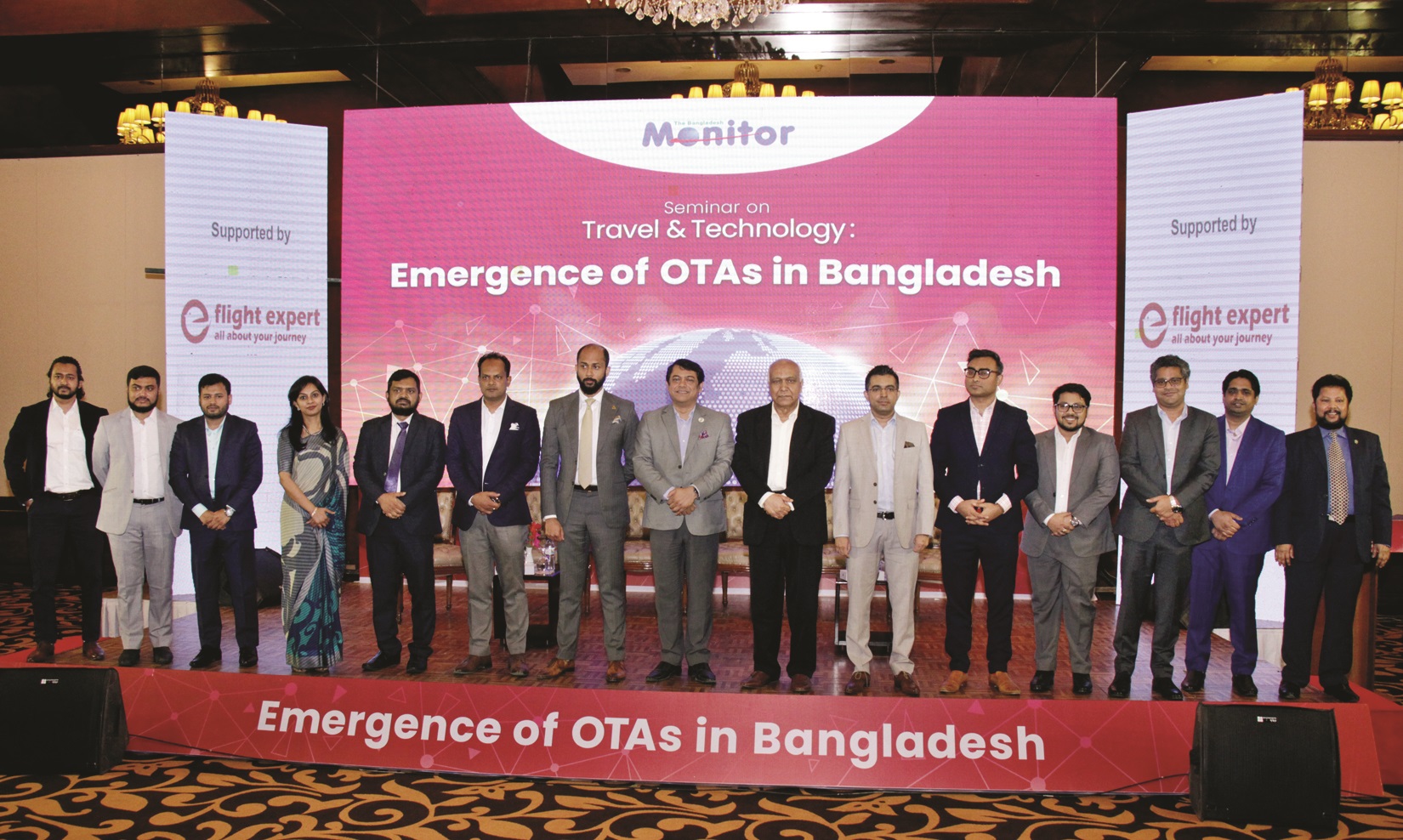
Dhaka : Fueled by the increase of people's disposable income and travelling spree, more knack for adventure and higher drive to excel academically as well as professionally, travelling in and out of Bangladesh has become a new trend among middle and upper-class people in the country.
But in 2020 came the pandemic and left the travel industry to a standstill. A year later, the industry had been somewhat resurrected, and it is on the way to change for the better as it seems the pandemic came more as a blessing than a curse for the Online Travel Agencies of Bangladesh.
With the resurrection of the industry, the shift to online became more apparent as people avoided physical visits to the agent's office, stations and so on. Slowly, the ease of online booking was paying off and the appeal of e-commerce in travel is continuing to grow.
Kazi Wahidul Alam, Editor of The Bangladesh Monitor said this while presenting his key-note paper at a seminar organised by the premier travel trade publication on March 9 at Pan Pacific Sonargaon Hotel in the capital.
Unlike most countries, the travel industry in Bangladesh has always been offline. Traditionally, you have to rely on a travel agent to book your tickets and you always had to call hotels numerous times to find a relevant match. Even though the overall industry was growing, the use of technology in the local travel industry was not growing as fast as it should have.
Around 2017, Online Travel Agencies or OTAs, started coming up in the country. The shift in the industry was only starting to gather momentum as people were slowly, but enthusiastically starting to move to online from offline.
Over the past few years, we have seen a handful of OTAs launching their operations in Dhaka. The total number of OTAs, of all sizes, in 2019 were somewhere over 50 in the country. According to industry experts, OTAs back then occupied about 5 per cent of the total travel market in Bangladesh, Wahidul Alam mentioned in his keynote address.
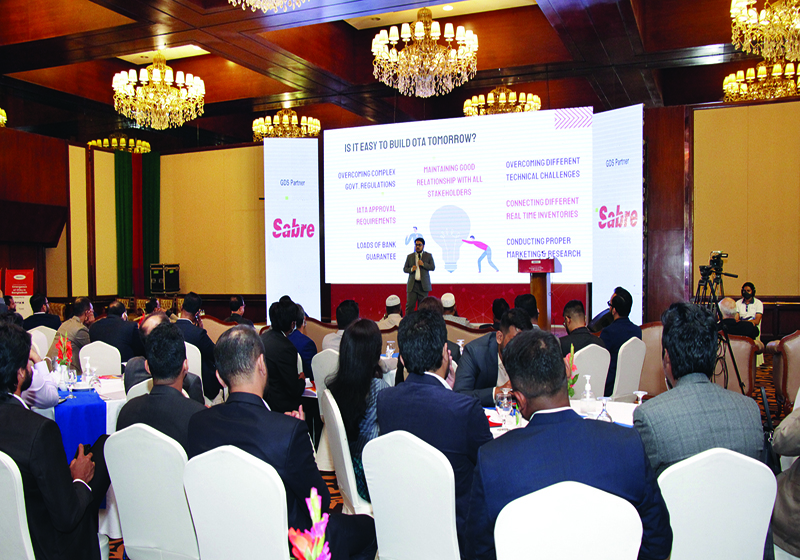 A brief presentation on OTAs by an industry expert at the seminar - Photo: Monitor
According to a prediction made in 2019, OTAs market share is supposed to be over 45 per cent by 2025. Today, OTAs are not only providing ticket booking services but also hotel booking, visa processing and other relevant services.
Even though, the travel agency business has been around for a long time, digitisation of the travel trade is relatively a recent phenomenon.
With a gross market value of USD 1,820 million in 2019, the air market of Bangladesh had an average daily ticket booking of 31,240 and 8 per cent of it was occupied by OTAs. The hospitality industry of the country, on the other hand, in 2019, had a gross market value of USD 425 million with 16.4 million total number of rooms yearly booked. Average daily room bookings was 33.3 thousand while 13,000 of which was done online, allowing OTAs to control 30-35 per cent of the total inventory.
And the international hospitality market for outbound Bangladeshi travellers stood at a market size of USD 152 million in 2019 with a 4.3 million total number of room bookings yearly, and 12 thousand of average room number bookings daily. 1.1 thousand of which was carried out online, making OTAs to cover 55 per cent of the online bookings.
Wahidul Alam opined that with a population of 164.5 million, 58 per cent internet penetration, USD 2 billion worth e-commerce market, 1.90 million bank transfers a month, 685,000 daily card transactions, 40,000 online orders per day, USD 97.4 million digital payment a year, and 9.5 million of transactions per day through mobile financial services with a total transaction amount of USD 173.5 million per day, OTAs are expected to flourish exponentially in the coming years.
"Internet penetration, digital payment, and overall awareness on e-commerce are broadly the handful conditions for an OTA business to succeed. And if we look at the numbers, we will see, Bangladesh is witnessing the rise of these trends for quite some years," Wahidul Alam said, adding, "combining them with OTA, the future only holds exponential growth for the OTA business."
Salman Bin Rashid Sayeem, CEO of Flight Expert, at the seminar, gave a presentation on OTAs history, operations and prospects where he said, "By 2025, the travel market in Bangladesh is expected to grow to USD 7 billion and OTAs will contribute to 1 per cent of the GDP."
Sadia Haque, Co-Founder of ShareTrip, also agreed with the notion that the future of travel in Bangladesh is digitisation, in the first panel discussion also attended by Saiful Haque, Country General Manager and CEO of Sabre Travel Network Bangladesh, Ahmed Reza, Country Manager Bangladesh, Cathay Pacific, Arifur Rahman, Citi Bank Head of Cards and Daraz Mahmud, Area Manager, Travelport Bangladesh.
"Globally, OTAs are capturing the market by bringing convenience and comfort to the end users. Even though OTAs just emerged in Bangladesh, they have already started showing significant and dynamic shifts in service patterns with value addition and improvisions," Sadia said while she referred to ShareTrip's initiative of providing Covid-19 updates related to aviation and tourism globally including health protocols, safety and travel measures etc, to make the experience better for the end user.
To shed light on how airlines are seeing the emergence of OTAs in the country, Ahmed Reza, said, "Even though the business in aviation has gone down during the pandemic, the growth of OTAs have significantly risen. 50 airlines have registered in NDC of IATA. This will create a bridge between the airlines and OTAs to increase their online sales."
Travel is an expensive and high-end market which involves plenty of money. For an OTA to succeed, they have to build trust and security in the market, not individually but industry-wide. People in the recent years started trusting OTAs for managing their travel and banks for handling e-commerce transactions.
In this regard, Arifur Rahman, Head of Cards and Director of Sales and Marketing of City Bank said banks are now pairing up with OTAs in various campaigns and promotions to give better solutions and deals to the customers. The banks are helping OTAs in Digital Payment with internet banking and cards, subsequently supporting them to build trust in the market, Arifur added.
Daraz Mahmud, Area Manager, Travelport Bangladesh, highlighted the revolutionary benefits the country is embracing due to the emergence of OTAs. People can now long into 4-5 portals at once due to OTAs and compare prices. Whereas, in the earlier days of brick-and-mortar agencies, the process used to take several days and considerable amount of labour.
It may be mentioned here that majority of the OTA platforms now are fully built and developed by local tech talents, indicating that our money is being spent on the development of our talent pool, keeping the money inside the country, which will not be the case if foreign outsourced products are used. Capitalising on the local tech talents is a key matrix for the OTAs.
And since the pandemic turned out to be a blessing in disguise for e-commerce, Saiful Haque, Country General Manager and CEO of Sabre Travel Network Bangladesh urged OTAs to grab the limelight as travellers now prefer contactless payment methods and digitised solutions.
The first session of the seminar had two special guests Mansur Ahmed Kalam, President of ATAB and Shahadat Hossain, President of HAAB. Both association representatives expressed how such total solution travel platforms were a need of time but urged all to maintain discipline. Since there had been instances where ill-intended businessmen tried to abuse the system for personal agendas, the government must continue strict monitoring and prioritise policy support for OTAs to ensure fair competition in the market and growth in the industry.
Major General Ibne Fazal Shayekhuzzaman, Director, Biman Bangladesh Airlines and Chairman, Sabre Travel Network (Bangladesh) Ltd in his speech as the chief guest addressed how secure internet currently is as information security and bank transaction security was a concern initially. He mentioned the country also is getting into IPv6 that will help monitor hacking activities.
"Sabre Travel Network Bangladesh works with new and innovative ideas and technology-based products to help OTAs and contribute to the industry," he added
This was followed by handing over crests to the special guests by the Editor of The Bangladesh Monitor which concluded the first session of the seminar.
Tina Jabeen, MD and CEO of Startup Bangladesh Ltd, began the second session with another keynote address where she stated how the clients and the business community of the tourism sector are starving for online services, making it the right time for OTAs to emerge. The pandemic has pushed us towards e-commerce, thus OTAs have been growing ever since with a promising future.
To further strengthen OTAs and such e-commerce operations, Tina said, availability of affordable bandwidth, tools and digital devices are a must. "The government must come up with policy support to make the nation digitally enabled. It cannot flourish without developing digital literacy among people," stressed Tina.
Branding Bangladesh through tourism, technology, and manpower in the global arena is another vital to-do, urged Tina. She praised Anchorless Bangladesh for their initiative, which invests in tech startups of the country including OTAs.
The seminar went on with another panel discussion among Rahat Ahmed, CEO of Anchorless Bangladesh, Faisal M Fateh Ul-Islam, Head of Ecommerce and M commerce, EBL, Shafiqul Islam, GM, Amadeus GTD Bangla Private Ltd, Yami M Saleh, MD of Tryotel Travels and MD of Saimon Group, and Mohamed Alhammadi, Country Manager of Emirates Bangladesh.
Rahat Ahmed emphasised how travel contributes greatly to the economy as it has a long supply chain. And OTAs bring all kinds of travel services from providers to the end consumers. To further bolster the trade and facilitate the industry as a whole, Rahat stressed on prioritising domestic tourism for the middle-class income group.
Also, after tying up with OTAs for promotions, banks have been receiving massive response from the customers, said Faisal M Fateh from EBL. About 20 million customers are actively looking for deals a month, he added. This proves how OTAs can get to a wider audience and banks are always on alert to support such value addition works.
Shafiqul Islam, GM, Amadeus Bangladesh, pinpointed how OTAs are creating a new segment in Bangladesh travel market. This has resulted in a higher number of consumers as well as demand among local agents for API.
Even though, there lie a few challenges for the OTAs in the country, but Yami M Saleh, MD of Tryotel Travels assured that the challenges are narrowing down while the scopes are broadening. "OTAs need to focus more on contents. There remain some hotels and tour operators which are not yet present online. OTAs have to bring them in their system as well, in order to provide complete solutions to the consumers," Yami noted.
The second panel discussion was concluded with Mohamed Alhammadi, Country Manager of Emirates Bangladesh. "Emirates is offering NDC enabled direct connect platform for travel agents. In order to facilitate drive in the economy, our partners play a huge role in delivering what we have to offer to the passengers. Thus, Emirates is always in effort to offer its benefits directly to the end users by collaborating with trade partners including OTAs."
The second session also saw Syed Almas Kabir, President of BASIS attending the seminar as a special guest. In his speech, Almas Kabir stressed, with unique selling points, travel agencies must excel in the digital era which has already began. "For instance, you can integrate augmented reality and virtual reality experiences to showcase destinations in your portals. This will excite the customers and make their e-commerce experience even better. Smart baggage tag to track luggage can be another unique service you can bring to add more value to your services," Almas Kabir noted...
He also urged the government to come forward and make some necessary policy changes, especially for online air ticket transaction. Banks also should make the payment methods smoother, quick and hassle-free. BASIS is ready to help OTAs in this regard, said Almas as he extended his helping hand.
Calling on BIDA, Rizwan Rahman, Chairman of DCCI, urged them to promote local investors as 85 per cent of the country's economy is home-grown. NBR also has a role here, he said. They must promote tourism industry as a whole. "For it, we must show them the avenues of income they could get by facilitating the industry."
Lastly, for better attention to the tourism industry that has always been under the shadow of civil aviation, Rizwan proposed a bold move yet a promising one - to have two separate secretariates for civil aviation and tourism, instead of one.
Fueled by the increase of people's disposable income and travelling spree, more knack for adventure and higher drive to excel academically as well as professionally, travelling in and out of Bangladesh has become a new trend among middle and upper-class people in the country.
But in 2020 came the pandemic and left the travel industry to a standstill. A year later, the industry had been somewhat resurrected, and it is on the way to change for the better as it seems the pandemic came more as a blessing than a curse for the Online Travel Agencies of Bangladesh.
With the resurrection of the industry, the shift to online became more apparent as people avoided physical visits to the agent's office, stations and so on. Slowly, the ease of online booking was paying off and the appeal of e-commerce in travel is continuing to grow.
Kazi Wahidul Alam, Editor of The Bangladesh Monitor said this while presenting his key-note paper at a seminar organised by the premier travel trade publication on March 9 at Pan Pacific Sonargaon Hotel in the capital.
Unlike most countries, the travel industry in Bangladesh has always been offline. Traditionally, you have to rely on a travel agent to book your tickets and you always had to call hotels numerous times to find a relevant match. Even though the overall industry was growing, the use of technology in the local travel industry was not growing as fast as it should have.
Around 2017, Online Travel Agencies or OTAs, started coming up in the country. The shift in the industry was only starting to gather momentum as people were slowly, but enthusiastically starting to move to online from offline.
Over the past few years, we have seen a handful of OTAs launching their operations in Dhaka. The total number of OTAs, of all sizes, in 2019 were somewhere over 50 in the country. According to industry experts, OTAs back then occupied about 5 per cent of the total travel market in Bangladesh, Wahidul Alam mentioned in his keynote address.
According to a prediction made in 2019, OTAs market share is supposed to be over 45 per cent by 2025. Today, OTAs are not only providing ticket booking services but also hotel booking, visa processing and other relevant services.
Even though, the travel agency business has been around for a long time, digitisation of the travel trade is relatively a recent phenomenon.
With a gross market value of USD 1,820 million in 2019, the air market of Bangladesh had an average daily ticket booking of 31,240 and 8 per cent of it was occupied by OTAs. The hospitality industry of the country, on the other hand, in 2019, had a gross market value of USD 425 million with 16.4 million total number of rooms yearly booked. Average daily room bookings was 33.3 thousand while 13,000 of which was done online, allowing OTAs to control 30-35 per cent of the total inventory.
And the international hospitality market for outbound Bangladeshi travellers stood at a market size of USD 152 million in 2019 with a 4.3 million total number of room bookings yearly, and 12 thousand of average room number bookings daily. 1.1 thousand of which was carried out online, making OTAs to cover 55 per cent of the online bookings.
Wahidul Alam opined that with a population of 164.5 million, 58 per cent internet penetration, USD 2 billion worth e-commerce market, 1.90 million bank transfers a month, 685,000 daily card transactions, 40,000 online orders per day, USD 97.4 million digital payment a year, and 9.5 million of transactions per day through mobile financial services with a total transaction amount of USD 173.5 million per day, OTAs are expected to flourish exponentially in the coming years.
"Internet penetration, digital payment, and overall awareness on e-commerce are broadly the handful conditions for an OTA business to succeed. And if we look at the numbers, we will see, Bangladesh is witnessing the rise of these trends for quite some years," Wahidul Alam said, adding, "combining them with OTA, the future only holds exponential growth for the OTA business."
Salman Bin Rashid Sayeem, CEO of Flight Expert, at the seminar, gave a presentation on OTAs history, operations and prospects where he said, "By 2025, the travel market in Bangladesh is expected to grow to USD 7 billion and OTAs will contribute to 1 per cent of the GDP."
Sadia Haque, Co-Founder of ShareTrip, also agreed with the notion that the future of travel in Bangladesh is digitisation, in the first panel discussion also attended by Saiful Haque, Country General Manager and CEO of Sabre Travel Network Bangladesh, Ahmed Reza, Country Manager Bangladesh, Cathay Pacific, Arifur Rahman, Citi Bank Head of Cards and Daraz Mahmud, Area Manager, Travelport Bangladesh.
"Globally, OTAs are capturing the market by bringing convenience and comfort to the end users. Even though OTAs just emerged in Bangladesh, they have already started showing significant and dynamic shifts in service patterns with value addition and improvisions," Sadia said while she referred to ShareTrip's initiative of providing Covid-19 updates related to aviation and tourism globally including health protocols, safety and travel measures etc, to make the experience better for the end user.
To shed light on how airlines are seeing the emergence of OTAs in the country, Ahmed Reza, said, "Even though the business in aviation has gone down during the pandemic, the growth of OTAs have significantly risen. 50 airlines have registered in NDC of IATA. This will create a bridge between the airlines and OTAs to increase their online sales."
Travel is an expensive and high-end market which involves plenty of money. For an OTA to succeed, they have to build trust and security in the market, not individually but industry-wide. People in the recent years started trusting OTAs for managing their travel and banks for handling e-commerce transactions.
In this regard, Arifur Rahman, Head of Cards and Director of Sales and Marketing of City Bank said banks are now pairing up with OTAs in various campaigns and promotions to give better solutions and deals to the customers. The banks are helping OTAs in Digital Payment with internet banking and cards, subsequently supporting them to build trust in the market, Arifur added.
Daraz Mahmud, Area Manager, Travelport Bangladesh, highlighted the revolutionary benefits the country is embracing due to the emergence of OTAs. People can now long into 4-5 portals at once due to OTAs and compare prices. Whereas, in the earlier days of brick-and-mortar agencies, the process used to take several days and considerable amount of labour.
It may be mentioned here that majority of the OTA platforms now are fully built and developed by local tech talents, indicating that our money is being spent on the development of our talent pool, keeping the money inside the country, which will not be the case if foreign outsourced products are used. Capitalising on the local tech talents is a key matrix for the OTAs.
And since the pandemic turned out to be a blessing in disguise for e-commerce, Saiful Haque, Country General Manager and CEO of Sabre Travel Network Bangladesh urged OTAs to grab the limelight as travellers now prefer contactless payment methods and digitised solutions.
The first session of the seminar had two special guests Mansur Ahmed Kalam, President of ATAB and Shahadat Hossain, President of HAAB. Both association representatives expressed how such total solution travel platforms were a need of time but urged all to maintain discipline. Since there had been instances where ill-intended businessmen tried to abuse the system for personal agendas, the government must continue strict monitoring and prioritise policy support for OTAs to ensure fair competition in the market and growth in the industry.
Major General Ibne Fazal Shayekhuzzaman, Director, Biman Bangladesh Airlines and Chairman, Sabre Travel Network (Bangladesh) Ltd in his speech as the chief guest addressed how secure internet currently is as information security and bank transaction security was a concern initially. He mentioned the country also is getting into IPv6 that will help monitor hacking activities.
"Sabre Travel Network Bangladesh works with new and innovative ideas and technology-based products to help OTAs and contribute to the industry," he added
This was followed by handing over crests to the special guests by the Editor of The Bangladesh Monitor which concluded the first session of the seminar.
Tina Jabeen, MD and CEO of Startup Bangladesh Ltd, began the second session with another keynote address where she stated how the clients and the business community of the tourism sector are starving for online services, making it the right time for OTAs to emerge. The pandemic has pushed us towards e-commerce, thus OTAs have been growing ever since with a promising future.
To further strengthen OTAs and such e-commerce operations, Tina said, availability of affordable bandwidth, tools and digital devices are a must. "The government must come up with policy support to make the nation digitally enabled. It cannot flourish without developing digital literacy among people," stressed Tina.
Branding Bangladesh through tourism, technology, and manpower in the global arena is another vital to-do, urged Tina. She praised Anchorless Bangladesh for their initiative, which invests in tech startups of the country including OTAs.
The seminar went on with another panel discussion among Rahat Ahmed, CEO of Anchorless Bangladesh, Faisal M Fateh Ul-Islam, Head of Ecommerce and M commerce, EBL, Shafiqul Islam, GM, Amadeus GTD Bangla Private Ltd, Yami M Saleh, MD of Tryotel Travels and MD of Saimon Group, and Mohamed Alhammadi, Country Manager of Emirates Bangladesh.
Rahat Ahmed emphasised how travel contributes greatly to the economy as it has a long supply chain. And OTAs bring all kinds of travel services from providers to the end consumers. To further bolster the trade and facilitate the industry as a whole, Rahat stressed on prioritising domestic tourism for the middle-class income group.
Also, after tying up with OTAs for promotions, banks have been receiving massive response from the customers, said Faisal M Fateh from EBL. About 20 million customers are actively looking for deals a month, he added. This proves how OTAs can get to a wider audience and banks are always on alert to support such value addition works.
Shafiqul Islam, GM, Amadeus Bangladesh, pinpointed how OTAs are creating a new segment in Bangladesh travel market. This has resulted in a higher number of consumers as well as demand among local agents for API.
Even though, there lie a few challenges for the OTAs in the country, but Yami M Saleh, MD of Tryotel Travels assured that the challenges are narrowing down while the scopes are broadening. "OTAs need to focus more on contents. There remain some hotels and tour operators which are not yet present online. OTAs have to bring them in their system as well, in order to provide complete solutions to the consumers," Yami noted.
The second panel discussion was concluded with Mohamed Alhammadi, Country Manager of Emirates Bangladesh. "Emirates is offering NDC enabled direct connect platform for travel agents. In order to facilitate drive in the economy, our partners play a huge role in delivering what we have to offer to the passengers. Thus, Emirates is always in effort to offer its benefits directly to the end users by collaborating with trade partners including OTAs."
The second session also saw Syed Almas Kabir, President of BASIS attending the seminar as a special guest. In his speech, Almas Kabir stressed, with unique selling points, travel agencies must excel in the digital era which has already began. "For instance, you can integrate augmented reality and virtual reality experiences to showcase destinations in your portals. This will excite the customers and make their e-commerce experience even better. Smart baggage tag to track luggage can be another unique service you can bring to add more value to your services," Almas Kabir noted.
He also urged the government to come forward and make some necessary policy changes, especially for online air ticket transaction. Banks also should make the payment methods smoother, quick and hassle-free. BASIS is ready to help OTAs in this regard, said Almas as he extended his helping hand.
Calling on BIDA, Rizwan Rahman, Chairman of DCCI, urged them to promote local investors as 85 per cent of the country's economy is home-grown. NBR also has a role here, he said. They must promote tourism industry as a whole. "For it, we must show them the avenues of income they could get by facilitating the industry."
Lastly, for better attention to the tourism industry that has always been under the shadow of civil aviation, Rizwan proposed a bold move yet a promising one - to have two separate secretariates for civil aviation and tourism, instead of one.
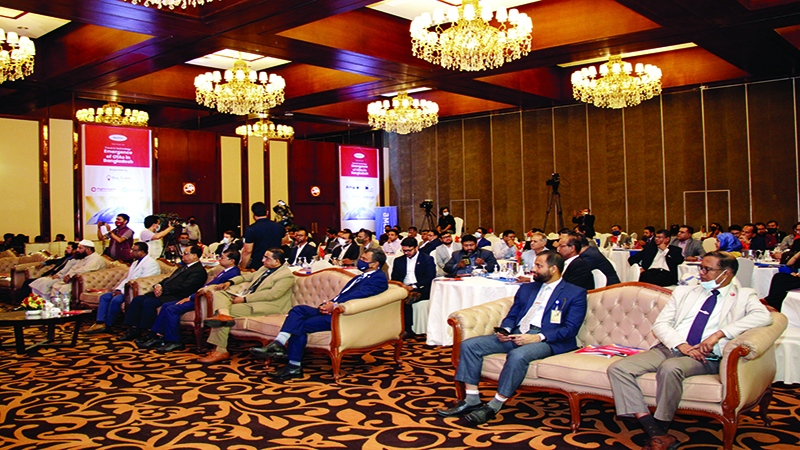 Guests seen at the day-long seminar on March 9 at a city hotel - Photo: Monitor




Download The Mobile App