

Policy, infrastructure support crucial to turn around bleak future of BD aviation : MD
NOVOAIR country's only private airline to complete 10 years of operations

Dhaka : Policy support has become pivotal to help the country's shrinking airline industry sustain. In Bangladesh's commercial aviation history, many airlines have come and gone, but only one private airline - NOVOAIR - has managed to sustain for a decade so far. However, without policy and infrastructure support, it will not only be difficult for the airlines to contribute more to the national development, but also to survive in the bleak days ahead.
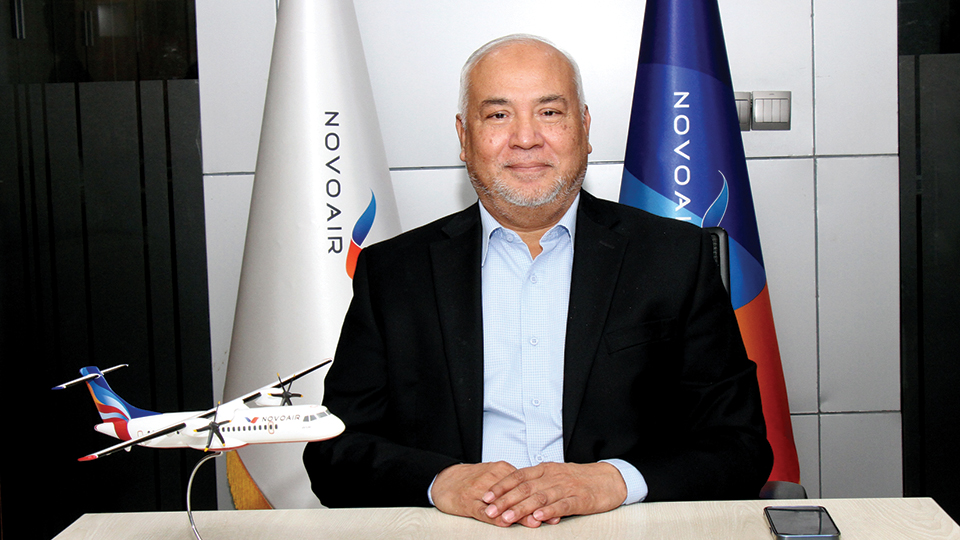
Mofizur Rahman, Managing Director of NOVOAIR said this while talking to The Bangladesh Monitor at his office in the capital recently ahead of the airline's 10th anniversary on January 9, 2023.
A pressing matter that has risen in the country's aviation industry is the air travel capacity currently in the domestic sectors has a surplus capacity of 35 per cent as the demand has declined 10-12 per cent in the last four months. Soon, the surplus capacity will go over 50 per cent, foresees the NOVOAIR Managing Director.
Air travel to Barishal is mere. Jashore is witnessing air travel demand decline by 20 per cent. After the rail network to Cox's Bazar opens in 2025, air travel demand to the most yield generating domestic destinations will also come down to 30 per cent, mentioned the AOAB President.
Therefore, soon the fares will not be sustainable, and ultimately the domestic operations will face huge losses. Airlines will not be able to subsidise the domestic sector loss with international earnings in the long run.
In this context, the country is surprisingly seeing new airlines coming up which it will not be able to accommodate, claimed Mofiz.
One respite could be, as Mofiz suggested, to open the closed airports in other parts of the country and establish new ones in promising areas.
A small eco-friendly airport in Bagerhat shows great potential to serve both aviation, tourism and business as well. The business community in Khulna, Rampal and Mongla Port will be benefited by it, as well as the tourism to Sundarbans, said NOVOAIR MD.
Among the closed airports, Ishwardi, if opened, will support the agriculture-based industries and Rooppur Power Plant. Shamsher Nagar Airport will help the resorts and tourist spots of the Moulvibazar area.
Also, Lalmonirhat and Thakurgaon Airports show great promise of air travel business. Across the border travel to Darjeeling and Sikkim will be supported by reopening the closed airport in Thakurgaon, stressed the airline's MD.
Furthermore, there are countless policy issues in our country, which keep the airlines far behind than our neighbours India, Sri Lanka and even Maldives. These have become great hurdles in the progress to become a safe, viable and sustainable aviation industry, claimed Mofizur.
Worldwide aircraft equipment is tax free. However, in Bangladesh, tax authorities impose 20 per cent tax on aircraft parts. The cost of such expensive items with additional 20 per cent tax, make it difficult for airlines to continue business operations sustainably, he added.
On the other hand, aviation jet fuel occupies 60 per cent of the total operation costs of an airline. In Bangladesh, the airlines are paying 40 per cent more than the worldwide price index of jet fuel, mentioned Mofiz, stressing how badly it is impacting the airlines' sustainability.
Even the international and domestic sectors of aviation have grave differences in the prices of jet fuel in Bangladesh, about 30 per cent, whereas, in other countries, the difference is 2-4 per cent merely, claimed Mofiz.
This is due to the monopoly business of the only supplier of jet fuel - Bangladesh Petroleum Corporation. There should be other players to generate some competition and allow customers - the airlines - to enjoy their rights, also claimed Mofiz.
On top of the exponential price hikes of jet fuel in the country, the airlines are currently having to pay BDT 725 government tax from each ticket sale. Such high tax amount for the airlines, not seen in any of the other modes of transport, must be brought down or fares will further go up with the ever-increasing operational cost. As a result, the passengers will be the ones to receive the last blow, stressed the Managing Director.
There is no alternative to rectifying these rules and regulations and the Civil Aviation and Tourism Ministry, as well as the Civil Aviation Authority of Bangladesh must play their respective roles in favour, said the airline's Managing Director who is also the President of the Aviation Operators Association of Bangladesh.
Infrastructural issues are also keeping the airlines from flourishing. Measures to develop the country's aviation infrastructures are taking place, but these are taking too long, claimed Mofizur.
He mentioned the new terminal at Jashore Airport that was ready two years back, but it is yet to see the light of the day. Hence, what the industry needs immediately to prosper is taking 5-6 years to be implemented.
On the other hand, the Third Terminal at Dhaka Airport will bring temporary comfort to passengers but it will not bring operational flexibility to the airlines, he further said.
Currently, a sequential delay of 20 minutes in arrival and departure takes place due to the dependency on a single runway by all parties - commercial aviation, helicopter operation, and military aircraft emergencies.
For this purpose, Dhaka airport needs a parallel runway. It cannot have an independent parallel runway anymore due to establishments occupying the area, but with another dependent parallel runway, 75 percent of the existing problems will be eradicated. But the authorities must act now, expressed Mofiz.
He also mentioned the country currently lacks trained manpower for this specialised industry. An airline is so regulated that it needs trained and skilled manpower in every step of the way.
Bangladesh Flying Academy and a few other institutions of the country are no longer producing quality manpower. They hardly have any aircraft. Some have stopped operations temporarily while some entirely, leading to shortage of all sorts of quality manpower for an airline from pilots to ground handlers.
CAAB must see to this, noted Mofiz, sighing that it is a matter of great regret that Bangladesh has no IATA accredited training school for aviation.
When NOVOAIR first came into operations on January 9, 2013, the private sector airline history of the country was not satisfactory. Yet, NOVOAIR took up the challenge to step into this uncertain industry because it foresaw a great need of a quality airline among travellers, which was not available back then.
"We wanted to make a difference by providing passengers with comfort and safety in air transport. From the airline's end, we have always prioritised ensuring a smooth head to tail service from booking a ticket to departing on a plane," said Mofiz.
Hence, NOVOAIR has been able to make a loyal passenger base. It has established itself as a safe airline among the passengers, both domestically and regionally, claimed Mofizur as he realised the airline's milestones in its 10 years of journey. "We are the first airline in the country to introduce a loyalty programme, mobile check-in, and seat selection facility," the Managing Director added. "With the motto of letting passengers have their own freedom, we will continue improving our services because there is no end to it," he claimed.
Even though the airline has met its domestic targets in the last 10 years, due to switching its fleet, Covid-19 pandemic, economic crisis and Russia-Ukraine war, NOVOAIR is yet to meet its subregional and regional aspirations, mentioned Mofiz.
"In the coming days, we will work to become a boutique airline in the region. NOVOAIR is currently planning to expand its operations regionally to Southeast Asia and Gulf destinations in late 2023 or early 2024," concluded the Managing Director.