

Top News
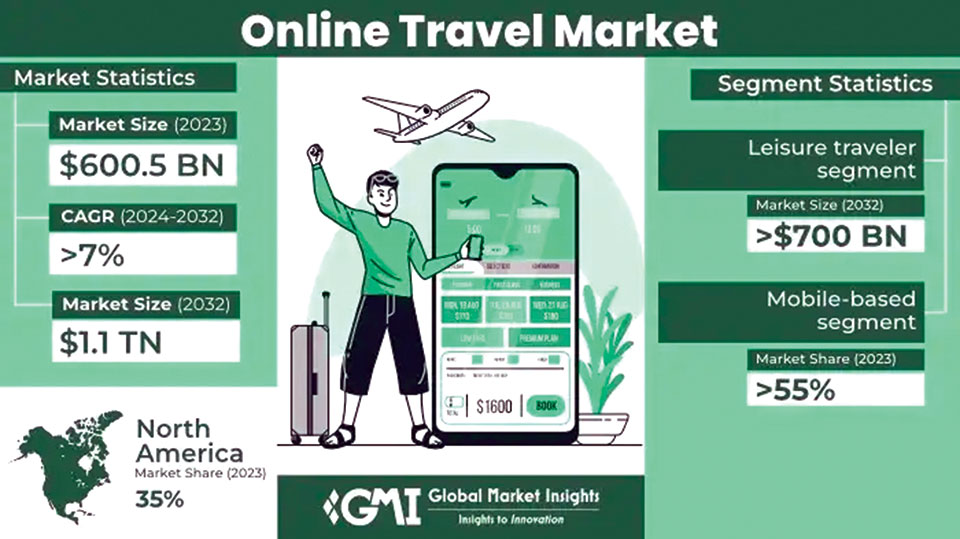
Dhaka : The online travel market size globally was valued at a staggering number of USD 600.5 billion in 2023. More promisingly, it is estimated to register a compound annual growth rate of over 7 per cent between 2024 and 2032, reaching an astonishing value of USD 1.1 trillion in the coming eight years.
According to a report published recently by Global Travel Market Insights Inc, the growth is fueled by a combination of economic factors and favorable market conditions. As global economies expand, individuals have greater disposable income to allocate towards travel and recreational pursuits, it added.
Even World Travel and Tourism Council in May 2024, highlighted a 20 per cent increase in global travel expenditure, attributed to economic recovery and increased consumer spending on travel.
Additionally, the Council in its report added that promotional offers, discounts, and competitive pricing strategies employed by online travel agencies further stimulate customer interest.
Market trends
Governments worldwide are increasingly recognizing the economic and social benefits of a thriving online travel industry, leading to a surge in initiatives and policies aimed at supporting the growth of online travel services.
Governments are offering tax breaks, travel vouchers, or interest-free travel loans to encourage domestic travel, incentivizing citizens to explore their own country, boosting domestic tourism bookings through online platforms.
Moreover, policymakers are introducing electronic visa application processes, simplifying visa requirements and processing times for international travelers-encouraging easier entry and faster booking decisions, facilitated through online travel platforms, further mentioned the report by Global Travel Market Insights Inc.
It may be mentioned here, in January 2024, the Indian government announced a simplified e-visa process for 50 additional countries, resulting in a 25 per cent increase in international travel bookings via online platforms.
Traditional vs online travel services
According to the report, the travel industry is witnessing a "fascinating" conflict between traditional travel agencies and online travel services. Consumer behavior is showing signs of a shift, leading to a potential resurgence of the modern travel agency model, while OTMs have dominated bookings in recent years.
Modern travel agencies offer a curated experience tailored to individual needs and preferences, leveraging human expertise to provide guidance, recommendations, and handle complex travel arrangements. Personalized itineraries and experiences tailored to each preference-is what travelers currently seek, informed the report.
For example, in February 2024, TripAdvisor expanded its personalization tools, including AI-driven recommendations for hotels, restaurants, and activities based on user preferences and past behavior, in an effort to enhance communication and streamline services.
Mobile-vs web-based platform
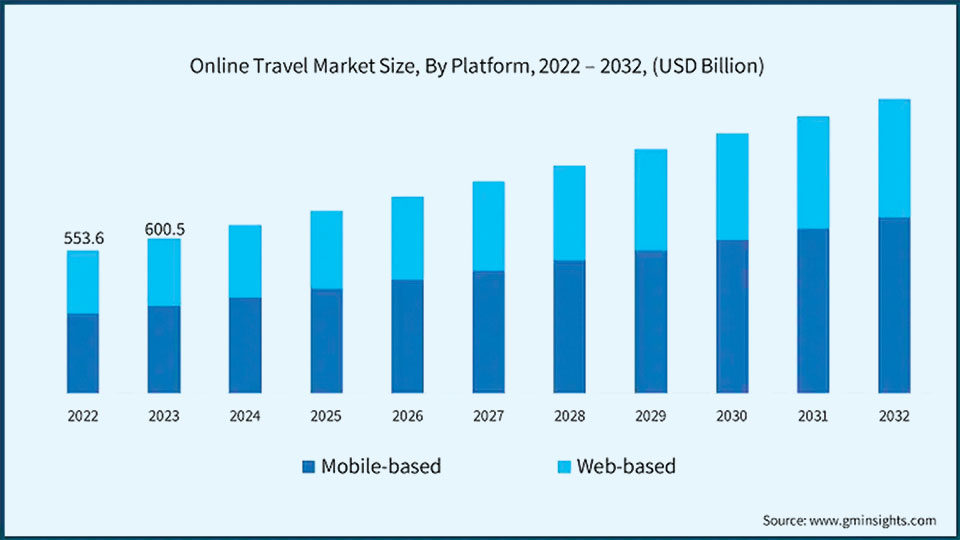
The report further explained that the online market is divided into mobile-and web-based platform. The mobile-based accounted for a market share of over 55 per cent in 2023.
This shows that mobile-based offerings have become essential for travel companies to capture and engage users effectively. Consumers increasingly prefer booking and managing their travel through mobile apps due to their convenience and functionality.
Therefore, governments are investing in digital infrastructure to support mobile connectivity, which is crucial for the effectiveness of mobile travel apps. Policies are also being developed to ensure secure and seamless mobile transactions for travel services.
For instance, in February 2024, the Indian government promoted digital payments through mobile apps, encouraging travel companies to adopt mobile payment solutions to facilitate easier transactions for both domestic and international travelers.
Another reason behind the rise of mobile travel bookings is the fact that users favor apps for real-time updates, easy access, and personalized experiences. The ability to access and manage travel information on-the-go is a significant driver of mobile app usage in the travel sector, mentioned the report.
It may be mentioned here, in April 2024, Hopper updated its app to include personalized travel alerts, which notify users of price drops and deals based on their search history and preferences, leading to a 35 per cent increase in app downloads.
Leisure vs business traveler
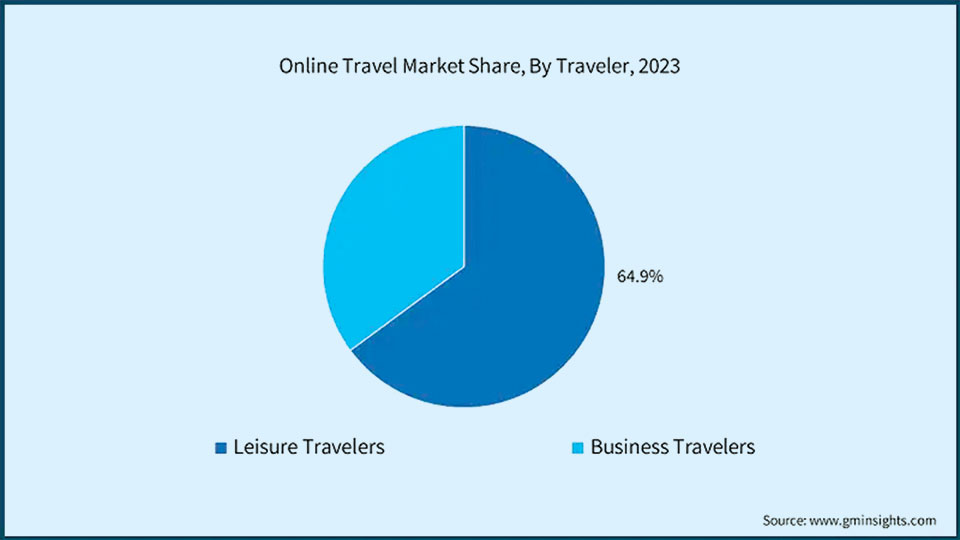
The report further detailed, based on traveler segment, the online travel market is categorized into leisure and business traveler. According to Global Travel Market Insights Inc's report, the leisure traveler segment is expected to hold over USD 700 billion by 2032.
Rising disposable incomes, especially in emerging markets, are contributing to a higher demand for leisure travel. Leisure travelers are increasingly looking for authentic, off-the-beaten-path experiences, including local culture and hidden gems.
There is also a growing interest in sustainable travel options, eco-friendly accommodations, cultural immersion, adventure tourism, and eco-tourism. Leisure travelers are increasingly seeking unique, personalized travel experiences over traditional vacation packages.
For example, in April 2024, Airbnb expanded its "Experiences" section to include more niche and adventure activities, such as local cooking classes, wildlife safaris, and cultural tours, leading to a 40 per cent increase in bookings for such experiences.
Market share
As per the report, Booking Holdings and Expedia Group dominate the global market with around 5 per cent market share.
Booking Holdings primarily focuses on the Online Travel Agency (OTA) Model, acting as an intermediary between travelers and travel suppliers. It earns revenue through commissions on bookings made through its platforms including Booking.com, Priceline, Kayak, Agoda, etc. Additionally, the company leverages a metasearch engine model for additional revenue streams.
Expedia Group, on the other hand, utilizes a combined OTA and metasearch model. However, it might have a slightly higher focus on the metasearch model compared to Booking Holdings, informed the report, adding, the company's brand portfolio includes Expedia.com, Vrbo, Hotels.com, Travelocity, and Orbitz. It leverages industry-leading technology, including AI predictions and virtual conversations.
Challenges
The report also noted the challenges persisting in the sector. Partnerships and acquisitions can help market players to tap into new customer demographics or geographic regions, it highlighted. Collaborating with established travel brands or loyalty programs can enhance brand image and attract customers who trust the partnered brand.
Strategic initiatives also help companies to expand their market reach and technological capabilities. For instance, in April 2024, Booking Holdings acquired the travel search engine, KAYAK to enhance its technological infrastructure and expand its market presence, leveraging its expertise to improve its metasearch capabilities to offer a wider range of travel options and more user-friendly search experience for customers.
The online travel market operates across different jurisdictions, each with its own regulations on data protection, consumer rights, and taxation, further claimed the report.
Adapting to new regulations can be costly and complex, especially for companies operating internationally. For example, economic recessions can reduce discretionary spending on travel, impacting online bookings and overall market growth.
Additionally, political instability and conflicts can disrupt travel plans and affect consumer confidence, concluded the report.