
Breaking News
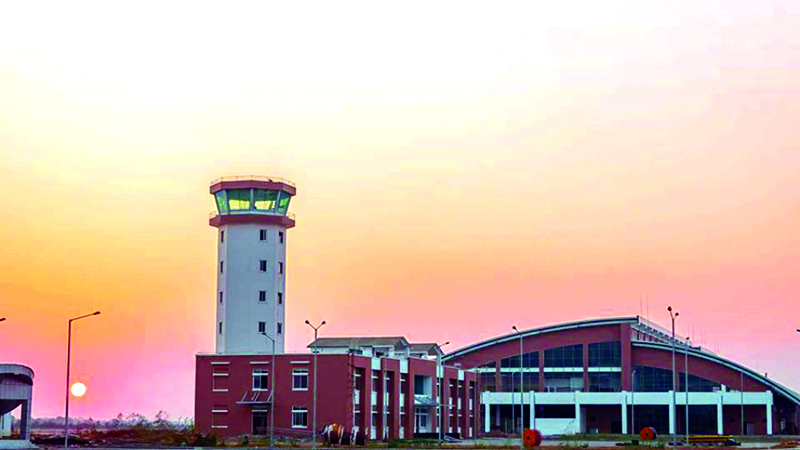
Kathmandu : The newly completed Bhairahawa International Airport of Nepal awaits applications for flight slots from international airlines. This is Nepal's second international airport which is finally ready after 10 years in the making and nearly Rs 40 billion spent. However, the expected rush of eager carriers is nowhere to be seen.
Located in south central Nepal and spread across 787 bighas (533 hectares), Gautam Buddha International Airport is a landmark. The modern facility has a 15,169 square-metre terminal building with a capacity to serve nearly a million passengers a year. The airport's 3,000-metre runway is long enough to handle the largest commercial jets.
However, there are no commercial jets wanting to fly to the airport currently, even though the facility is ready to welcome them.
Reports said, no marketing or promotional campaign has been rolled out yet to attract international airlines, despite the fact that the countdown to the inauguration has begun.
Gautam Buddha International Airport is a 280-km drive from Kathmandu, and is also intended to serve as an alternate and backup international air transport point for Nepal, should poor weather conditions or a natural calamity shut down the capital's Tribhuvan International Airport.
The government has planned to open the doors of the airport on May 16, the birthday of Gautam Buddha, which is a holiday in Nepal.
"The calibration of important navigational equipment of the airport has been completed. We have planned to do a test flight at the airport on April 14, the Nepali New Year," said Pradeep Adhikari, Director General, Civil Aviation Authority of Nepal. "Then on May 16, there will be a commercial take-off from the new airport."
It has long been understood that Nepal needed a second international airport. Traffic through Kathmandu's airport was getting too heavy and had reached a saturation point, resulting in planes being forced to hold for hours in the skies and passengers suffering hours of delays on the ground.
"If you build a new airport, you simply need to make it affordable," said Birendra Basnet, Managing Director, Buddha Air, Nepal's largest private carrier. "Airlines do not expect subsidies for long periods. But it helps, particularly in the initial airport setup, to encourage airlines to launch services because the subsidy can lower the risk of their entry."
"Besides, to entice airlines and passengers to create demand, the government should introduce other facilitation measures like opening a labour permit office in Bhairahawa. It needs homework, planning and strategy," added Basnet.
From March 27, the Civil Aviation Authority of Nepal will issue details of the regulations, procedures and other information pertinent to flying aircraft at the new airport through the Aeronautical Information Publication.
Adhikari, Director General of Nepal's aviation body, said that constant talks were being held with international airlines already flying into Nepal to serve Bhairahawa too.
"It's a new airport. It will take some time to do business," he said, adding that planes would come sooner or later. "There is no need to worry."
So far, not one international airline has applied to connect Bhairahawa, said reports. Experts claimed it is because of the lack of marketing.
Promotional activities and marketing for the new airport were made several times, but they all came to nothing.
Also on Bangladesh Monitor