


Time to act : CAAB reform must not stall under new govt

Dhaka : As Bangladesh's new government took charge amid high expectations for economic recovery and sectoral reform, aviation stakeholders are urging immediate action on a long-pending institutional overhaul: the separation of the Civil Avia-tion Authority of Bangladesh (CAAB)'s regulatory and operational functions.
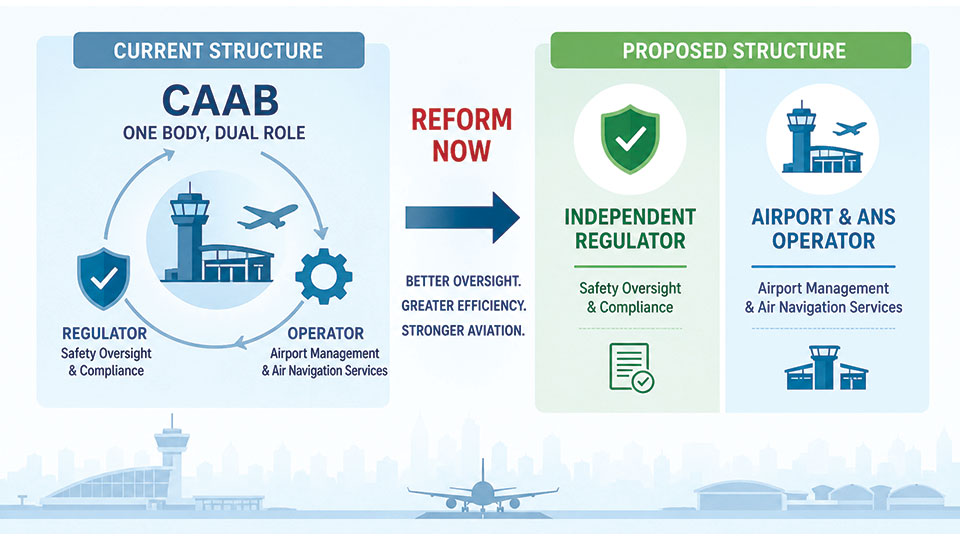
The reform-previously approved through an ordinance under the interim administration-proposed dividing CAAB into two independent entities: a regulator responsible for safety oversight and compliance, and a separate operator to manage airports and air navigation services. However, with the change in government, concerns are growing within the aviation and tourism industry that the initiative could lose momentum or be quietly shelved.
Industry experts warned that delaying or reversing the reform would be a step backward for Bangladesh's aviation sector at a time when global standards are moving decisively toward functional specialization and institutional transparency.
Structural flaw that persists
For years, CAAB has functioned both as regulator and operator-an arrangement widely criticized for creating a conflict of interest. As a regulator, CAAB is expected to enforce safety, security, and compliance standards. Simultan-eously, as an operator, it manages airports and provides air navigation services-activities it is supposed to regulate.
This dual role undermines accountability and weakens oversight, as no independent authority exists to objectively monitor operational performance.
The International Civil Aviation Organization (ICAO) has consistently recommended that member states separate these roles to ensure impartial regulation and efficient service delivery. Bangladesh's earlier ordinance was aligned with these global standards, making its implementation not just desirable, but necessary.
Reform now, not later
With passenger traffic rising and infrastructure investments expanding-including upgrades at Hazrat Shahjalal International Airport-the need for a modern, efficient aviation governance structure has never been more urgent.
A professionally run airport operator entity would be able to focus on service quality, commercial development, and infrastructure management, while an independent regulator would concentrate on safety oversight, licensing, and compliance.
Failing to separate these functions risks continued inefficiencies, slower decision-making, and diminished international confidence in Bangladesh's aviation system.
Lessons from global peers
Many countries have already embraced this model with measurable success. In India, for example, the Directorate General of Civil Aviation (DGCA) acts as the independent regulator, while the Airports Authority of India (AAI) manages airport operations. This clear division has enabled both entities to develop specialized expertise and improve performance.
Similarly, in the United Kingdom, the Civil Aviation Authority operates independently of airport operators, ensuring robust oversight without operational bias.
Closer to home, Nepal has also moved toward splitting its Civil Aviation Authority into separate regulatory and service-provider bodies following repeated safety audit concerns and ICAO recommendations. The reform process there underscores the importance-and urgency-of institutional clarity in aviation governance.
These examples demonstrate that separating regulatory and operational roles is no longer optional; it is a global standard for countries seeking to enhance safety, efficiency, and competitiveness.
Risks of inaction
Aviation experts cautioned that abandoning or delaying the CAAB reform could have tangible consequences. These include weaker safety oversight, reduced investor confidence, and potential setbacks in international aviation ratings.
Bangladesh is positioning itself as a regional connectivity hub, and such ambitions require not only modern infrastructure but also credible, transparent institutions.
Moreover, as international airlines and investors evaluate markets, governance structures play a crucial role in shaping perceptions. A regulator that is also an operator raises red flags about impartiality and efficiency.
This is why, the Federal Aviation Administration (FAA) of the US does not put Bangladesh in Category One status-without which it would be impossible to operate direct flights between the two countries.
Call for continuity
The transition to a new government often brings policy shifts, but experts emphasize that critical structural reforms-especially those aligned with international standards-must transcend political cycles.
The CAAB separation initiative is not a partisan measure; it is a strategic necessity for the long-term development of Bangladesh's aviation and tourism sectors.
Stakeholders across the industry therefore called on the new administration to reaffirm its commitment to the reform and fast-track its implementation. This includes enacting the necessary legislation, defining institutional frameworks, and ensuring both entities are staffed with qualified professionals.
Way forward
Bangladesh stands at a pivotal moment in its aviation journey. With growing passenger demand, expanding airport infrastructure, and increasing global connectivity, the sector has immense potential. However, unlocking that potential requires decisive governance reform.
Separating CAAB's regulatory and operational functions is not merely an administrative adjustment-it is a foundational step toward building a safer, more efficient, and internationally competitive aviation system. The ordinance has already set the direction. What is needed now is political will.
Delaying action risks prolonging inefficiencies and missing an opportunity to modernize the sector. Acting swiftly, on the other hand, would send a strong signal that Bangladesh is committed to global best practices and ready to elevate its aviation industry to the next level.
For the new government, the message from industry stakeholders is clear: this reform must move forward-without delay, without dilution.