

Bangladesh can become trusted aerospace partner by 2035
Bangladesh born aerospace expert Asad Kagozi outlines practical roadmap for BD

Dhaka
: Bangladesh may not be building aircraft or launching rockets anytime soon,
but the country possesses the ingredients necessary to become a respected
player in the global aviation and space ecosystem.
This
view was shared by Bangladesh-born aerospace professional Asad Kagozi (Head of
Costing Process, Methods, Tools, and Data at Airbus Commercial) during an
exclusive interview with The Bangladesh Monitor.
Kagozi's
aerospace journey began long before joining Airbus. As a researcher at the
Fraunhofer Institute for Production Systems and Design Technology (IPK) in
Berlin, he worked on East-West aerospace industrial collaboration before
spending nearly two decades with Airbus in aerospace strategy, digital
technologies, industrial intelligence, and advanced engineering.
According
to him, these experiences shaped his conviction that sustainable aerospace
industries are built on knowledge, industrial capability, and long-term
partnerships.
According
to Kagozi, the future of aerospace is no longer confined to aircraft
manufacturing. Instead, it encompasses a vast ecosystem of artificial
intelligence, digital engineering, advanced analytics, robotics, sustainable
technologies, satellite applications, cybersecurity, and data science.
Countries that invest in talent, innovation, and industrial capability today
will be the leaders of tomorrow.
Practical
path for Bangladesh
Rather
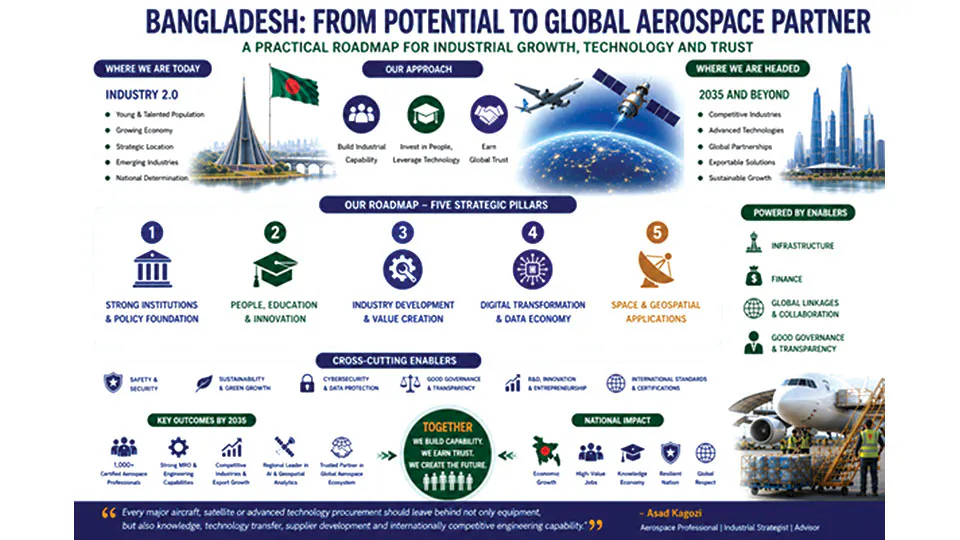
than attempting to replicate the path of established aerospace nations, Kagozi
believes Bangladesh should focus on areas where it already possesses
significant advantages. He identified four strategic opportunities: expanding
domestic airline capability, developing Maintenance, Repair and Overhaul (MRO)
capabilities, securing technology transfer through industrial participation
(offset) agreements, and building world-class competence in Data Science,
Geospatial Analytics, and Earth Observation applications.
He
emphasized that aviation and space should become strategic pillars of a
long-term National Industrial Policy, rather than being developed as isolated
sectors.
He
noted that a large share of Bangladesh's international air travel market is
currently served by foreign carriers. Supporting the expansion of local
airlines would help retain valuable foreign exchange while creating jobs and
strengthening the aviation ecosystem.
The MRO sector, in particular, represents one of Bangladesh's most realistic entry points into the global aerospace value chain. Initially, the country could focus on component-level maintenance, avionics support, cabin refurbishment, and engineering services before gradually expanding into more advanced capabilities.
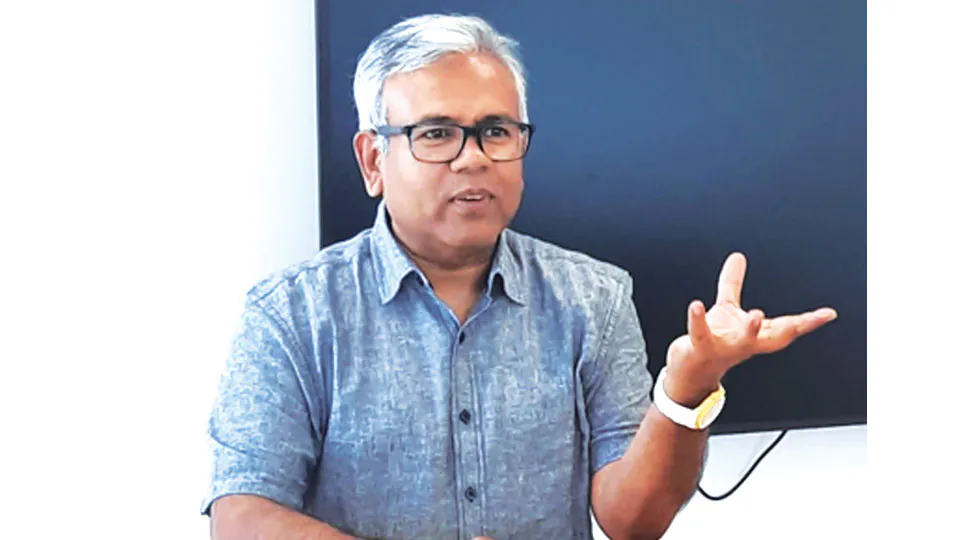 Asad Kagozi
Kagozi
further recommended that every major aircraft or advanced technology
procurement should include industrial participation (offset) obligations,
technology transfer, supplier development, and workforce training, ensuring
that each investment leaves behind lasting industrial capability rather than
only physical assets.
Not
transit hub, but
Kagozi
does not believe Bangladesh will become another Dubai or Singapore in terms of
passenger transit. However, he sees enormous potential for the country to
emerge as a specialized aviation engineering, maintenance, cargo, and
technology hub.
To
achieve this, he recommended investment in aviation training academies,
internationally recognized certification programs, tax-friendly MRO zones,
cargo infrastructure, and long-term policy stability. Bangladesh's competitive
advantage, he argued, lies not in geography but in its large pool of talented
young people, relatively competitive operating costs and the opportunity to
develop internationally recognized engineering capability.
Technology
to drive next aviation revolution
Modern
airports are increasingly becoming data-driven ecosystems. Artificial
Intelli-gence, digital twins, predictive maintenance, biometric processing, and
intelligent passenger-flow management are transforming airport operations
worldwide.
Kagozi
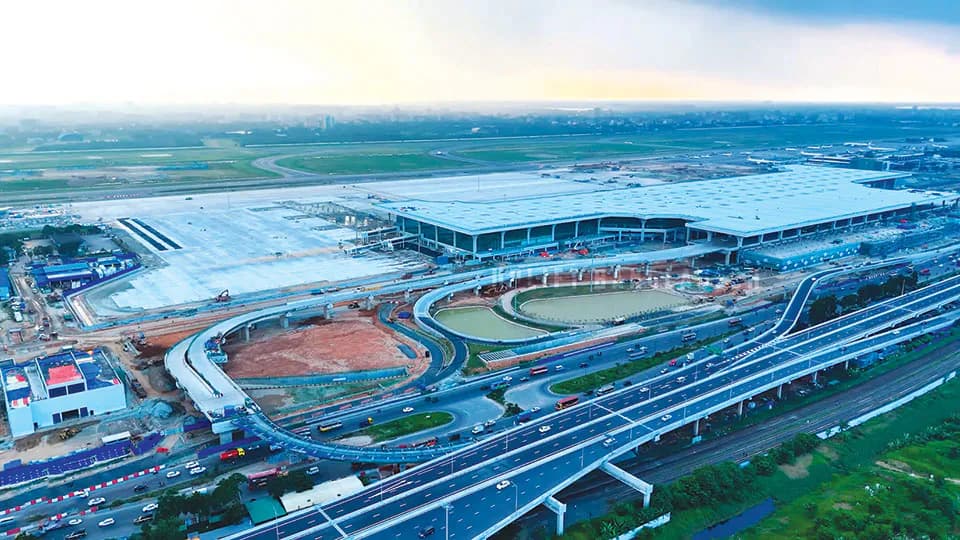
believes Bangla-desh's new airport infrastructure, including the Third Terminal
of Hazrat Shahjalal International Airport, should be supported by advanced
digital systems. Investments in integrated operations centers, cybersecurity,
passenger analytics, digital identity solutions, and real-time data-sharing
platforms will be essential to creating world-class passenger experiences.
According
to Kagozi, future airports should be viewed not simply as transport
infrastructure, but as intelligent digital ecosystems that continuously
optimize safety, operational efficiency and passenger experience.
Space
technology without building satellites
Perhaps
Kagozi's most intriguing proposition concerns Bangladesh's participation in the
growing (USD 1.8 trillion) global space economy.
He argued that entering the space economy must not be confused with the capital-heavy, high-risk trap of manufacturing or owning physical hardware in orbit. Instead, Bangladesh's strategy must be 100 percent asset-light (suitable to the nation's need and financial affordability) - purchasing raw telemetry and communication bandwidth from global mega-constellations via open APIs and mastering the downstream software analytics layer at home.
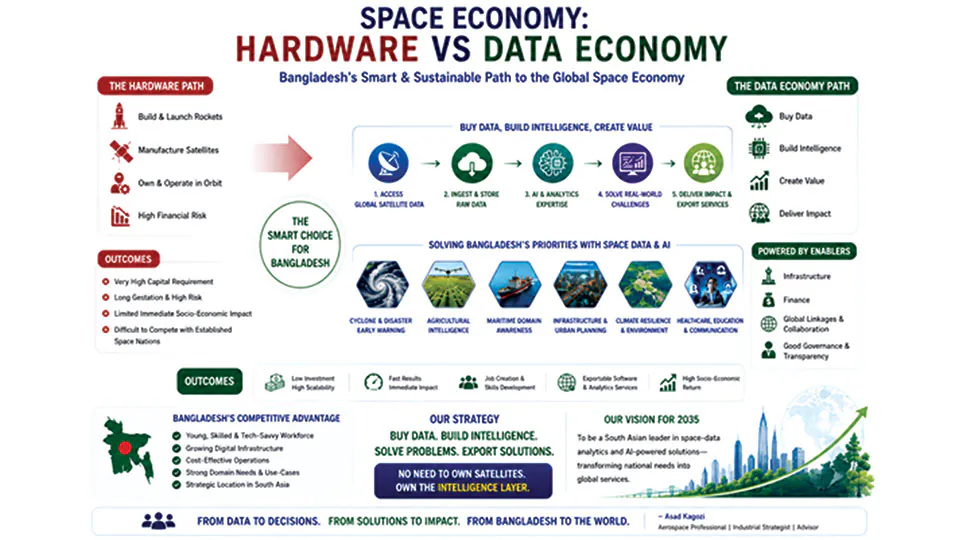
By
running advanced machine learning over imported feeds, local engineers can
build specialized capabilities to solve urgent domestic challenges - such as
mapping cyclonic storm surges (e.g. 72 hours in advance), predicting
agricultural pest invasions (e.g. three weeks early), tracking illegal maritime
activity in the Bay of Bengal, climate resilience, education, healthcare,
commuter traffic, communication, and so on.
The
real opportunity lies in building expertise in geospatial analytics, artificial
intelligence, and Earth observation applications. By processing and
interpreting satellite data, Bangladeshi engineers could create valuable
domestic solutions while developing exportable software and analytics services
for the international aerospace market.
Investing
in people: "Triple-Helix" Framework
For
Kagozi, human capital remains the foundation of every successful aerospace
industry. With global demand for pilots, engineers, technicians, data
scientists, and aviation professionals (more than two million) expected to rise
sharply over the next two decades, Bangladesh has a unique opportunity to
position itself as a supplier of highly skilled talent.
To
capture this historic opportunity, Kagozi urged an aggressive,
industry-integrated "Triple-Helix Operational Model" that firmly
binds Government executive power, Academic research, and Industrial capacity
into a unified National Strategy.
He
continued arguing the immense importance of stronger collaboration among
involved parties and creating a permanent Government-Academia-Industry
collaboration platform, arguing that universities should not only prepare
students for employment but also help create entirely new industries through
innovation, entrepreneurship and research.
Vision
for 2035
Looking
ahead, Kagozi envisions Bangladesh evolving from a technology consumer into a
trusted regional partner in aviation engineering, MRO services, advanced
manufacturing, artificial intelligence, geospatial analytics, and space-enabled
digital services. Rather than competing in capital-intensive hardware, he
believes Bangladesh should build internationally respected capabilities in
engineering, software, data science and systems integration.
"By
2035, I hope Bangladesh will no longer be asking how to build an aircraft or
launch a satellite. Instead, the world will recognize Bangladesh as a nation
that develops outstanding engineers, delivers trusted industrial solutions, and
transforms technology into economic value and national resilience."
According
to Kagozi, national success should not be measured by the number of aircraft
assembled or satellites launched, but by the strength of institutions, the
competitiveness of local industries, the capability of the engineering
workforce and the confidence Bangladesh earns from global partners.