

ASEAN airports support USD 244 billion in GDP, 23.3 million jobs

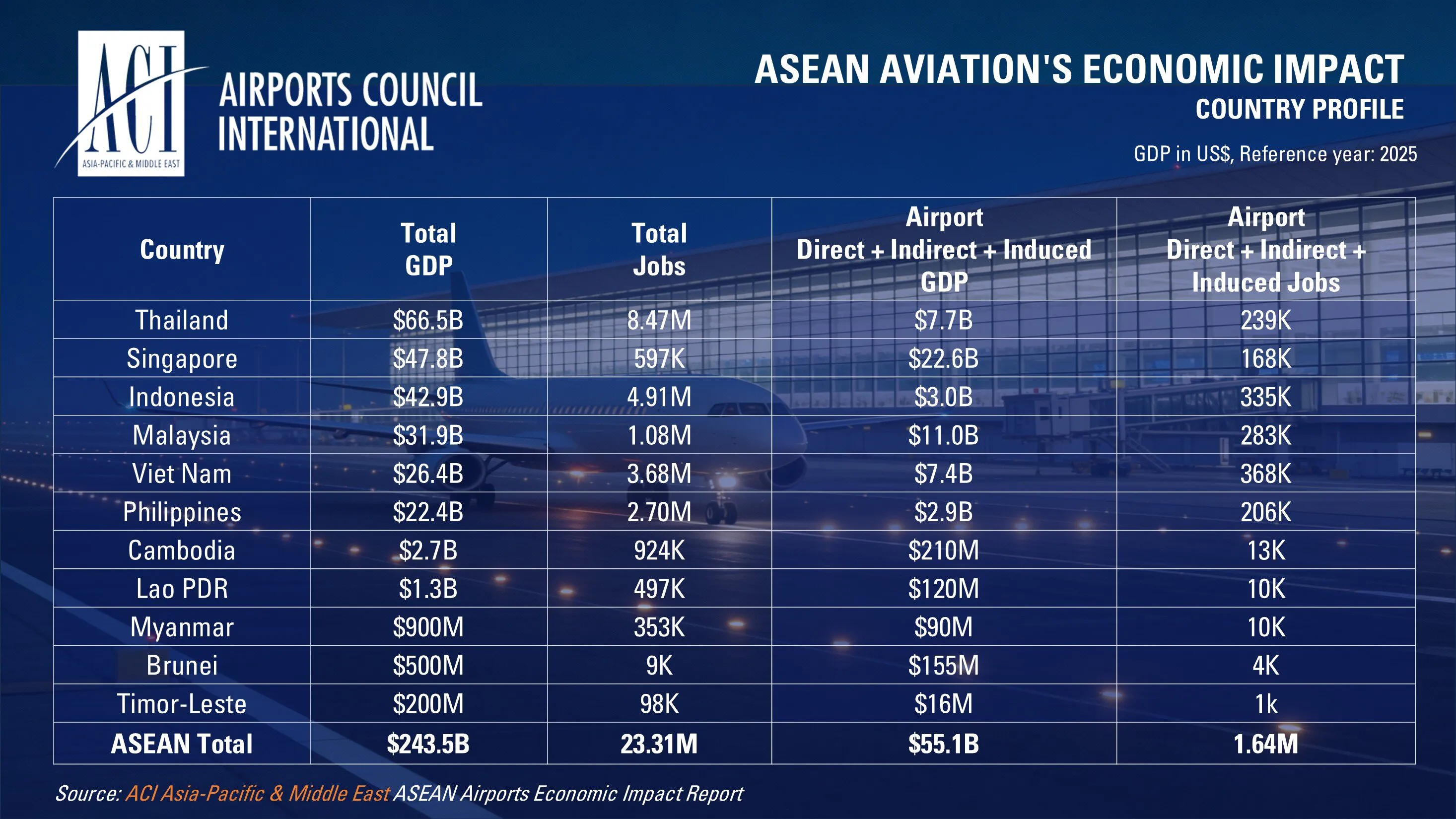
Dhaka: Airports and the air connectivity the facilities enable supported 23.3 million jobs and contributed USD 244 billion to the gross domestic product (GDP) of the Association of Southeast Asian Nations (ASEAN) in 2025, according to a new study.
Airports Council International Asia-Pacific & Middle East (ACI APAC & MID) released the study, titled "Strengthening the ASEAN Single Aviation Market (ASAM) for Greater Connectivity within and beyond ASEAN." It is the first comprehensive assessment of the economic contribution of airports across the bloc.
The consultancy InterVISTAS carried out the analysis. It looked at connectivity, policy, infrastructure, and implementation gaps that must be addressed for ASEAN to realize the full potential of the single aviation market.
Direct airport contribution
Airport-related activity alone supported 1.6 million jobs and contributed USD 55 billion to ASEAN's GDP in 2025. This includes direct operations, supply-chain effects, and household spending.
The study also estimated that airport-related activity generated USD 36 billion in tax revenue for governments across 11 ASEAN states. Of this, USD 8 billion came from airport activity and USD 28 billion from its wider catalytic effects.
Rapid growth in connectivity
According to the study, almost all ASEAN member states at least doubled their scheduled seat capacity between 2004 and 2025. Most of the intra-ASEAN growth occurred between 2010 and 2015, when several ASAM-related protocols were signed.
Low-cost carriers have been a major driver. They accounted for 51% of intra-ASEAN seats in 2025, up from 29% in 2008, which has made air travel more affordable across the region.
Key findings
- - Direct air connectivity across ASEAN rose by 358% between 2004 and 2025. The resulting gains are linked to about USD 50.6 billion in GDP and 6 million jobs.
- - Vietnam, Indonesia, and Malaysia recorded the largest employment impacts from airport-related activity, at about 368,000, 335,000, and 282,000 jobs, respectively.
- - Singapore, Malaysia, and Thailand posted the largest GDP impacts, at about USD 22 billion, USD 11 billion, and USD 7.7 billion, respectively.
- - An estimated 84.8 million international tourists arrived in ASEAN by air in 2025, spending about USD 127 billion. This is around two-thirds of total international tourism spending in the region.
- - ASEAN airports handled more than 700 million passengers and almost 9 million tonnes of cargo.
Cost of inaction
The study said further gains are possible if ASAM is fully implemented. In an unconstrained scenario, the region could see about 6 million additional intra-ASEAN passengers, an 11.6% increase over 2025 traffic.
This would create about 15,000 aviation-sector jobs and add USD 600 million to GDP. Tourism, trade, investment, and other catalytic effects could add 434,000 more jobs and USD 3.7 billion in GDP.
Combined, the gains would total almost 450,000 jobs and USD 4.3 billion in additional GDP.
Calls for market access, infrastructure
ACI Asia-Pacific & Middle East Director General Stefano Baronci said ASEAN states have made historic progress with ASAM, but there is still room for improvement. He urged governments to address remaining challenges on market access and traffic rights, starting with opening air connectivity to secondary cities so more local economies benefit.
He also said lagging airport infrastructure is a core factor limiting liberalization in Southeast Asia. This affects airlines' ability to fully capitalize on the opportunities ASAM has created.
The study stressed that liberalization alone will not deliver the gains. It must be matched by sufficient airport and airspace capacity and supportive regulatory frameworks.
USD 341 billion investment needed
ASEAN passenger traffic is forecast to more than double over the next decade. ACI estimates the region will need about USD 108 billion in airport investment by 2036 to accommodate this growth.
A further USD 233 billion will be required between 2037 and 2056, when passenger traffic is expected to reach 2.9 billion. This brings the total investment requirement to about USD 341 billion over the next 30 years.
Baronci said airports will have to mobilize significant capital to expand capacity, modernize infrastructure, and stay competitive. He called on ASEAN members to speed up the implementation of existing air services agreements and remove capacity, regulatory, and operational barriers.