

Global air cargo rebounds as capacity returns, fuel prices ease

Dhaka: Global air cargo activity picked up pace last week as airlines redeployed capacity after a slowdown caused by overlapping public holidays in Europe, the United States, and the Middle East and South Asia (MESA) region.
Pentecost in Europe, Memorial Day in the United States, and the four-day Eid al-Adha festival in MESA and Africa had disrupted operations the previous week, according to the latest figures from WorldACD Market Data.
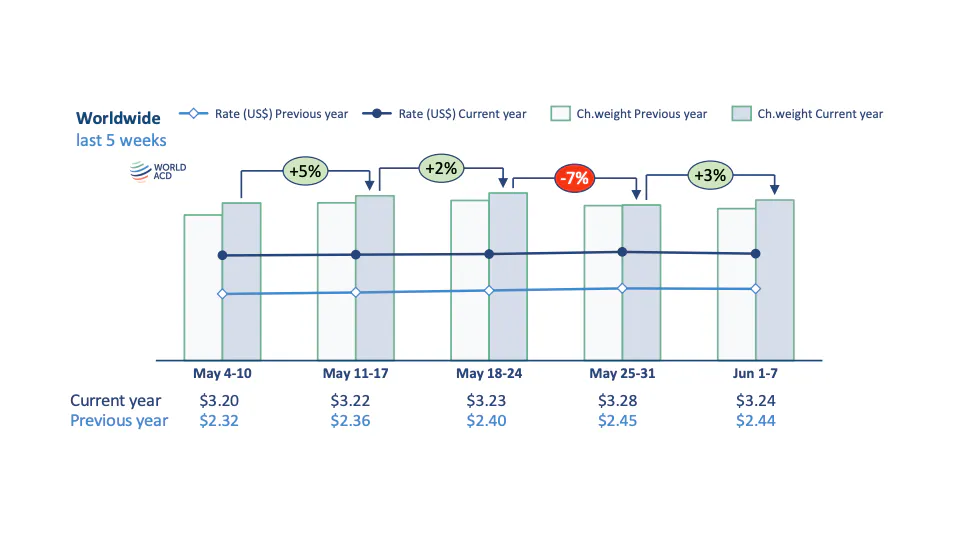
Global tonnage rebounded +3% week-on-week (WoW) in week 23 (June 1 to June 7), recovering from a -7% drop in chargeable weight the week before.
North America led the rebound with a +16% rise in volumes, followed by MESA at +13%. Europe and Africa posted single-digit gains of +6% and +3%, respectively, while Asia Pacific and Central & South America (CSA) each declined -2%.
A two-week comparison showed the lingering impact of Eid al-Adha, with MESA and Africa outbound chargeable weight falling -13% and -12%, respectively, against the prior fortnight. Other regions saw smaller, single-digit declines.
Volumes from Europe, North America, and MESA fell on all intercontinental routes over the same two-week period, while tonnage from the Asia Pacific rose +3% to North America but dropped on other routes, reflecting continued e-commerce and AI equipment demand out of Southeast Asia.
Year-on-year, total chargeable weight last week was +6% higher than the same period last year, though Pentecost and Eid al-Adha fell two weeks later in the prior year, complicating a direct comparison.
Last year, the week following the same holidays saw a +2% WoW rise in chargeable weight, comparable to this year's recovery.
Because of the shifted Eid al-Adha date, tonnages from Africa and MESA were -5% and -2% lower year-on-year, while other regions posted gains ranging from +3% (Europe) to +9% (Asia Pacific).
Chargeable weight from MESA to Europe rose +13% WoW, driven by increases from Dubai (+19%) and India (+9%). Exports to the United States fell -4% overall, mainly due to declines from Bangladesh (-42%) and India (-2%).
Traffic from Asia Pacific to Europe contracted -6% WoW, with double-digit drops from Malaysia (-24%), Vietnam (-16%), Taiwan (-11%), and Singapore (-10%). Exports to the United States stayed flat overall, as gains from Thailand, Vietnam, and South Korea offset declines from Malaysia, Indonesia, Hong Kong, and Japan.
Capacity returns
Global capacity rose +1% WoW last week, recovering from a -1% dip the week before. The gain was driven by MESA (+8%) and Africa (+2%), while North America saw a -2% decline. Capacity from other regions stayed unchanged.
Flights to and from MESA jumped +11% WoW, rebounding from a -5% drop the previous week, as Doha recorded its highest capacity level in five weeks.
MESA capacity, however, remains -28% below pre-Iran-war levels, with the Gulf area down -43% and South Asia down -11%.
Fuel prices push rates down
As aviation fuel prices continued to decline, global airfreight pricing slipped -1% WoW to a global average of USD 3.24 per kilo. Rates from Africa and MESA fell -10% and -4%, respectively, while Europe and CSA declined -1% each. Asia Pacific and North America rates rose +1%.
Year-on-year pricing remained up +33% overall, with CSA the only region not posting a double-digit increase, at +9%. Other regions ranged from +26% (North America) to +47% (MESA).
Spot rates from Asia Pacific rose +1% WoW, with gains of +3% to the United States and +1% to Europe. The rise to the United States was led by Japan (+13%) and Indonesia (+8%), while China and Vietnam each rose +3% and South Korea fell -11%.
Spot rates from Asia Pacific to Europe stayed largely stable, apart from China (+5%) and Thailand (-6%).
A fresh outbreak of hostilities in the Middle East this week halted the recent decline in oil prices, suggesting upward pressure on airfreight rates is likely to persist unless the conflict ends soon.