

Time for strategic reset : Can Biman survive new competitive reality?

Dhaka
: For more than five decades, Biman Bang-ladesh Airlines has carried the
national flag across the skies, serving as a symbol of the country's aviation
aspirations and a vital link between Bangladesh and the world. Established in
1972, shortly after the country's independence, Biman has played an important
role in supporting trade, tourism, labor mobility, and national connectivity.
Yet,
despite completing 54 years of operations, the national carrier continues to
face challenges that have prevented it from realizing its full potential. While
aviation markets across South and Southeast Asia have witnessed remarkable
transformation, Biman has often struggled with issues relating to fleet
expansion, network development, commercial management, operational efficiency,
and institutional accountability.
Today,
the airline stands at a critical crossroads.
Rapidly
changing market
Bangladesh's
aviation sector is one of the fastest-growing in the region. Rising disposable
income, increasing outbound travel, a large expatriate workforce, growing
business connectivity, and expanding tourism have all contributed to sustained
growth in passenger demand.
At
the same time, foreign airlines have significantly strengthened their presence
in the Bangladesh market. Carriers from the Middle East, Turkey, China,
Southeast Asia, and South Asia continue to expand their operations, offering
extensive global networks, modern fleets, superior connectivity, and
competitive fares.
The
opening of the Third Ter-minal of Hazrat Shahjalal Inter-national Airport is
expected to accelerate this trend further. The state-of-the-art facility will
substantially increase airport capacity and improve passenger experience,
making Bangladesh an even more attractive destination for international
airlines.
Industry
observers expect several new foreign carriers to enter the market, while many
existing airlines are likely to increase frequencies and capacity in the coming
years.
The
competitive environment that Biman faces tomorrow will be significantly more
challenging than the one it faces today.
Fleet
Fleet
availability remains one of Biman's biggest challenges.
Although
the airline has modernized parts of its fleet in recent years through the
acquisition of Boeing 777, 787 Dreamliners and other aircraft, the overall
fleet size remains inadequate compared with market demand and the ambitions of
competing airlines.
The
government has recently approved plans for the acquisition of several new
Boeing wide-body and narrow-body aircraft. However, industry sources indicated
that deliveries are unlikely to commence before 2031 because of global aircraft
production backlogs.
To
address immediate capacity shortages, Biman is reportedly considering the lease
of Airbus aircraft. However, the leasing process remains at a preliminary
stage, with requests for proposals yet to be finalized and no certainty
regarding implementation timelines.
This
creates a significant gap between current capacity requirements and future
fleet availability.
Without
timely fleet expansion, Biman risks further erosion of market share on both
regional and long-haul routes.
Private
airlines expanding aggressively
While
Biman grapples with fleet constraints, Bangladesh's private airlines are moving
ahead aggressively.
US-Bangla
Airlines, in particular, has emerged as a major force in the country's aviation
sector. The airline has steadily expanded its domestic and international
network, improved service standards and strengthened its fleet.
Its
reported plans to acquire more than 21 brand-new Boeing 737-8 aircraft signal
an ambitious growth strategy that could significantly reshape the competitive
landscape.
Air
Astra is also steadily expanding its domestic footprint and exploring future
international opportunities. They are also in the process of acquiring 3-4
Boeing aircraft to commence their international operations.
In addition, several new aviation ventures backed by foreign airline partners and international investors are reportedly awaiting regulatory approvals to enter the market.
The
emergence of strong private-sector competitors is a positive development for
Bangladesh's aviation industry, fostering competition, service quality and
consumer choice. However, it also places additional pressure on Biman to
modernize and become more commercially responsive.
Structural
challenges remain
The
challenges facing Biman extend beyond fleet limitations.
Over
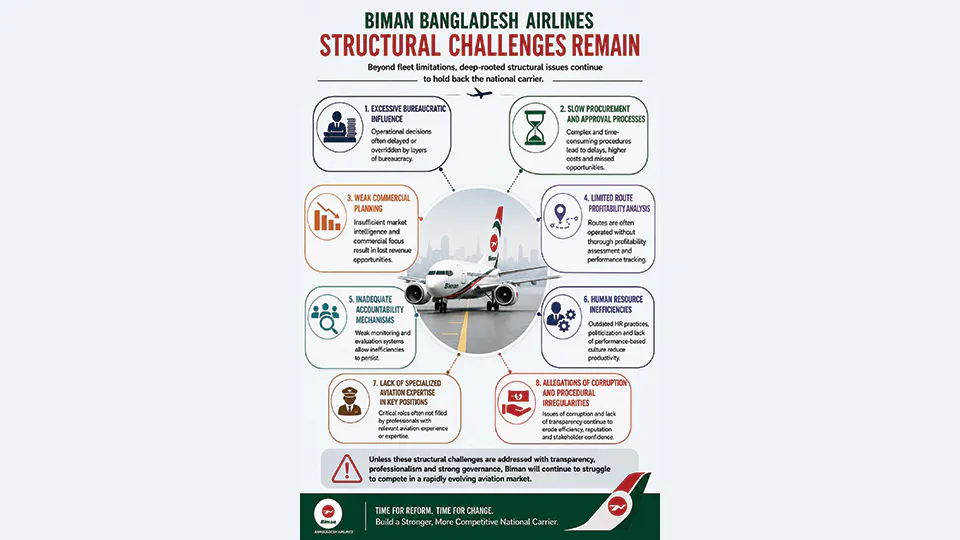
the years, industry stakeholders have repeatedly raised concerns regarding:
- · Excessive
bureaucratic influence in operational decision-making.
- ·
Slow
procurement and approval processes.
- ·
Weak
commercial planning.
- ·
Limited
route profitability analysis.
- ·
Inadequate
accountability mechanisms.
- ·
Human
resource inefficiencies.
- ·
Lack of
specialized aviation expertise in key positions.
- ·
Allegations
of corruption and procedural irregularities.
While
successive management teams have introduced reforms and improvements, many
structural issues continue to affect organizational performance.
In
today's highly competitive aviation environment, airlines compete not only
through aircraft and routes but also through speed of decision-making, customer
experience, digital capabilities, revenue management and operational
efficiency.
These
are areas where Biman must significantly improve if it intends to compete
effectively against leading regional carriers.
Learning
from regional success stories
Several
government-owned airlines in Asia have successfully transformed themselves into
globally respected brands by adopting commercial principles while maintaining
state ownership.
Singapore
Airlines, Emirates, Qatar Airways, and Turkish Airlines demonstrate how
government-backed carriers can achieve world-class performance when
professional management, commercial autonomy, and long-term strategic planning
are prioritized.
Closer
to home, airlines such as Vietnam Airlines and Malaysia Airlines have
undertaken extensive restructuring to improve competitiveness and operational
efficiency.
The
lesson is clear: state ownership is not necessarily the problem; inefficient
governance is.
Privatization:
Debate worth having?
The
question of privatization has periodically surfaced in discussions surrounding
Biman's future.
Recent
developments in the region have added new momentum to that debate.
India
successfully transferred Air India back to the Tata Group after years of
financial challenges under government ownership. Pakistan has also moved
forward with the privatization of Pakistan International Airlines (PIA) as part
of broader economic reforms.
- Advocates
argue that privatization could bring:
- ·
Greater
operational flexibility.
- ·
Faster
decision-making.
- ·
Access to
private capital.
- ·
Improved
corporate governance.
- ·
Stronger
commercial discipline.
- ·
Enhanced
accountability.
Critics,
however, contend that Biman performs strategic national functions that may not
always align with private-sector profit objectives. They argue that the airline
serves important national interests, including labor traffic, diplomatic
missions and emergency transportation requirements.
Rather
than full privatization, some analysts advocate alternative models such as
strategic partnerships, partial divestment, public-private ownership structures
or management contracts with experienced international airline operators.
Road
ahead
Biman's
future will ultimately depend on the choices made today.
The
aviation market around it is evolving rapidly. New airport infrastructure,
expanding foreign competition, growing private airlines and changing passenger
expectations are reshaping Bangladesh's aviation landscape.
The
national carrier can no longer rely on regulatory protection or historical
status to maintain its position.
To
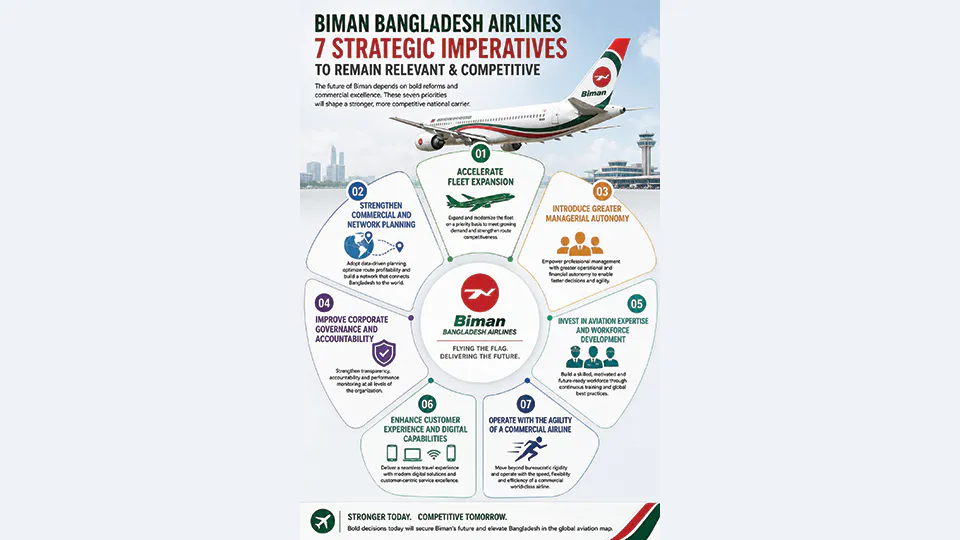
remain relevant and competitive, Biman must:
- ·
Accelerate
fleet expansion.
- ·
Strengthen
commercial and network planning.
- ·
Introduce
greater managerial autonomy.
- ·
Improve
corporate governance and accountability.
- ·
Invest in
aviation expertise and workforce development.
- ·
Enhance
customer experience and digital capabilities.
- · Operate
with the agility of a commercial airline rather than the rigidity of a
traditional government department.
The
coming decade may well determine whether Biman emerges as a strong and
competitive national carrier or gradually loses ground to more dynamic
competitors.
Bangladesh
deserves a national airline capable of competing confidently on the regional
and global stage. Achieving that vision will require bold decisions, meaningful
reforms and a willingness to embrace change.
The
time for a strategic reset has arrived.