

EU Covid-19 summit : Vaccine passport expected to roll out by summer

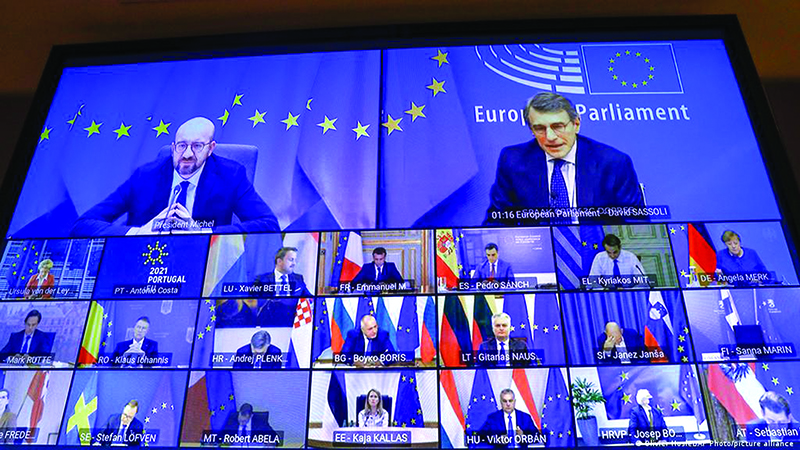
Dhaka: Heads of the European Union's 27-member states came together for a virtual summit on February 25 with the aim of solving urgent coronavirus-related health and logistical issues confronting the bloc.
Member state politicians used the meeting to discuss approaches to speeding up the delivery of vaccines, the implementation and use of vaccine passports and the potential for conflict arising from national border closings.
Perhaps the most important short-term announcement to emerge from the meeting was that of "convergence" around the concept of a vaccine passport.
Speaking at a press conference alongside European Commission President Ursula von der Leyen, European Council President Charles Michel said Europeans and their leaders "need to face the truth" about the difficulty of the task at hand but said hope was on the horizon.
Commission President von der Leyen, too, stressed progress made so far, noting that 8 per cent of the bloc's adult population had already been vaccinated.
Vaccine passport within three months
One of the more contentious issues EU leaders addressed was that of digital vaccine passports for those who have been vaccinated. Southern EU states such as Greece, Spain and Italy - all heavily or entirely dependent on tourism - believe such a scheme could ease air travel, helping them avoid a repeat of last year's disastrous summer holiday season.
Northern neighbours have been hesitant to buy amid concerns about discrimination and whether people who have been vaccinated can still carry the virus.
In the evening press conference, German Chancellor Angela Merkel said there was consensus on having the certificates, but not precisely how they should be used.
"Everyone agreed that we need a digital vaccination certificate," the German chancellor said. She added that the certificates could be available by summer, as the bloc needs three months to create a technical framework.
She urged, however, that the creation of the certificates "does not mean that only those who have a vaccination passport are allowed to travel."
Von der Leyen cited Israel's work tracking and documenting a person's vaccination history on so-called Green Passes while stressing the importance of maintaining the functionality of the European single market.
Though there is no unanimity as yet about what kind of card or cards might be used and recognised across the bloc, von der Leyen spoke of a minimum data system and said the European Commission was working to create a "gateway for interoperability between nations".
Von der Leyen said member states would "have to act fast" if the programme was to be implemented by summer.
Belgian Member of European Parliament (MEP) Marc Botenga said that granting freedom of movement rights based on health status could be a "slippery slope" for the bloc.
"It's even more questionable as long as people don't have access to the vaccine," he said, adding, "Let's guarantee, first, that people get the vaccine, and then we can debate on what kind of stamps or cards or whatever we want."