

Frequency before expansion : Strategic imperative for Biman

Dhaka
: In the airline business, success is not measured by the number of
destinations displayed on a route map. It is measured by how effectively an
airline serves those destinations. Yet many airlines, particularly state-owned
carriers, often fall into the temptation of announcing new routes as a symbol
of growth while overlooking a fundamental principle of commercial aviation:
frequency drives profitability.
Aviation
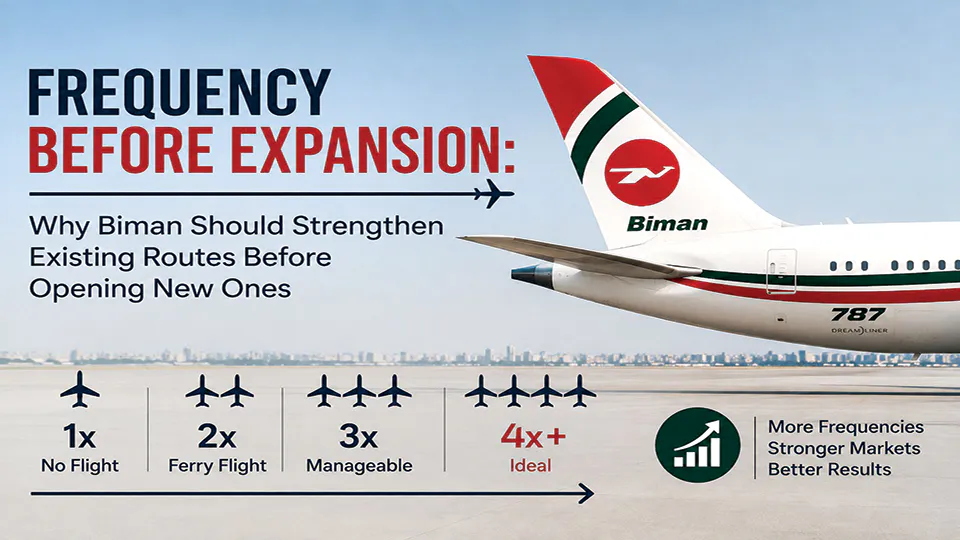
experts have long used a simple but powerful expression: "A once-a-week
flight is no flight, twice-a-week is a ferry service, three flights are
manageable, and four or more frequencies begin to create a commercially viable
market." Though informal, this saying reflects decades of experience in
airline network planning and route management.
As
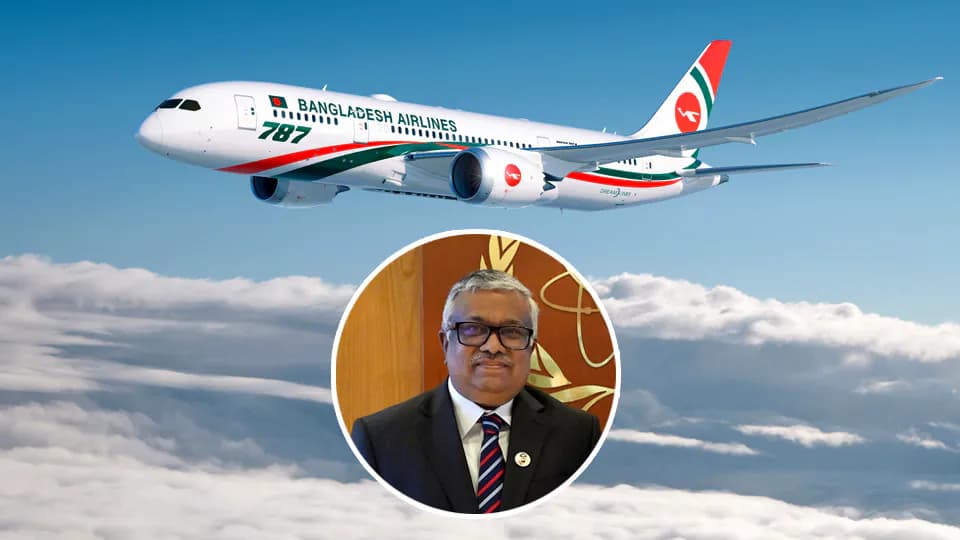
Biman Bangladesh Airlines celebrates more than fifty-five years of operations,
it may be time to revisit its network strategy and ask a critical question:
Should the national carrier continue expanding its route network with limited
frequencies, or should it focus on strengthening services in markets where it
already enjoys substantial passenger demand and a natural competitive
advantage?
Value
of frequency
Passengers
today demand flexibility. Whether they are migrant workers travelling to the
Middle East, students heading to Europe, business executives flying to Japan,
or expatriate Bangladeshis visiting family from Canada and the United Kingdom,
they want options.
A
passenger rarely chooses an airline simply because it serves a destination.
More often, the decision is influenced by schedule convenience. Daily or
near-daily flights allow travelers to depart and return according to their
needs. Conversely, an airline operating only once or twice a week forces
passengers to adjust their plans around the airline's schedule.
- ·
This is why
frequency matters.
- ·
Higher
frequencies provide:
- ·
Greater
flexibility for passengers.
- ·
Stronger
market visibility.
- ·
Improved
customer confidence.
- ·
Better
connectivity.
- ·
Increased
corporate and business travel.
- ·
Higher
passenger retention.
- ·
Enhanced
cargo opportunities.
In
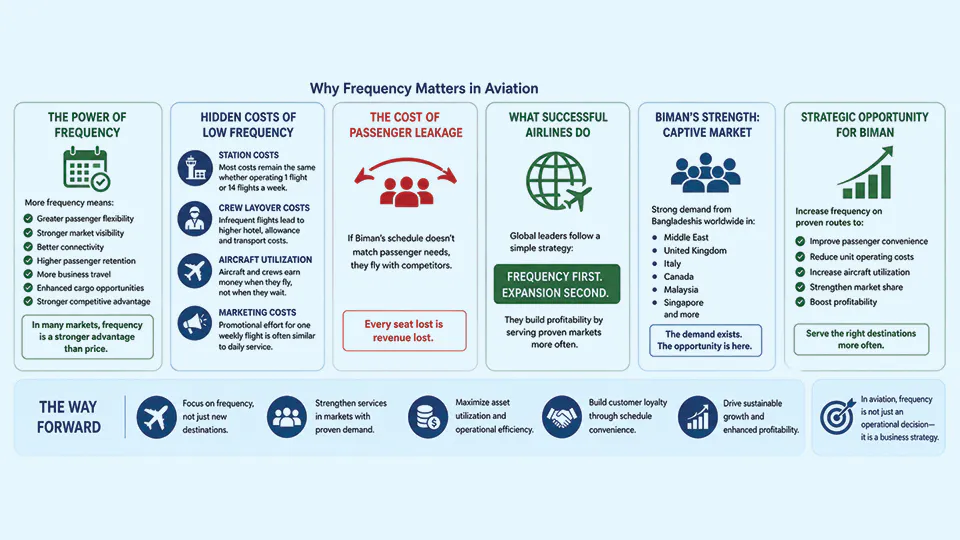
many markets, frequency is a stronger competitive advantage than price.
Biman's
captive market advantage
Few
airlines enjoy the natural market strengths available to Biman Bangladesh
Airlines.
Millions
of Bangladeshis live and work abroad. Large expatriate communities are spread
across Saudi Arabia, the Uni-ted Arab Emirates, Qatar, Oman, Kuwait, Bahrain,
the United Kingdom, Italy, Canada, Malaysia, Singapore, and many other
countries.
These
communities create a steady stream of traffic throughout the year. Unlike many
foreign airlines that must compete aggressively for passengers, Biman already
enjoys a strong brand connection among Bangladeshi travelers.
This
captive market should theoretically provide a strong foundation for sustainable
growth.
Yet
the airline has often struggled to translate this advantage into dominant
market share.
One
reason may lie in its frequency strategy.
Recent
route developments
In
recent months, Biman has relaunched or expanded services to several important
international destinations.
The
airline has resumed:
- ·
One weekly
flight to Tokyo.
- ·
Two weekly
flights to Manchester.
- ·
Three
weekly flights to Rome.
- ·
Three
weekly flights to Toronto.
The
return of these destinations is undoubtedly welcome. However, questions remain
regarding the commercial viability of operating such strategically important
routes with limited frequencies.
Tokyo
is one of Asia's largest business and economic centers. Bangladesh's economic
relationship with Japan continues to expand through trade, investment,
infrastructure development, education, and tourism.
Manchester
serves a large Bangladeshi population concentrated in northern England.
Rome
has become one of the most important European gateways for Bangladeshi migrant
workers and expatriates.
Toronto
serves one of the fastest-growing Bangladeshi communities in North America.
In
each of these markets, passenger demand appears capable of supporting
additional services. Yet limited frequencies may prevent the airline from fully
capturing available traffic.
Hidden
cost of
At
first glance, operating one or two flights a week may appear financially
prudent. Fewer flights should mean lower costs. However, airline economics are
rarely that simple.
Many
of the costs associated with operating an international route remain virtually
unchanged regardless of frequency.
Station
costs
Every
overseas destination requires a local operational presence.
An
airline typically maintains:
- ·
Airport
offices.
- ·
Sales and
reservation facilities.
- ·
Administrative
support.
- ·
Station
management.
- ·
Customer
service personnel.
- ·
Marketing
and promotional activities.
Whether
Biman operates one flight a week or fourteen flights a week, most of these
costs remain the same.
Consider
a hypothetical station with annual operating expenses of USD 1 million.
If
the route operates only once a week, the station supports just 52 flights
annually. The station cost alone amounts to approximately USD 19,000 per
flight.
However, if the same station supports daily operations, the cost drops to less than USD 3,000 per flight.
The
station infrastructure remains identical. The difference is simply the number
of flights sharing the expense.
This
is one of the key reasons why low-frequency routes often struggle financially.
Crew
layover costs
Crew
utilization is another area where low-frequency operations become expensive.
A
long-haul flight may require:
- ·
Flight deck
crew.
- ·
Relief
pilots.
- ·
Cabin crew.
After
arrival, crew members often need mandatory rest periods before operating the
return sector.
When
flights are infrequent, airlines frequently incur:
- ·
Hotel
accommodation expenses.
- ·
Daily
allowances.
- ·
Transportation
costs.
- ·
Administrative
support costs.
The
problem becomes more significant when crew members remain idle during extended
layovers.
An
airline pays salaries, allowances, and accommodation expenses while generating
no revenue during that period.
Higher-frequency
operations allow more efficient crew scheduling, shorter layovers, and better
productivity.
In
simple terms, airlines earn money when aircraft and crews are working-not when
they are waiting.
Aircraft
utilization: Key to profitability
Perhaps
the most expensive asset owned by an airline is its aircraft.
A
Boeing 787 Dreamliner, for example, represents an investment worth hundreds of
millions of dollars.
Aircraft
ownership, lease payments, insurance, depreciation, and financing costs
continue whether the aircraft is flying or parked.
Every
hour spent on the ground reduces earning potential.
Successful
airlines therefore strive to maximize aircraft utilization.
Higher
frequencies create more efficient rotations, stronger connectivity, and
improved revenue opportunities.
Low-frequency
operations often produce scheduling inefficiencies that reduce overall fleet
productivity.
Marketing
costs do not decline
Another
common misconception is that fewer flights reduce marketing expenses.
In
reality, airlines launching a route must still invest heavily in:
- ·
Travel
trade engagement.
- ·
Advertising
campaigns.
- ·
Digital
marketing.
- ·
Corporate
sales activities.
- ·
Public
relations.
- ·
Airport
branding.
The
promotional effort required to support one weekly flight is often similar to
that required for daily service.
As
a result, marketing expenditure per flight becomes substantially higher when
frequencies are limited.
Revenue
loss through passenger leakage
Perhaps
the most damaging consequence of low-frequency operations is lost revenue.
Suppose
a passenger wishes to travel from Dhaka to Toronto on a specific day. If
Biman's flight schedule does not meet that requirement, the passenger will
simply choose another carrier.
The
same applies to business travelers flying to Tokyo or expatriates travelling to
Manchester.
Competitors
such as Emirates, Qatar Airways, Turkish Airlines, Etihad Airways, Saudia, and
others offer daily or multiple daily departures through their hubs.
While
Biman may possess the advantage of nonstop service, insufficient frequency
often pushes passengers toward alternative carriers.
In
aviation terminology, this phenomenon is known as "passenger
leakage."
Every
seat lost to a competitor represents lost revenue that is difficult to recover.
What
successful airlines do differently?
The
world's most successful airlines generally follow a common strategy.
Before
launching new destinations, they strengthen frequencies on routes where demand
is already proven.
Emirates
did not become a global airline by opening hundreds of destinations with one
weekly flight. It built its network by increasing frequency in profitable
markets and creating schedule convenience.
The
same principle applies to Qatar Airways, Turkish Airlines, Singapore Airlines,
Lufthansa, and many other successful carriers.
Their
philosophy is clear: Frequency first. Expansion second.
Strategic
opportunity for Biman
For
Biman Bangladesh Airlines, the opportunity is obvious.
The
airline already has a strong presence and substantial passenger demand in:
- ·
Saudi
Arabia.
- ·
United Arab
Emirates.
- ·
Qatar.
- ·
Oman.
- ·
United
Kingdom.
- ·
Italy.
- ·
Canada.
- ·
Malaysia.
- ·
Singapore.
The
infrastructure is already in place. The brand is established. Passenger demand
exists.
Instead
of spreading resources across numerous low-frequency routes, Biman could
potentially achieve stronger financial performance by increasing frequencies in
these proven markets.
Additional
services to London, Manchester, Rome, Toronto, Jeddah, Riyadh, Dammam, Dubai,
Doha, Muscat, Kuala Lumpur, and Singapore would not only improve passenger
convenience but also reduce unit operating costs by spreading fixed expenses
across a larger number of flights.