

Rich in sites yet poor in arrivals, BD lacks promotion of Buddhist tourism

Bangladesh is a land of glorious cultural heritage with inter-religious harmony and co-existence. Buddhism entered in ancient Bengal more than 2,000 years ago and made deep influence on Bengali life, culture and civilisation.
Bangladesh is believed to be a rich repository of South Asian Buddhist heritage. In order to draw world's attention to rich Buddhist heritage in Bangladesh, the Government organised an international event in collaboration with World Tourism Organisation in October 2015.
UNWTO in October 2015 organised an international conference in Dhaka under the title 'International Conference on Developing Sustainable and Inclusive Buddhist Heritage and Pilgrimages Circuits in South Asia's Buddhist Heartland'. This was the first opportunity ever to focus Bangladesh as a heritage of Buddhism and 12 ministers from overseas participated in the conference.
Unfortunately, the efforts to attract the attention of Buddhist tourist circuit confined to the conference supported by UNWTO. No further effort to promote Buddhist tourism followed.
This has resulted in lost opportunity for Bangladesh tourism. As per World Bank report, the top 10 Buddhist tourist countries produced 243.6-million trips in 2021. But Bangladesh failed to attract notable share of these trips.
Despite huge potential, Bangladesh has not been able to use tourism for the overall economic development and employment growth.
Religion plays an important role in generating travel or in the business of tourism. People travel from place to place for pilgrims. The followers of Buddhism are playing a great role in developing tourism. Many Asian nations are influenced by Buddhism and the followers of Buddhism visit places around Asia, wherever there is the presence of Buddhist and its followers.
Buddhist travellers follow the way and the majority has the intention of following the footprints of Lord Buddha. A good number of visitors primarily follow the route from Lumbini of Nepal to different places in Bihar of India where Buddha spends most of his time.
There are several Buddhist Travel Circuits in the Asian region. But Bangladesh is yet to be part of the circuit.
Most prominent sites
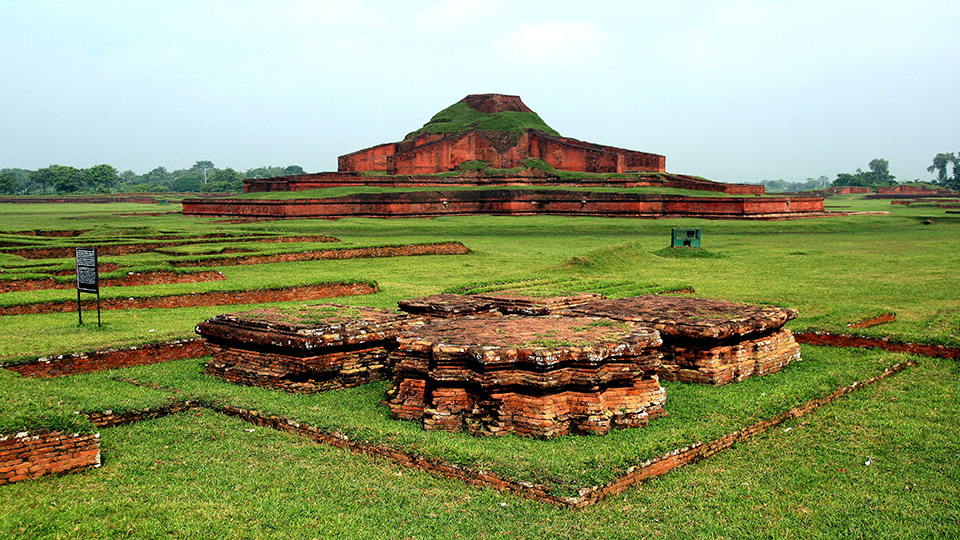
Paharpur Buddhist Monastery (originally it is Somapura Mahavihara), which has been accepted as a World Heritage site in 1985, built by the Pala King Dharmapala in the 8th Century AD. Somapura Mahavihara was one of the top five Buddhist monasteries in ancient times. It is the single largest in the world and second largest after Nalanda.
Atish Dipankara Srijyan (11th century), who is treated as the 2nd Lord Buddha, stayed in this Mahavihara for many years. He inspired Buddhism in Tibet.
Mainamati Salban Vihara is another very important site in Cumilla and there are over 50 ruins and so far some of them are excavated and this was built by Deva rulers, Bhaba Deb in 8th century AD.
Among several monasteries in Bangladesh, many of them are in between 8-12 centuries AD. The major of them are Somapura Mahavihara, Salban Vihara, Paharpur Mahavihara, Vikrampuri Mahavihara, Pandit Vihara were established in Bangladesh. The cruciform Buddhist monastery was first built in the 5th century in Bharat Vaina Jessore.
In the Hills of Chattogram, a large number of people who have their ethnicity are followers of Buddhism since time immemorial. They are Chakma, Chak, Marma, Tanchangya and the Khyang. In this part of Bangladesh, the monasteries have the influence of Myanmar.
As per World Bank report, the top 10 Buddhist tourist countries produced 243.6-million trips in 2021 and most of them are in Asia except a few from the West and Australia. The Buddhist people in these Buddhist traveller-generating countries are 380.67 million.
Different monasteries which are popular in the world generate plenty of visitors. Borobudur temple in Megalang in Central Java attracts 5.0-million visitors from home and abroad each year, It is one of the largest Buddhist temple ranking with Bagan in Myanmar and Angkor Wat in Cambodia, which attracts 2.6-million travellers.
This is a huge tourist movement who moves around the world for the love of Buddhism and supporting the Tourism economy.
The World Bank has made a move for developing the Buddhist Circuit with the approach of the Governments in the South Asia region.
The formulation of this programme was initiated in 2014 with a visit by the World Bank team to some of the main places associated with Buddha's journey through South Asia. This process of retracing Buddha's footsteps was informed by scholarly research on Buddha's teaching delivered in these places.
In the post-Covid time, all the research shows that long-haul travel will take longer time to restore; rather the concentration is more on the regional and short haul travel. Instead of focusing on too many products, at this point of time we can target the Buddhist tourist and market the rich Heritages of Buddhism in Bangladesh to the Buddhist tourist generating countries. They produce 243.69 trips per year, and we can get our share from these travellers. This will cover religious tourism as well as the leisure tours.
When asked what steps have been taken after the Conference on Buddhist Heartland by UNWTO, Bangladesh Tourism Board (BTB) CEO Abu Taher Mohammad Zaber said he is not aware of this particular issue. The government is formulating a master plan to take tourism sector forward and link the tourist spots across the country by a business chain.
Bangladesh has several Buddhist sites and some of them, including Paharpur, are world heritage sites. This is a great opportunity after the post-pandemic period, as the market is more regional or short haul. We have the sites, but creating basic facilities will help arrest the attention of Buddhist lovers from Asia. In fact, Buddhist tourism is a great strength of Bangladesh.