


Asia-led carriers drive air cargo growth despite turbulent 2025

Singapore : The global
air cargo market expanded in 2025 despite tariffs, geopolitical tensions and
major changes in international trade, with leading carriers shifting capacity
and routes to keep pace with rapidly changing demand.
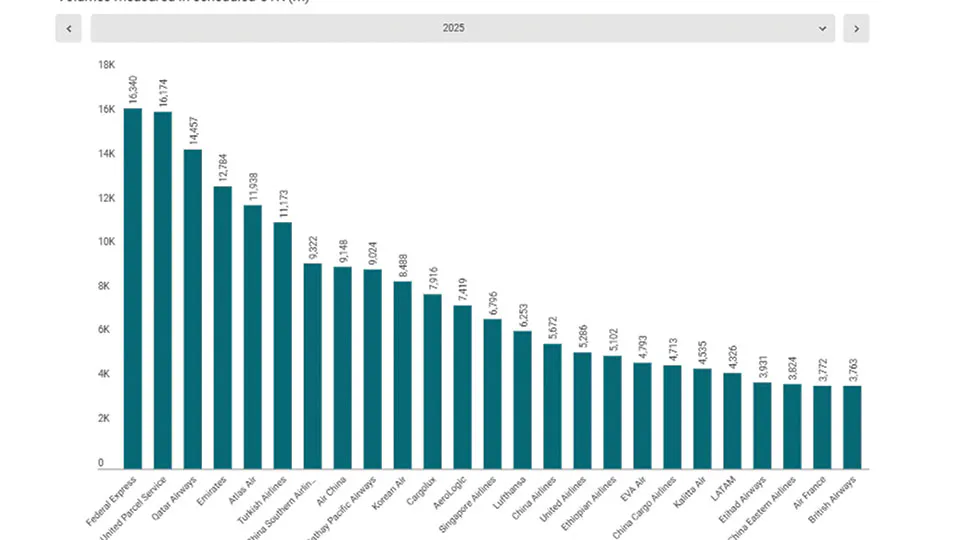
The world's 25 largest
cargo airlines recorded a combined 5.5 percent increase in cargo ton-kilometers
(CTK), outperforming the industrywide growth of 3.4 percent. Carriers with
strong exposure to Asian markets benefited particularly from the reshaping of
global supply chains.
FedEx retained the top
position, although its cargo volume fell 9.9 percent to 16.3 billion CTK. It
reported a 40 percent increase in international economy package volumes during
2025, reflecting stronger e-commerce demand, while international priority volumes
fell 12 percent.
UPS remained close
behind in second place, increasing its cargo activity by 7.2 percent to 16.1
billion CTK. UPS also expanded its European healthcare logistics operations and
increased intra-Asia and Europe-India capacity.
Qatar Airways moved to
third place after its CTK volume declined 5 percent to 14.4 billion. Qatar
expanded its freighter network, launched specialized services for high-tech and
aerospace cargo, and increased cooperation with partners. Its cargo fleet stood
at 28 Boeing 777 freighters at the end of 2025.
Further down the
rankings, Air China emerged as one of the strongest performers, with CTK rising
23.4 percent to 9.1 billion. China Eastern also climbed the rankings.
Overall, Asia-Pacific
carriers led regional growth with an 8.4 percent increase in cargo demand.
Europe grew 2.9 percent, Africa 6 percent, and Latin America and the Caribbean
2.3 percent, while North American airlines declined 1.3 percent.
The shifting market
increasingly redirected cargo from Asia-North America toward Asia-Europe, as
tariffs and the removal of US de minimis exemptions reshaped e-commerce and
supply chains.